
Plywood sanding grit sequence: calibration 60-80 sets thickness, finish sanding 100-150 delivers furniture-grade surface.
The correct plywood sanding grit sequence separates export-quality furniture panels from rejects — and most sanding failures trace back to one mistake: wrong grit at the wrong stage. Vietnamese plywood factories that supply furniture-grade panels to the EU, Korea, and Japan run a two-phase sanding process. Each phase has a specific objective, a defined grit range, and a failure mode that produces material loss. Getting this sequence right is non-negotiable when the face veneer is only 0.2–0.4mm thick.
This guide covers the factory-level sanding sequence used at Mika Plywood’s dedicated furniture facility in Phu Tho Province. All parameters come from production operations, not theory. If you are specifying sanded plywood for import — or evaluating why a shipment arrived with surface defects — this is where to start.
⚙️ The Two-Phase Factory Sanding System
Plywood sanding inside a production facility is not a single operation. It is two separate phases, run on different machines with different objectives:
Phase 1 — Calibration: Coarse grits on a steel drum. Goal: set panel thickness to within ±0.3mm of specification. Material removal is heavy. Surface appearance is irrelevant at this stage. (Mika Plywood production data, 2026)
Phase 2 — Finish Sanding: Fine grits on a rubber platen. Goal: produce a smooth face veneer surface that accepts paint, lacquer, or veneer overlay. Material removal is minimal. Surface quality is everything.
Both phases use wide-belt industrial sanders, but the machine setup differs completely between phases. A factory running only one phase — calibrating without finish sanding — ships panels that measure correctly but feel rough. A factory running only finish sanding ships panels with poor thickness consistency. Export-grade furniture plywood requires both.
📌 Which Products Get Sanded?
Not all plywood types go through the sanding line. This distinction matters when you are comparing prices between product types:
| Product Type | Sanding? | Why |
|---|---|---|
| Furniture-grade birch, okoume, EV | Both phases | Cabinet and interior finish required |
| Commercial bintangor plywood | Finish only (light) | Presentation grade, not precision calibrated. See double sanded vs single sanded plywood |
| Packing-grade plywood | None | Appearance irrelevant, cost reduction |
| Film-faced plywood | None | Film adhesion needs raw surface |
| Anti-slip plywood | None | Wire mesh surface applied post-press |
This table explains a real pricing difference that buyers observe: furniture-grade sanded panels cost more than packing panels even at the same thickness and core species. The sanding process consumes time, belts, and material — and it affects panel thickness (sanded panels are typically 0.2–0.4mm thinner than the nominal press thickness to account for material removal).
📋 Phase 1 — Calibration: The 60→80 Grit Sequence
Calibration is the heaviest sanding operation. The panel exits the hot press with surface irregularities, minor warping, and thickness variation across its face. The calibration line corrects all three.
⚙️ 60-Grit Pass — Stock Removal
The first belt runs at 60 grit. This is coarse by any standard — equivalent to an aggressive floor sanding application. At this grit:
- The steel contact drum presses firmly against the panel surface
- Material removal is 0.1–0.3mm per pass, depending on panel condition
- Surface scratches left by 60 grit are deep and clearly visible
- Belt speed is set higher to maximize stock removal efficiency
The 60-grit pass does not improve surface appearance. It levels the panel — removing press marks, surface irregularities, and thickness variation from edge to edge. A panel that entered calibration at 9.4–9.8mm nominal thickness exits at a consistent 9.2mm (±0.3mm across the panel face).
⚠️ Important: For thin-face veneers below 0.3mm, factories reduce the 60-grit pressure or skip to 80 grit as the first pass. A miscalibrated 60-grit belt on 0.2mm birch face veneer causes burn-through in seconds. At Mika Plywood, QC checks face veneer thickness before setting the calibration drum pressure.
⚙️ 80-Grit Pass — Scratch Reduction
The second calibration belt runs at 80 grit. Its sole purpose is removing the scratches left by 60 grit. This is the “grit step rule” in practice: move up by no more than one step so the previous grit’s scratch depth is fully removed.
The 80-grit pass removes a further 0.05–0.1mm of material. The surface is still rough to the touch, but the deep 60-grit tracks are gone. The panel is now dimensionally stable and ready for finish sanding.

📊 Phase 2 — Finish Sanding: The 100→120→150 Grit Sequence
Finish sanding shifts the objective from thickness control to surface quality. The machine changes configuration: a rubber-padded platen replaces or supplements the steel drum, belt tension reduces, and belt speed may lower to reduce heat generation on the face veneer.
📌 Why Surface Temperature Matters
Heat is the primary enemy of finish sanding on thin-face plywood. Dull belts create friction heat faster than fresh belts. At 120 grit and above, if the belt temperature rises past the glue line temperature — typically 110°C for melamine, 135°C for phenolic — the face veneer can delaminate from the core mid-sanding. (Kumarengineeringco.in, 2024)
Factories monitor belt condition by tracking:
- Sheets processed per belt (replace before degradation, not after)
- Surface temperature of panel exiting the sander (infrared probe)
- Visual check for “glazed” scratches (sign of dull belt overheating)
100-Grit Pass — Intermediate Bridge
The 100-grit belt is a bridge between calibration and finish. It removes the 80-grit scratches without the risk of aggressive material removal from the face veneer. This pass requires precision — too much pressure at 100 grit still risks burning through 0.2mm face veneer on thick-core panels.
The 100-grit pass reduces surface roughness from visible-to-touch to detectable-by-touch. The factory inspector can still feel the grain texture, but the calibration scratches are gone.
120-Grit Pass — Pre-Finish Grade
At 120 grit, the panel surface reaches a quality level that many commercial buyers specify as the minimum acceptable for general interior furniture use. Major buyers in India, Southeast Asia, and the Middle East typically accept 120-grit finish for standard furniture-grade panels.
The 120-grit pass leaves the panel “paint-ready” for most applications. Lacquer, water-based paint, and vinyl wraps all bond well to a 120-grit surface. However, open-pore wood stains and oil finishes require a finer surface.
💡 Tip: When requesting a sanded plywood sample from Mika Plywood, specify the target grit finish. “Sanded plywood” without a grit specification defaults to 120-grit finish. If your application requires 150 or 180, state it explicitly in your specification sheet.
150-Grit Pass — Furniture Export Grade
The 150-grit pass is the standard finish for furniture-grade export plywood destined for the EU, South Korea, Japan, and Australia. At this grit:
- Surface roughness is smooth to the touch
- Face veneer grain texture is defined but not rough
- The surface accepts high-build lacquer, UV coating, and premium PVC overlay without adhesion issues
Material removal at 150 grit is minimal — approximately 0.01–0.02mm per pass. The sander operates at lower belt tension and reduced drum pressure. The panel is visually inspected after each 150-grit pass under raking light to detect any remaining scratch marks or veneer irregularities.
📐 Grit Sequence by Product and Market
Different export markets specify different surface finish standards. This table maps common buyer requirements to the required factory grit sequence:
| Destination Market | Typical Application | Required Grit Finish | Factory Sequence |
|---|---|---|---|
| India, Middle East | Commercial furniture | 120 grit | 60→80→100→120 |
| EU, Australia | Cabinet and interior | 150 grit | 60→80→100→120→150 |
| South Korea, Japan | Premium furniture, cabinet | 150–180 grit | 60→80→100→120→150→180 |
| US furniture market | CARB P2, smooth face | 150 grit | 60→80→100→120→150 |
“We specify grit finish on every order confirmation and verify it with a sample panel before loading the container. A buyer in Germany requesting 150-grit E0 furniture plywood gets a different surface specification than a buyer in India requesting 120-grit commercial grade — even if the core and glue are identical.” — Jay, International Sales Manager, Mika Plywood
The practical implication for importers: if you do not specify grit finish, you will receive whatever the factory’s standard finish is — and that standard varies by factory segment.
🔧 Calibration Machines vs. Finish Sanders
The physical equipment matters when evaluating sanding quality. A factory running one machine for both calibration and finish sanding is cutting corners — and the panel surface will show it.
Calibration Sanders use a heavy steel contact drum. The drum is rigid and does not flex, which is exactly what thickness accuracy requires. The drum presses the belt against the panel uniformly across its full width, removing material evenly from edge to edge. These machines are large, expensive (USD 40,000–120,000 per unit), and require regular drum grinding to maintain flatness. (TMC Wood Machinery, 2024)
Finish Sanders (Wide-Belt Platen Sanders) use a rubber-padded platen or combination roller+platen system. The rubber pad absorbs minor surface irregularities and follows the panel grain, producing a consistent finish without over-sanding high points. Belt tension is lower, feed speed is slower, and the abrasive belt itself is finer and more expensive per unit.
Mika Plywood’s furniture production facility runs dedicated machines for each phase: a calibration line handles all 60→80-grit work, then panels transfer to a separate wide-belt finish sander for the 100→120→150 passes. This separation prevents cross-contamination of coarse abrasive particles (which cause deep scratches on fine-grit panels) and allows each machine to be optimized for its specific task.
🏭 Why Calibration Sanding Matters for Importers
Thickness tolerance is not just a specification number on a data sheet. It directly affects how plywood performs in your buyer’s application — and how your buyer rates you as a supplier.
Furniture manufacturers cutting cabinet boxes, drawer frames, or shelf panels require consistent thickness across every sheet. A ±1mm variation in panel thickness means joints that do not close flush, visible gaps at cabinet edges, and rejected assemblies at the end of the furniture production line. EU cabinet buyers specify thickness tolerance of ±0.3mm as a minimum — consistent with Mika Plywood’s factory-calibrated output. For a detailed look at how tolerance is verified and why it matters, see understanding thickness tolerance in Vietnam plywood.
The calibration sanding sequence (60→80) is what produces that ±0.3mm tolerance. Without it, panels pressed at 120°C for 60 seconds still vary by ±1.0–1.5mm across the face — well outside furniture-grade tolerance. (Norton Abrasives, 2024)
💡 Pro tip: Ask your supplier to show you a thickness measurement record for the last shipment. Premium factories record thickness at 9 points across each panel (four corners, four edges, center). Factories without calibration equipment cannot produce this record.
Get Sanded Furniture-Grade Plywood Specs
📦 Sanded Plywood Specifications — What to Include in Your Order
When placing an order for sanded plywood from Vietnam, these are the parameters that define the product — all of them affect price:
| Parameter | Options | Notes |
|---|---|---|
| Face veneer species | Birch D/E, Okoume A/B, EV A/B, Bintangor A/B | Determines face thickness and sanding risk |
| Core species | Styrax, Eucalyptus, Acacia | Affects density, sanding resistance |
| Glue type | Melamine (MR), Phenolic (WBP) | Melamine standard for furniture |
| Emission | E0, E1, CARB P2 | Must specify for EU/US market |
| Sanding finish | 120 grit, 150 grit, 180 grit | Default is 120 unless specified |
| Thickness tolerance | ±0.3mm standard | Tighter tolerances require premium pricing |
| Panel size | 1220×2440mm (4×8), 1250×2500mm | EU buyers typically specify 1250×2500 |
All sanded furniture-grade panels from Mika Plywood are calibration-sanded as a standard process. The grit finish level (120/150/180) is confirmed on the purchase order. Understand the full plywood manufacturing process that precedes sanding — particularly hot pressing parameters and core construction — to understand why calibration is necessary before finish sanding begins.
✅ Sanding Quality Checks at the Factory
After the finish sanding line, every production batch undergoes a structured QC check before palletizing:
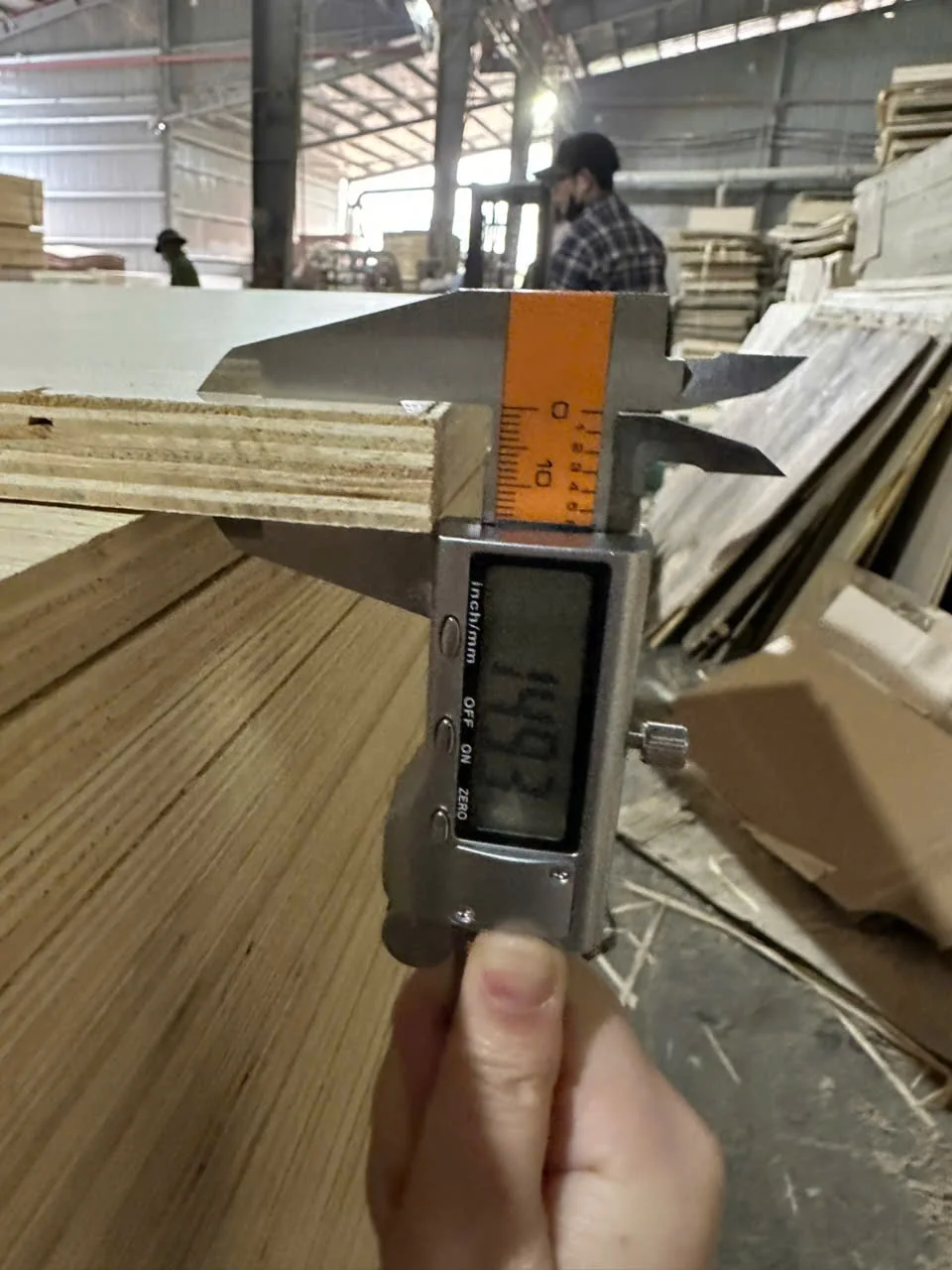
Thickness Measurement — 9-point measurement across each panel using a calibrated digital caliper. Panels outside ±0.3mm tolerance return to the sanding line for a correction pass or are downgraded.
Surface Inspection — Under raking light at 45°, QC inspectors look for: visible scratch marks from previous grits, veneer burns (dark spots from heat), face veneer thinning or transparency (sign of near burn-through), and raised grain fibers.
Moisture Check — Post-sanding moisture content must remain 8–14%. Over-sanding generates heat that can drive moisture below 6%, causing panels to absorb ambient moisture after palletizing and develop surface waviness.
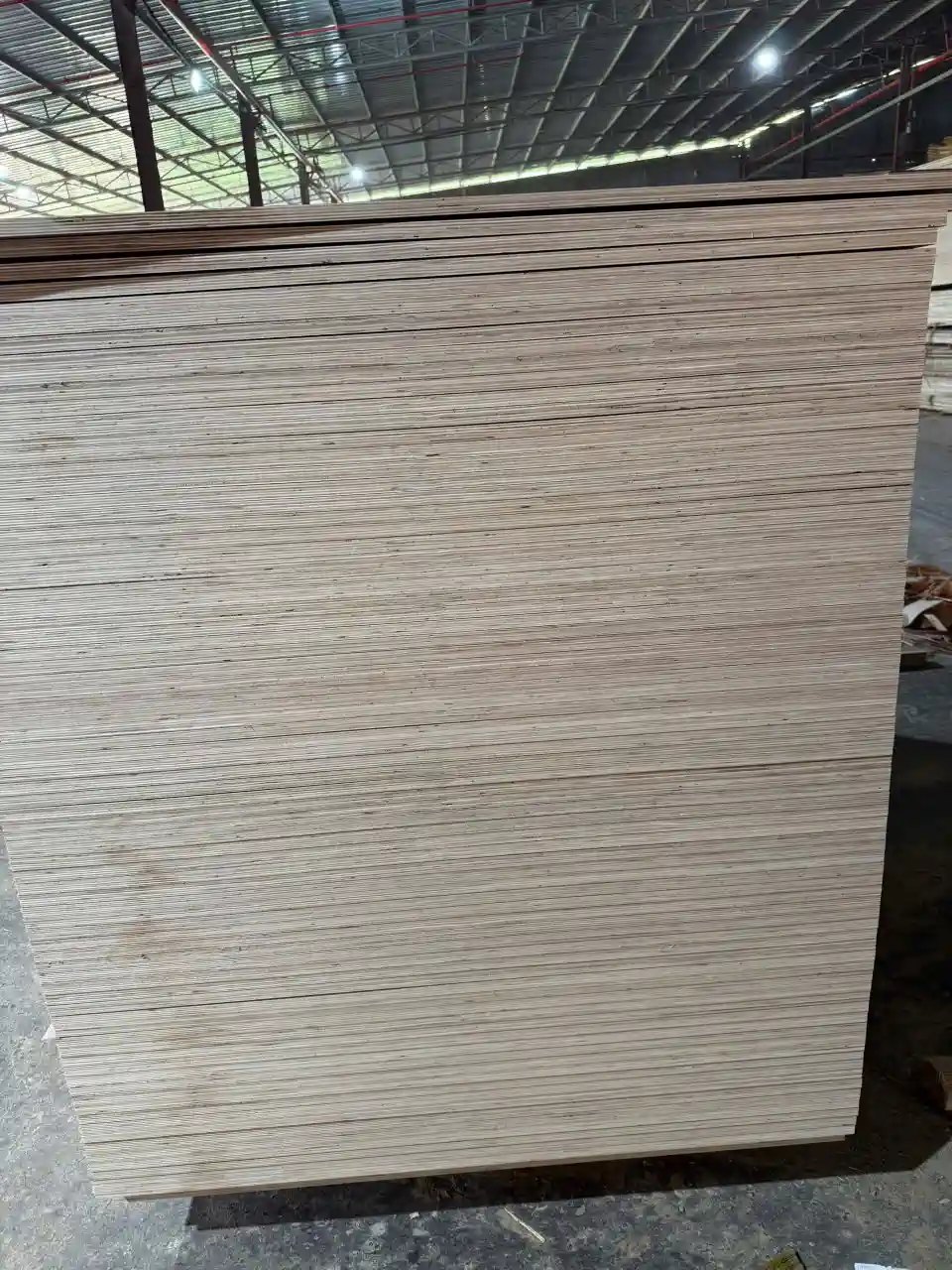
Panels that pass all three checks are accepted, marked with the production batch number, stacked, strapped, and placed on pallets for container loading. Mika Plywood provides photos of the QC process and final pallet stacking for every container — buyers can verify surface quality before shipping.
For furniture plywood buyers who need precise surface specifications, the plywood face veneer types guide covers which face species tolerate aggressive calibration and which require the lighter-pressure 80-grit-first approach. Similarly, buyers specifying panels with E0 emission for the EU market should review plywood glue types and emission standards — the glue type affects hot-press temperature, which directly affects how the face veneer responds to calibration sanding.
Disclosure: This article is published by Mika Plywood, a Vietnam-based plywood manufacturer and export operator. While we aim to provide objective industry guidance, readers should consider our perspective as a market participant when evaluating recommendations.
🔗 Related Technical Guides
For buyers importing sanded furniture plywood, these articles cover the production steps that precede and follow sanding:
- Vietnam Plywood Manufacturing Process — From Log to Container — Full 10-stage factory process including hot-pressing parameters before sanding
- Plywood Core Types — Acacia vs Eucalyptus vs Styrax — Core species affect density and calibration sanding removal rates
- Plywood Face Veneer Types — Complete Buyer Guide — Face species and thickness determine which grit sequence is safe
- Plywood Glue Types and Emission Standards — Glue type affects hot-press temperature, which affects post-press panel surface condition
📋 Summary — Factory Sanding Grit Sequence
The complete factory sanding grit sequence for furniture-grade export plywood:
Calibration Phase:
- 60 grit — heavy stock removal, panel leveling, thickness calibration
- 80 grit — removes 60-grit scratch depth, prepares for finish phase
Finish Phase:
3. 100 grit — removes 80-grit scratches, bridge between calibration and finish
4. 120 grit — commercial furniture standard, India and Middle East markets
5. 150 grit — furniture export standard, EU, Korea, Japan, Australia
6. 180 grit (premium) — ultra-smooth for lacquer, UV coating, Japanese market
The rule that applies throughout: never skip more than one grit. On 0.2–0.3mm face veneers, skip no grits. Replace belts before degradation produces heat, not after visible burn-through.
If you are importing sanded plywood from Vietnam and need factory-verified thickness tolerance and grit finish documentation, Mika Plywood provides this as a standard part of every order’s quality documentation.
Request Sanded Plywood Specifications and Samples
Frequently Asked Questions
What grit sequence does a plywood factory use for sanding?A standard factory sanding grit sequence has two phases. Calibration phase: 60 grit (heavy stock removal and thickness setting), then 80 grit (removing 60-grit scratches). Finish phase: 100 grit (intermediate smoothing), 120 grit (pre-finish surface), 150 grit (final surface for furniture-grade panels). Some premium furniture factories add a 180-grit pass for export markets requiring very smooth surfaces. Packing-grade and film-faced plywood skip sanding entirely.What is the difference between calibration sanding and finish sanding in plywood?Calibration sanding uses coarse grits (60-80) with a steel contact drum to set panel thickness within ±0.3mm tolerance. The objective is dimensional accuracy, not surface appearance. Finish sanding uses a rubber-padded platen with finer grits (100-150) to produce the smooth surface required for furniture, cabinets, and interior applications. Both phases use wide-belt sanders, but with different belt materials, contact drums, and belt speeds.Why can't you skip grits in plywood sanding?Each grit leaves scratch marks with a specific depth. The next grit must be fine enough to sand out those scratches completely. If you skip from 60 to 120, the 60-grit scratches are too deep for 120 to remove in a single pass — you either sand excessively (risking veneer burn-through) or leave visible scratch marks under finish. The industry rule is: never skip more than one grit step, and on thin veneers (0.2-0.4mm), skip no grits at all.What grit should be used for sanding birch or okoume face veneer plywood?For thin-face veneers like birch (0.2-0.4mm face), calibration uses a lighter 80-grit pass only — 60 grit risks burning through to the core on thin faces. Finish sanding runs 100→120→150. For export markets requiring very fine surfaces (Germany, Korea, Japan), a final 180-grit pass is added. The QC limit: total material removed from the face veneer during sanding must not exceed 0.05mm. Thicker faces (0.6-1.0mm) tolerate the full 60→80 calibration sequence.Does packing plywood or film-faced plywood get sanded?No. Packing-grade plywood, film-faced plywood, and anti-slip plywood are never sanded. Packing grades use C/D face veneers where surface appearance is irrelevant — sanding adds cost with no buyer benefit. Film-faced plywood receives a phenolic or melamine film overlay that bonds to the raw panel surface — sanding the face before filming actually reduces film adhesion. Anti-slip plywood has a wire-mesh surface applied post-pressing. Sanding only applies to furniture, cabinet, and interior-grade plywood.
Ready to order?
Get Sanded Furniture-Grade Plywood Specs

Written by
David
Export Project Leader
Content contributor at Vietnam Plywood.
On this page
- ⚙️ The Two-Phase Factory Sanding System
- 📌 Which Products Get Sanded?
- 📋 Phase 1 — Calibration: The 60→80 Grit Sequence
- ⚙️ 60-Grit Pass — Stock Removal
- ⚙️ 80-Grit Pass — Scratch Reduction
- 📊 Phase 2 — Finish Sanding: The 100→120→150 Grit Sequence
- 📌 Why Surface Temperature Matters
- 100-Grit Pass — Intermediate Bridge
- 📐 Grit Sequence by Product and Market
- 🔧 Calibration Machines vs. Finish Sanders
- 🏭 Why Calibration Sanding Matters for Importers
- 📦 Sanded Plywood Specifications — What to Include in Your Order
- ✅ Sanding Quality Checks at the Factory
- 🔗 Related Technical Guides
- 📋 Summary — Factory Sanding Grit Sequence
On this page
- ⚙️ The Two-Phase Factory Sanding System
- 📌 Which Products Get Sanded?
- 📋 Phase 1 — Calibration: The 60→80 Grit Sequence
- ⚙️ 60-Grit Pass — Stock Removal
- ⚙️ 80-Grit Pass — Scratch Reduction
- 📊 Phase 2 — Finish Sanding: The 100→120→150 Grit Sequence
- 📌 Why Surface Temperature Matters
- 100-Grit Pass — Intermediate Bridge
- 📐 Grit Sequence by Product and Market
- 🔧 Calibration Machines vs. Finish Sanders
- 🏭 Why Calibration Sanding Matters for Importers
- 📦 Sanded Plywood Specifications — What to Include in Your Order
- ✅ Sanding Quality Checks at the Factory
- 🔗 Related Technical Guides
- 📋 Summary — Factory Sanding Grit Sequence
Industry Newsletter
Stay Updated with
Plywood Industry Insights
Factory prices, spec guides, market trends and export tips — delivered weekly to B2B buyers and importers in 20+ countries.