Product Overview
Film Faced Plywood Vietnam — Waterproof, Reusable, Construction-Grade
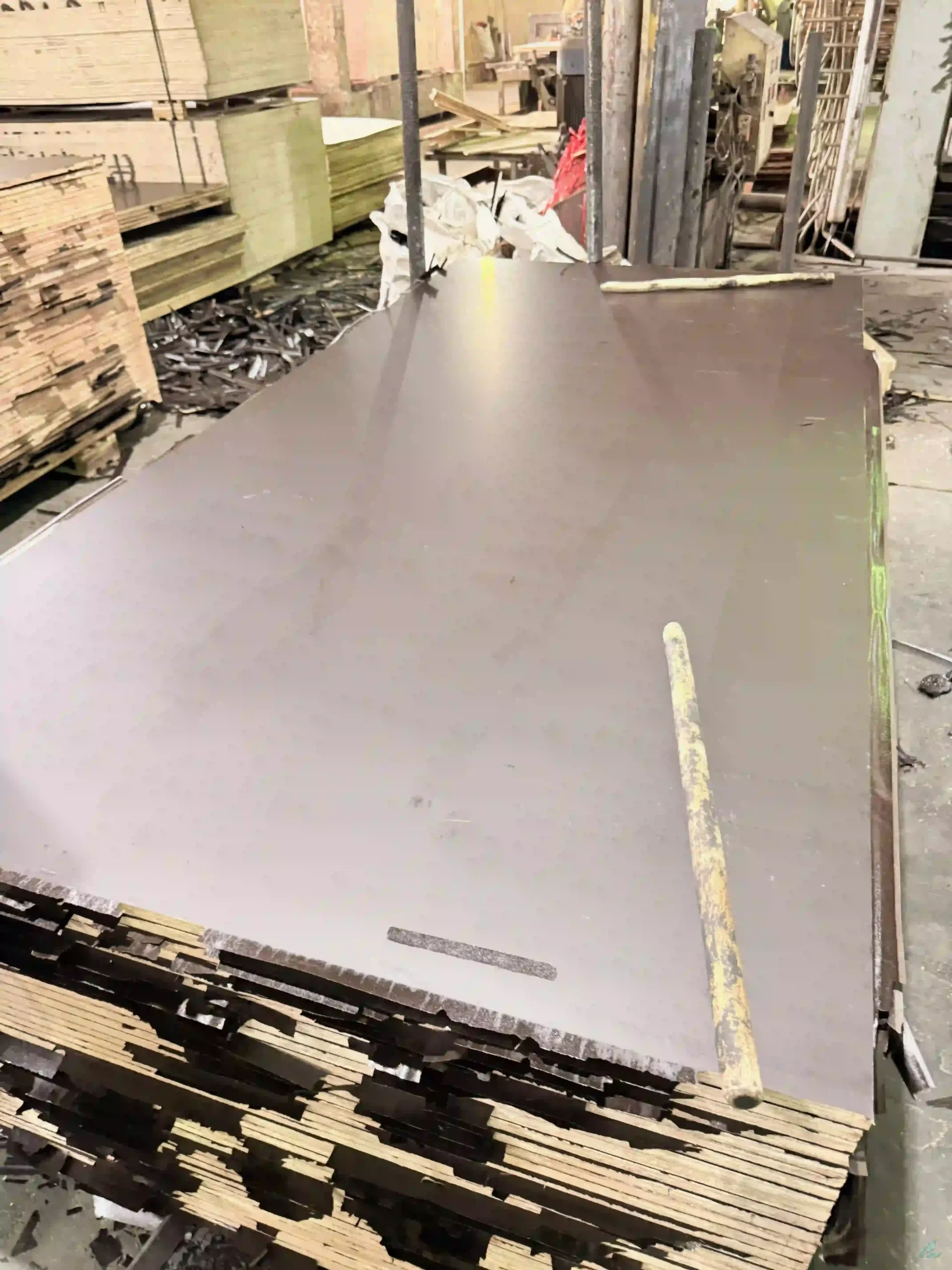
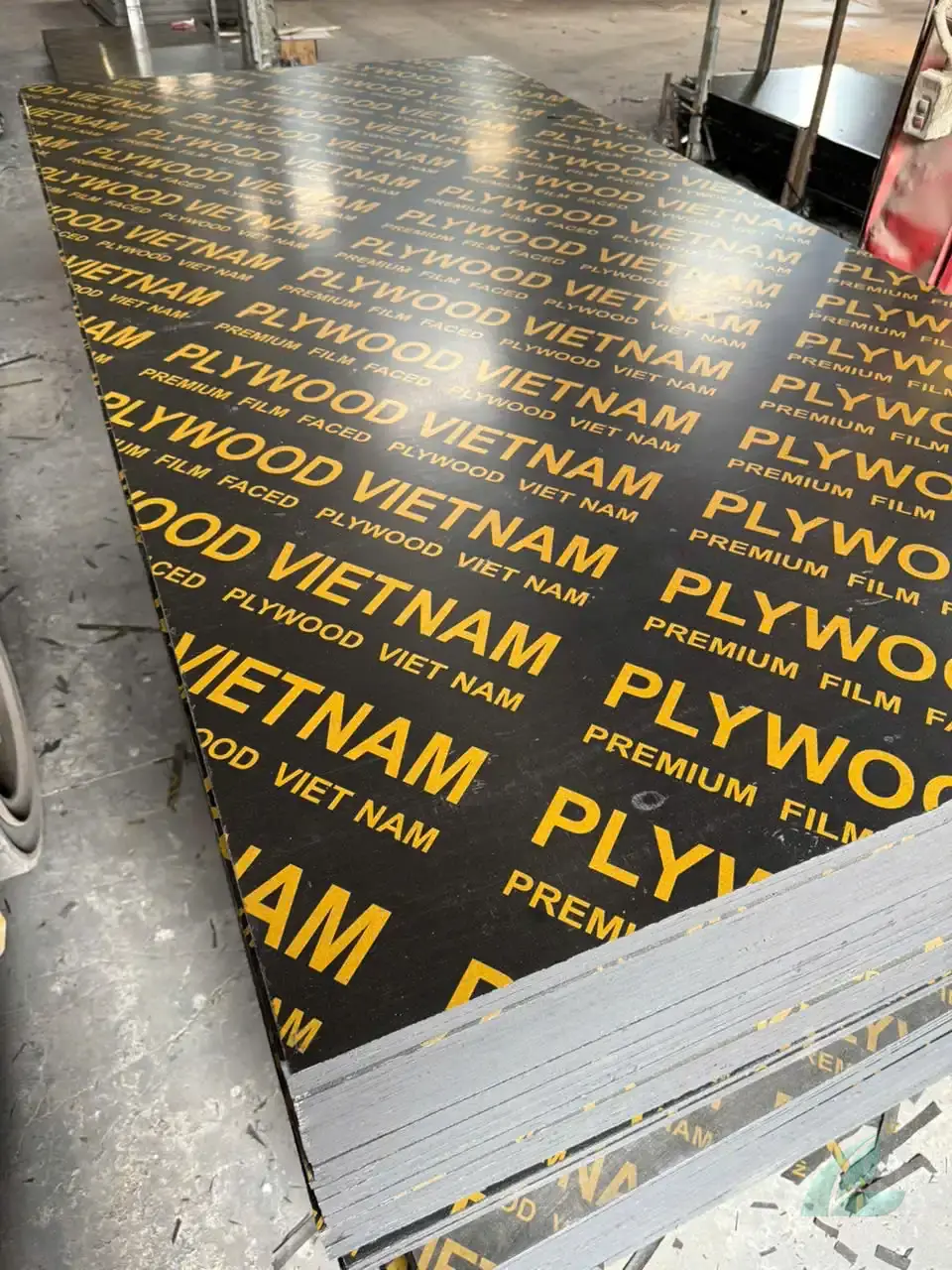
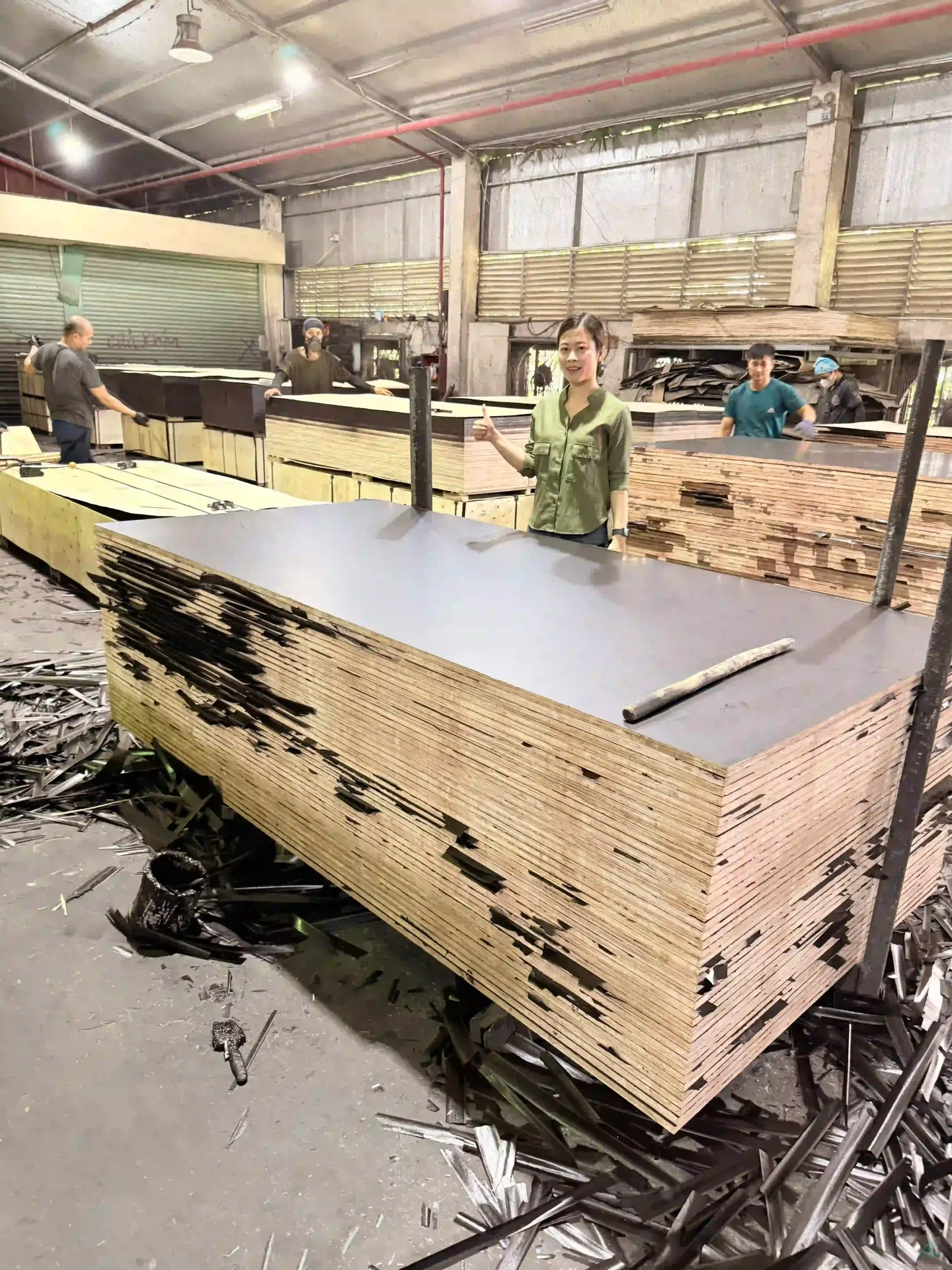
Mika Plywood film faced plywood Vietnam features WBP phenolic coating on both sides for maximum water resistance. Calibrated core thickness delivers consistent concrete finish. Reusable 6–10 times for cost-effective formwork operations.
- Waterproof WBP bonded — zero delamination under repeated soaking
- Reusable 6–10 times — significantly reduces cost per pour
- Smooth anti-stick phenolic surface — clean concrete removal
- Calibrated thickness ±0.3mm — consistent performance
- Available in Black/Brown film — 12mm/15mm/18mm/21mm
- Full export documentation — CO, Fumigation, Insurance
Need a sample or quotation?
Request Quote →Technical Data
Film Faced Plywood Vietnam — Technical Specifications
| Country of Origin | Vietnam — Mika Plywood Export Factory |
| Face / Back | Black or Brown Film (Phenolic / Dynea) |
| Film Weight | 120–140 g/m² (standard phenolic) | Black Dynea: 160–220 g/m² |
| Core Options | Acacia, Eucalyptus |
| Core Veneer Thickness | 1.6 – 1.8mm (calibrated) |
| Glue Type | Phenolic (WBP) — standard for construction grade |
| Emission Standard | E1/E2 available (construction-grade — WBP phenolic bonding prioritizes waterproof performance over emission class) |
| Surface Finish | Unsanded — phenolic film overlay applied direct to core |
| Thickness Range | 12mm / 15mm / 18mm / 21mm |
| Standard Sizes | 1220×2440mm (4×8ft), 1250×2500mm |
| Density | Depends on core: Acacia ~580 kg/m³, Eucalyptus 650–750 kg/m³ |
| Moisture Content | ≤ 12% |
| Reusability | 6–10 times (up to 18+ with phenolic glue) |
| MOQ | 1 × 40ft High Cube container |
| Container Load (40HC) | Acacia core ~47.5 CBM (16 pallets) | Eucalyptus core ~44.5 CBM (15 pallets) |
| Lead Time | 15–20 working days after confirmation |
| Certifications | FSC, CO, Phytosanitary, Fumigation, B/L, Insurance |
| Popular Markets | India, UAE, Australia, Europe, Southeast Asia |
Construction Options
Core Construction — Choose Your Grade
We always use eucalyptus for outermost layers before veneering with face material, ensuring maximum strength and adhesion.
Acacia Core
Acacia core film faced plywood (~580 kg/m³). Lighter weight per panel, maximum CBM per container (~47.5 CBM, 16 pallets). Best value for cost-conscious formwork buyers.
Layers
Acacia inner + outer plies, WBP phenolic bonded
Mixed Core
Outer eucalyptus plies + inner acacia layers. Combines the stability of eucalyptus surface bonding with acacia's lighter inner fill. Balanced cost-performance for demanding construction markets.
Layers
Eucalyptus outer + Acacia inner, WBP phenolic bonded
Eucalyptus Core
Full eucalyptus core (650–750 kg/m³). Maximum panel density, stiffness, and load resistance. Preferred for heavy-duty concrete forming, industrial flooring, and truck beds. 15 pallets per 40HC.
Layers
100% Eucalyptus plies, WBP phenolic bonded
Applications
Key Applications of Film Faced Plywood Vietnam
Concrete Formwork
Primary use for shuttering and concrete forming systems in high-rise and civil construction projects worldwide.
Scaffolding Platforms
Phenolic film surface provides safe, durable working platforms in construction scaffolding systems.
Truck Flooring
Durable phenolic surface withstands heavy loads and moisture exposure in truck and trailer floors.
Container Shelves
Waterproof panels used for internal container shelving and load separation.
Construction Stages
Used for temporary stage platforms, working floors, and shoring systems on construction sites.
Industrial Flooring
Heavy-duty film faced panels for warehouse and industrial facility flooring applications.
Why Mika Plywood
Why Construction Buyers Choose Mika Plywood Film Faced Plywood Vietnam
- Waterproof WBP bonded panels — zero delamination under repeated soaking
- Reusable 6–10 times — significantly reduces cost per pour
- Smooth anti-stick phenolic surface — clean concrete removal every time
- Calibrated thickness ±0.3mm — consistent performance across every panel
- Core options: Acacia (~580 kg/m³) or Eucalyptus (650–750 kg/m³)
- Full export documentation and live video QC before loading
How to Order
Order Film Faced Plywood Vietnam in 5 Simple Steps
Send Your Inquiry
Contact via WhatsApp or email with thickness, size, quantity, and film color (black/brown).
Get Quotation
Receive FOB Hai Phong pricing, product photos, and full specifications within 12 hours.
Confirm Order
Review Proforma Invoice, confirm order or request sample panel and test reports.
Production & QC
15–20 days production with real-time loading photos and video inspection before shipping.
Shipping & Documents
Ship from Hai Phong Port with full export documents: Invoice, Packing List, B/L, CO, Fumigation.
Related Plywood Products
Anti-Slip Plywood Packing Plywood Eucalyptus Plywood Core VeneerFAQ
Frequently Asked Questions — Film Faced Plywood Vietnam
Common questions from importers about film faced plywood vietnam — specifications, ordering, shipping, and quality.
Film faced plywood is a waterproof plywood coated with phenolic or melamine film. Ideal for shuttering, concrete formwork, floor systems, and industrial use. Mika Plywood manufactures film faced plywood in Vietnam with WBP phenolic bonding for maximum reusability and durability.
With proper handling and oiling, high-grade film faced plywood from Mika Plywood can be reused 6–10 times for formwork applications. Premium phenolic-bonded boards can achieve 18+ reuses, significantly reducing cost per pour for construction projects.
Brown film is more common and affordable. Black film (especially imported Dynea) offers higher durability and better water resistance, used in premium formwork applications. Both are available from Mika Plywood Vietnam.
Mika Plywood film faced plywood uses WBP Phenolic (Water Boiled Proof) glue as standard — the correct glue for waterproof and repeated use in construction environments. MR (Melamine Resin) glue is a separate, moisture-resistant (not waterproof) option used in furniture and packing plywood. WBP Phenolic is the only appropriate specification for concrete formwork and repeated wet-contact applications.
Not recommended. The sealed film surface is not suitable for painting, laminating, or aesthetics. For furniture, use birch, okoume, or commercial plywood. Film faced plywood is specifically designed for construction and industrial applications.
Density depends on the core species chosen, not the film surface. Acacia core film faced plywood is approximately 580 kg/m³. Eucalyptus core panels range from 650–750 kg/m³ and are heavier and denser. Choose eucalyptus core for applications requiring maximum load resistance.
Mika Plywood film faced plywood is kiln-dried to ≤12% moisture content before pressing. Store panels flat off the ground, under cover, away from direct sun and rain. The phenolic film surface is waterproof, but panel edges should be sealed or painted before outdoor storage to prevent edge moisture ingress through the core.
Mika Plywood performs thickness spot-checks at ±0.3mm tolerance during production, visual inspection of film adhesion and surface continuity, and bond line verification. Before every container is loaded, Mika Plywood provides real-time loading photos and video footage of the production batch for buyer review.
Yes. Mika Plywood holds FSC Chain of Custody certification, and FSC documentation is available for buyers requiring sustainable wood sourcing proof for EU, Australian, or green building compliance. Certificate of Origin (CO Form D for ASEAN tariff preference), Phytosanitary, and Fumigation certificates are included with every shipment.
For acacia core at 18mm, Mika Plywood loads approximately 16 pallets per 40HC (~47.5 CBM), with each pallet holding approximately 55 sheets — totaling around 880 sheets per container. Eucalyptus core loads approximately 15 pallets (~44.5 CBM) due to higher panel weight. Mika Plywood provides a detailed packing list with every order.
Standard lead time is 15–20 working days from Proforma Invoice confirmation to vessel loading at Hai Phong Port. This includes pressing, film application, drying, stacking, pallet assembly, and ISPM 15 fumigation. Urgent orders can be discussed — contact Mika Plywood's team to check production availability.
FOB price depends on four main factors: core species (eucalyptus costs more than acacia due to higher density), film type (black Dynea film commands a premium over standard brown phenolic), thickness (thicker panels use more material per unit), and order volume (larger container volumes may qualify for better pricing). Contact Mika Plywood for a current quotation.
Phenolic film (120–140 g/m², standard on Mika Plywood panels) provides superior waterproofing, abrasion resistance, and 10–18 reuse cycles under normal conditions. Melamine film (80–120 g/m²) is lighter, cheaper by 10–15%, but limited to 6–8 reuses and degrades faster in outdoor exposure. For construction formwork requiring repeated pours, phenolic film delivers lower cost-per-pour despite higher initial price. Mika Plywood defaults to phenolic film for all construction-grade film faced plywood.
In-Depth Guide
Complete Guide to Film Faced Plywood Vietnam
Everything importers need to know — specifications, construction, quality verification, and export process.
Film Faced Plywood: What It Is and How It Works
Film faced plywood is a structural panel bonded with Water Boiled Proof (WBP) phenolic glue, then faced on both surfaces with a smooth phenolic or melamine film overlay. Unlike furniture-grade plywood (which is sanded and finished for aesthetics), film faced plywood is left unsanded beneath the film coating — the film itself provides the functional surface. This is not a limitation; it is the design intent. The phenolic film creates a sealed, non-porous surface that does not absorb water, concrete slurry, or chemical agents, making it ideal for repeated contact with wet concrete during formwork operations.
The core of film faced plywood from Mika Plywood Vietnam is composed entirely of tropical hardwood veneer — acacia (~580 kg/m³) or eucalyptus (650–750 kg/m³) depending on the specification ordered. Core veneers are kiln-dried to ≤12% moisture content before pressing to minimize post-pressing expansion. The core construction uses WBP phenolic adhesive throughout — the same adhesive chemistry as the film itself — creating a panel where all bond lines share the same waterproof standard. The film overlay is applied hot-pressed onto both face and back surfaces to achieve complete adhesion across the full panel area.
The practical outcome is a panel that can be nailed, screwed, and concrete-loaded, then cleaned and reused 6–10 times in standard formwork conditions. With careful oiling (release agent applied to film surface before each pour), premium Mika Plywood panels in controlled site conditions can achieve 18 or more uses — a critical factor in the economics of large construction projects where formwork cost is a significant budget line item.
Film colour — black or brown — is a buyer preference. Brown film (standard phenolic) is the most common and cost-effective. Black film, often using imported Dynea overlay, provides a harder, more abrasion-resistant surface and is preferred by buyers in Australia, Europe, and for high-specification projects where panel longevity is prioritized over initial cost.
Phenolic Film vs Melamine Film: Which Formwork Panel Do You Need?
Film faced plywood is available with two distinct surface coatings — phenolic film and melamine film. The choice between them determines reuse capability, cost per pour, and suitability for different construction environments. Understanding the difference is critical for buyers optimizing formwork economics.
| Property | Phenolic Film | Melamine Film |
|---|---|---|
| Film Material | Phenolic resin impregnated paper | Melamine resin impregnated paper |
| Film Weight | 120–140 g/m² (standard) | 160–220 g/m² (Dynea) | 80–120 g/m² |
| Reuse Cycles (Normal) | 10–18 times | 6–8 times |
| Reuse Cycles (Optimal) | 20–25+ with care and release agent | 10–12 with care |
| Water Resistance | Superior — passes 72hr boil test | Moderate — resists rain but not prolonged immersion |
| Concrete Release | Excellent — smooth anti-stick surface | Good — may require more release agent |
| Surface Hardness | High — abrasion resistant | Medium — scratches more easily |
| Film Color | Brown (standard) or Black (Dynea premium) | Brown or Grey (lighter tones) |
| UV Resistance | Good — slower degradation outdoors | Poor — degrades faster in direct sunlight |
| Cost Premium | Base price (standard for construction) | 10–15% lower than phenolic |
| Best Application | High-rise formwork, repeated pours, outdoor exposure | Budget projects, indoor forming, limited reuse |
| Recommended Glue | WBP Phenolic throughout | WBP Phenolic or MR (depending on exposure) |
| Mika Plywood Standard | Yes — phenolic film is Mika Plywood default | Available on request for budget specifications |
Maximizing Film Faced Plywood Reuse Cycles: Practical Guide
The economic value of film faced plywood is measured not by purchase price but by cost per concrete pour — a metric that depends directly on how many times each panel can be reused before replacement. Mika Plywood's standard phenolic film faced plywood achieves 6–10 reuses under typical Asian construction site conditions, and 18+ reuses with proper care. The difference between these numbers is worth significant money on multi-story construction projects.
Release agent application is the single most impactful practice for extending panel life. Before each pour, apply a thin, even coat of form oil or release agent to the film surface. This prevents concrete from mechanically bonding to the phenolic film — the primary cause of surface damage during stripping. Mika Plywood recommends water-based release agents for most climates; petroleum-based agents for cold-weather pours where concrete cures slowly and adhesion risk is higher.
Edge sealing protects the most vulnerable part of the panel. While the film surface is waterproof, panel edges expose raw core veneer to moisture. Sealing edges with wax emulsion, paint, or end-grain sealer before first use prevents water ingress that causes edge swelling, delamination at the perimeter, and premature panel failure. This single step can add 3–5 reuse cycles to panel life.
Proper stripping technique matters more than most site supervisors realize. Mechanical stripping tools (crowbars, pry bars) applied to panel edges will chip the film and crack the core. Use dedicated formwork strippers that apply force evenly across the panel surface, or use compressed air to break the concrete-film bond before lifting. Never use the panel edge as a lever point.
Storage between pours directly affects panel longevity. Stack panels flat on level dunnage, under cover, away from direct sunlight. UV exposure degrades phenolic film faster than any other factor — panels stored in open sun between pours lose 2–3 potential reuse cycles compared to panels stored under shade. If site conditions prevent covered storage, at minimum stack panels film-face-down to protect the working surface.
Cost-per-pour calculation: If a phenolic film faced panel costs $12 (USD) per sheet and achieves 15 reuses, the cost per pour is $0.80 per sheet. A melamine film panel at $10 that achieves 7 reuses costs $1.43 per pour — 79% more expensive on a per-use basis. For a 20-story building requiring 500 panels per floor pour cycle, the phenolic option saves approximately $6,300 over the project lifetime. This calculation is why experienced construction project managers specify phenolic film faced plywood from Mika Plywood despite the higher initial purchase price.
Core Construction & Density Options
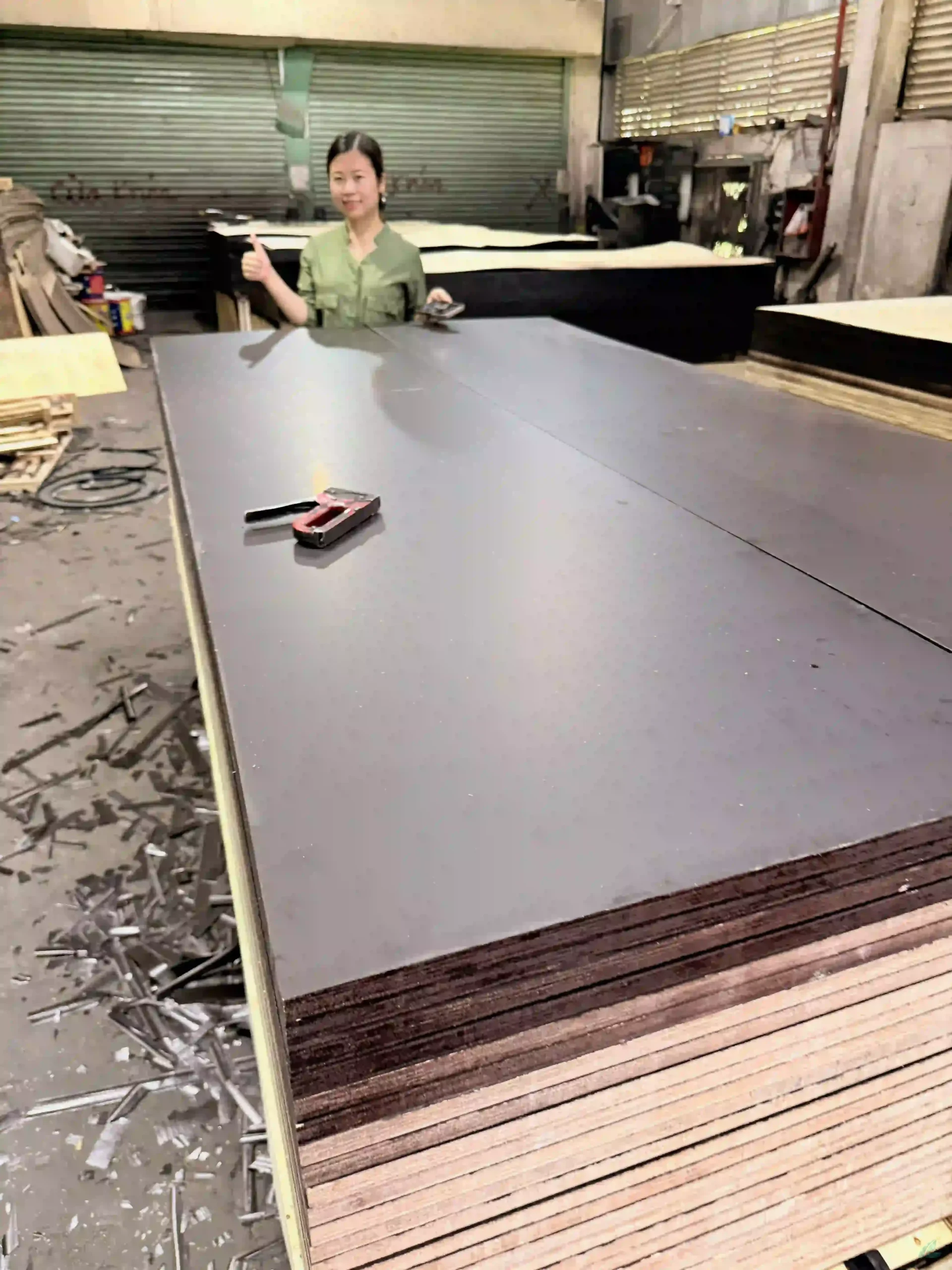
Film faced plywood Vietnam edge cross-section showing core veneer layers Mika Plywood factory
The density of film faced plywood is determined by the core species, not the film overlay. This is a critical distinction for buyers who need to calculate container payload weights and logistics costs accurately.
Acacia core panels (~580 kg/m³) are the lightest option. A standard 18mm acacia-core film faced panel (1220×2440mm) weighs approximately 29–32 kg per sheet. In a 40HC container, acacia core enables loading approximately 16 pallets (~47.5 CBM) before approaching the 28.5 MT payload limit. This higher CBM per container makes acacia core the cost-optimal choice for buyers where freight cost per CBM is the primary driver.
Eucalyptus core panels (650–750 kg/m³) are denser and heavier — the same 18mm panel weighs approximately 35–42 kg per sheet. In a 40HC container, eucalyptus core loads approximately 15 pallets (~44.5 CBM) — fewer sheets per container, but higher panel density means better stiffness, screw-holding, and resistance to deflection under load. Eucalyptus core is the preferred specification for truck flooring, industrial ramps, and high-traffic scaffolding platforms where load-bearing performance is critical.
Mixed core construction — eucalyptus outer plies with acacia inner fill — represents a practical middle ground. The eucalyptus outer layers provide the surface stability and edge strength that formwork contractors value, while the acacia inner fill reduces overall panel weight and cost. This configuration is popular with buyers in India and Southeast Asia who need reliable formwork panels at competitive pricing without sacrificing edge performance.
Regardless of core choice, Mika Plywood applies eucalyptus as the outermost core ply on both face and back sides. This means the film adhesion surface is always the densest, most dimensionally stable veneer in the layup — a construction practice that protects bond line integrity and extends reusability.
Film Faced Plywood Technical Specifications
The following specifications reflect Mika Plywood standard production for film faced plywood Vietnam. Density values depend on core species ordered.
| Property | Specification |
|---|---|
| Product Type | Film Faced Plywood — Phenolic / Dynea Film Overlay |
| Surface | Unsanded — phenolic or melamine film applied direct to core |
| Film Options | Black film (Dynea or equivalent) / Brown film (standard phenolic) |
| Core Species | Acacia (~580 kg/m³) or Eucalyptus (650–750 kg/m³) |
| Glue Bond | WBP Phenolic throughout — face-to-core and core-to-core |
| Thickness Range | 12mm, 15mm, 18mm, 21mm (custom available) |
| Standard Sizes | 1220×2440mm (4×8ft), 1250×2500mm (metric) |
| Thickness Tolerance | ±0.3mm |
| Moisture Content | ≤ 12% (kiln-dried core veneer) |
| Reusability | 6–10 times standard | 18+ with care and release agent |
| Container Load (40HC) | Acacia core ~47.5 CBM (16 pallets) | Eucalyptus core ~44.5 CBM (15 pallets) |
| MOQ | 1 × 40HC container |
| Lead Time | 15–20 working days after PI confirmation |
| Certifications | FSC, CO (Form D), Phytosanitary, Fumigation, Insurance |
Why Contractors and Importers Choose Mika Plywood Film Faced Plywood
Film Faced Plywood in Concrete Formwork: Performance Facts
Concrete formwork is the primary application for film faced plywood globally, and understanding why requires understanding the performance demands of formwork work. During a pour, the phenolic film surface is in direct contact with wet concrete — alkaline, abrasive, and under hydrostatic pressure from the weight of the concrete column above. The film must not absorb moisture (which would cause swelling, surface pitting, and concrete staining), must not delaminate from the core (which would destroy the panel and damage the concrete surface finish), and must release cleanly from the cured concrete without leaving film fragments or requiring aggressive stripping that damages the panel edge.
Mika Plywood film faced plywood meets all three requirements through two design decisions: WBP phenolic bonding throughout the panel layup (not just at the film surface), and controlled core veneer kiln-drying to ≤12% moisture before pressing. The WBP phenolic glue passes the 72-hour boiling test — meaning the bond remains intact after 72 hours of immersion in boiling water. This is not a standard that MR (melamine) glue meets. For formwork applications where panels may be repeatedly soaked, cleaned with pressure washers, and exposed to rain between pours, WBP bonding is the non-negotiable specification.
The practical reuse number for film faced plywood depends on four factors: film quality (black Dynea film outperforms standard brown in abrasion resistance), release agent application (oiling the film before each pour protects the surface and prevents concrete adhesion), stripping method (mechanical stripping tools can damage film edges), and site conditions (direct UV exposure degrades film faster than shaded storage). Mika Plywood's quoted range of 6–10 reuses represents realistic field performance under standard Asian construction site conditions. European buyers using Dynea film with controlled stripping procedures routinely report 15–20 reuses.
For contractors calculating formwork economics, the critical metric is not purchase price but cost per pour. A panel that costs 20% more but lasts 40% longer delivers a lower cost per pour — the formula construction project managers use to evaluate film faced plywood suppliers during tender specification.
Film Faced Plywood vs Anti-Slip Plywood — Which Do You Need?
Both products use WBP phenolic bonding and share core options. The difference is in surface design and application focus.
| Feature | Film Faced Plywood | Anti-Slip Plywood |
|---|---|---|
| Surface Film | Smooth phenolic/Dynea film | Hexagonal wire-mesh textured film |
| Primary Use | Concrete formwork, shuttering | Truck flooring, scaffolding platforms, walkways |
| Anti-Slip Rating | Low — smooth surface for concrete release | High — mesh texture provides grip in wet/oily conditions |
| Core Options | Acacia, Eucalyptus | Acacia, Eucalyptus |
| Glue Bond | WBP Phenolic | WBP Phenolic |
| Unsanded Core | Yes — film applied direct | Yes — anti-slip film applied direct |
| Thickness Range | 12–21mm | 12–21mm |
| Reusability | 6–10x (18+ with care) | 6–10x |
| Price Range (FOB) | USD 300–480/CBM | USD 350–520/CBM |
Container Loading: How Many Sheets Fit in a 40HC?
Film faced plywood Vietnam container loading packing export Mika Plywood factory
A common question from first-time importers is how many sheets of film faced plywood fit in a 40-foot High Cube container — and the honest answer is: it depends on thickness and core species.
For acacia core film faced plywood, Mika Plywood loads approximately 16 pallets per 40HC container (layout: 4×4 pallets lying flat), reaching ~47.5 CBM and approximately 27.5 MT gross weight — well within the 28.5 MT payload limit. A single pallet at 18mm holds 55 sheets (1000mm stack height ÷ 18mm per sheet). 16 pallets × 55 sheets = 880 sheets per 40HC at 18mm acacia core.
For eucalyptus core film faced plywood, the heavier density (700 kg/m³) means payload weight is reached with 15 pallets (~44.5 CBM, ~28 MT gross weight). 15 pallets × 55 sheets at 18mm = 825 sheets per 40HC.
For 12mm panels: acacia core enables more sheets per pallet (1000 ÷ 12 = 83 sheets/pallet), resulting in a higher total sheet count (16 × 83 = ~1,328 sheets) but still limited to 16 pallets by payload weight. For 21mm panels: fewer sheets per pallet (1000 ÷ 21 = 47 sheets), but the total CBM remains the constraining factor.
Mika Plywood provides a detailed container loading plan with every order — including a packing list with bundle count, sheet count per bundle, total sheets, total CBM, and estimated gross weight. This documentation is required for accurate customs declaration at destination ports and for letter-of-credit compliance. Mixed thickness orders (e.g., 18mm + 21mm) are accepted and will receive a mixed packing plan with recalculated weights.
Export Markets and Buyer Requirements by Region
Mika Plywood film faced plywood Vietnam is exported to over 20 countries across construction markets with distinct specification requirements. Understanding regional preferences helps buyers align their orders with market expectations.
In India, film faced plywood is widely used for residential and commercial high-rise construction, infrastructure projects, and large civil works. Indian buyers typically order brown film, acacia core (for cost efficiency), in 12mm and 18mm thicknesses. The most common panel size is 1220×2440mm (4×8ft). Shipments arrive at Mundra Port (Gujarat) and Nhava Sheva (Mumbai). Mika Plywood is familiar with Indian port documentation requirements and customs classification under HS code 4412.
In Australia and New Zealand, buyers prioritize black Dynea film for extended service life and prefer eucalyptus core for maximum panel stiffness. Australian construction standards for formwork (AS 3610 framework) create demand for high-quality, verifiable panels — Mika Plywood's FSC certification and ability to provide third-party test reports on request make the company a preferred supplier for specification-driven projects.
In the UAE and Middle East, film faced plywood is used extensively in the region's high-rise construction boom. Buyers in this market specify both brown and black film, with eucalyptus core common for tower formwork applications. Dubai Municipality requirements for construction materials align with Mika Plywood's FSC and WBP documentation capabilities.
In Southeast Asia (Malaysia, Singapore, Thailand, Philippines), film faced plywood is used for both commercial construction and infrastructure projects. Buyers in this region often source mixed specifications — 15mm for slab forming, 18mm for column and beam work — within a single container.
For all markets, Mika Plywood provides full export documentation in English, including CO Form D (for ASEAN tariff preferences), Phytosanitary Certificate, Fumigation Certificate, and optionally FSC Chain of Custody Certificate for buyers requiring green building compliance.
Why Source Film Faced Plywood from Vietnam Rather Than China?
Vietnam has established itself as a significant exporter of film faced plywood, and for good reason. The combination of abundant tropical hardwood core supply (acacia and eucalyptus, both plantation-grown in northern Vietnam), competitive labor costs, and improving manufacturing infrastructure has positioned Vietnamese factories to compete effectively with Chinese producers on price, quality, and certification.
The key differences buyers should evaluate: Core species availability — Vietnam uses acacia and eucalyptus cores (plantation tropical hardwood), while Chinese factories commonly use poplar or pine cores. For formwork applications, the higher density of Vietnamese acacia and eucalyptus cores provides better rigidity and nail-holding compared to softer Chinese poplar core. Certification status — Mika Plywood holds FSC Chain of Custody certification, an increasingly required credential for buyers supplying construction projects in the EU, Australia, and regulated markets. Many Chinese manufacturers offer CE marking claims without independent verification. Production scale and lead time — Vietnam's medium-scale factories (of which Mika Plywood is an example) provide shorter lead times (15–20 working days) than large Chinese factories which prioritize high-volume orders. Buyers ordering 1–5 containers can expect dedicated production scheduling from Mika Plywood, while Chinese factories may deprioritize small orders. Price competitiveness — FOB Hai Phong pricing for film faced plywood Vietnam is competitive with FOB Chinese pricing at equivalent quality grades, with the advantage of shorter sea freight transit time to Indian, Australian, and Southeast Asian ports.
Buyers making the switch from Chinese to Vietnamese supply consistently report positive outcomes in panel consistency, response time, and documentation quality — all critical for construction project timelines and contractor accountability requirements.
Related Products & Resources
Bintangor Plywood — Commercial Grade ExportOkoume Plywood — Lightweight Furniture GradeBirch Plywood — D/E Grade Baltic QualityBirch UV Coated — Pre-Finished PanelsGurjan Plywood — Premium Hardwood FaceEucalyptus Plywood — High-Density Hardwood CoreMika Plywood — ManufacturerReady to Import Film Faced Plywood Vietnam?
Contact Mika Plywood now — leading film faced plywood manufacturer in Vietnam. Get full quotation, sample video, and load inspection within 12 hours.
Get Free Quote