Vietnam packing plywood prices: $110–$280/CBM. Compare export vs local grade specs, price drivers, and which grade your shipment actually needs.
Vietnam packing plywood prices vary by a factor of two — not because of supplier margins, but because export grade and local grade are fundamentally different products built for different conditions. Buying the wrong grade costs more in the long run.
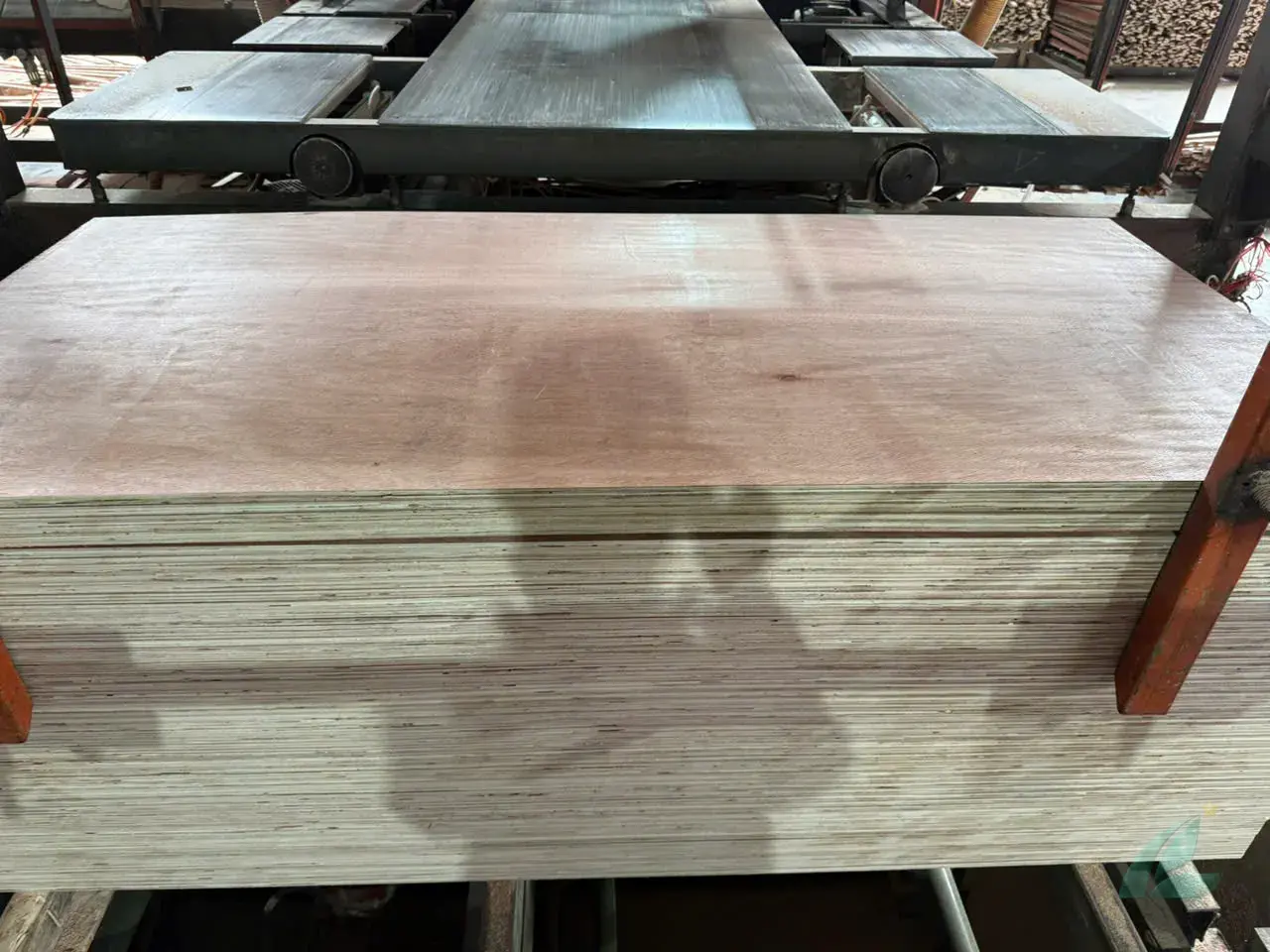
This guide covers what separates export grade from local grade at the specification level, what drives the price gap, and a decision framework for choosing the right product for your shipment. All price data reflects Mika Plywood production data as of Q1 2026. For rates across all plywood categories, see the 2025 pricing guide.
📊 Price Comparison at a Glance
Before going deeper, here is the full comparison between the two grades. All prices are indicative (subject to change — contact for current pricing):
| Specification | Export Grade | Local Grade |
|---|---|---|
| FOB Price (per CBM) | $200 – $280 | $110 – $160 |
| Per Sheet (8–18mm) | ~$5.80 – $8.50 | ~$3.20 – $4.80 |
| Core Species | Acacia or Eucalyptus | Mixed tropical (acacia + scraps) |
| Glue Type | MR Melamine or WBP Phenolic | Urea-formaldehyde (UF) |
| Emission Standard | E1 or E2 | E2 (no standard for export markets) |
| Thickness Tolerance | ±0.5mm | ±1.0mm or wider |
| Moisture Content | ≤14% (controlled) | 15–20%+ (uncalibrated) |
| Surface Finish | Unsanded, clean face | Rough, fiber tear acceptable |
| Pre-Shipment Inspection | Available, PSI-ready | Not applicable |
| Primary Markets | India, Middle East, Europe, Africa | Vietnam, Laos, Cambodia, short-haul |
⚠️ Important: Urea-formaldehyde (UF) glue is NOT the same as MR melamine glue. UF glue has minimal moisture resistance and will delaminate under shipping humidity. Export grade always specifies MR or WBP.
📦 What Is Export Grade Packing Plywood?
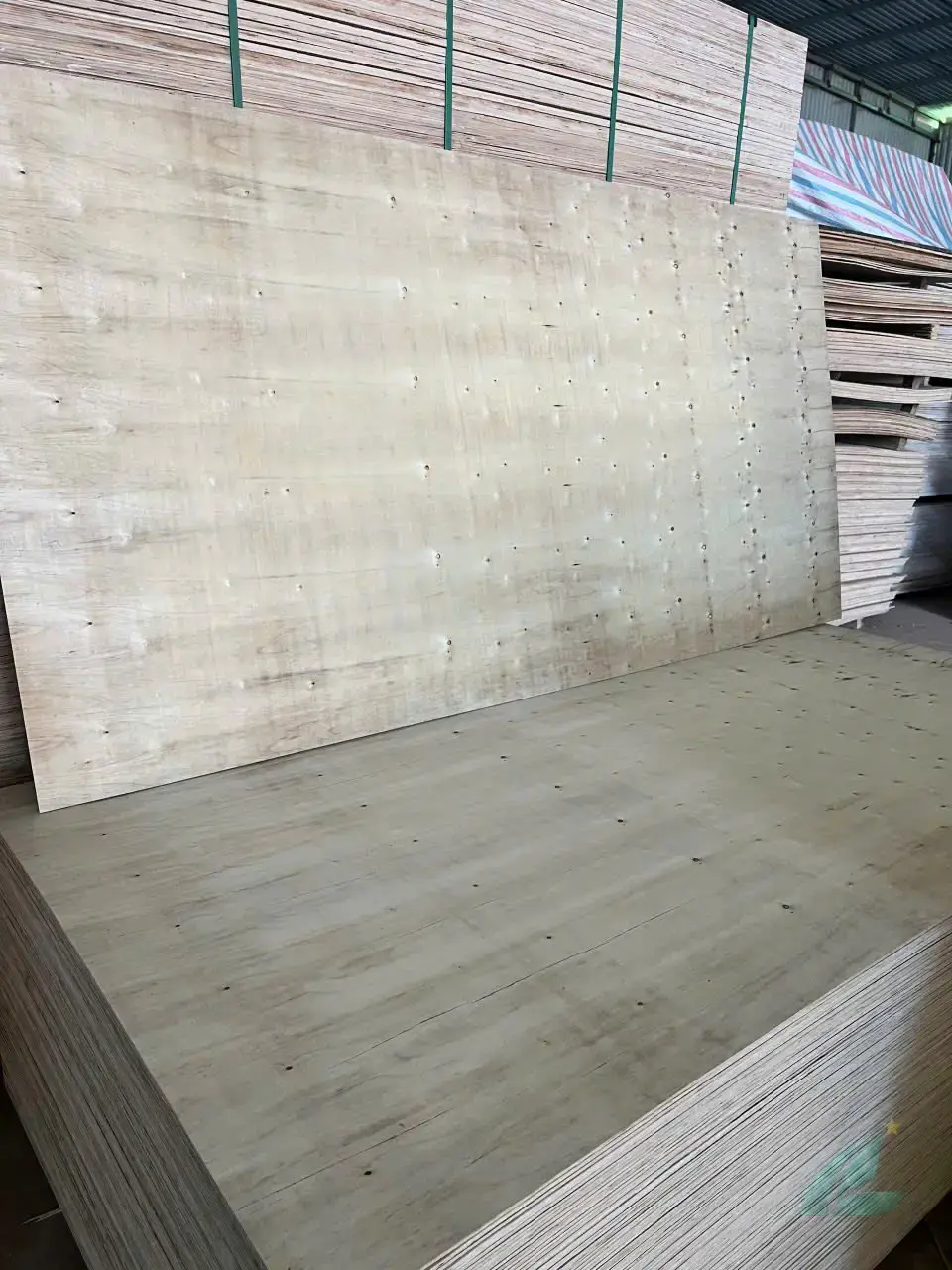
Export grade packing plywood is manufactured to survive a full sea freight cycle — from factory floor to destination warehouse, through high humidity, temperature swings, and rough container handling.
The defining specifications are:
Core: Acacia or Eucalyptus
Acacia core (~580 kg/m³) is the standard choice. It provides adequate compression strength for stacking and is cost-efficient. Eucalyptus core (650–750 kg/m³) is used when buyers need higher density or the shipment involves heavy industrial goods. Both species produce consistent veneer in Northern Vietnam’s plantation forests, where Mika Plywood’s production facilities are located. (Mika Plywood production data, 2026)
Glue: MR Melamine or WBP Phenolic
MR melamine glue passes a 12-hour boiling test — sufficient for sealed container shipping where the panels are not exposed to standing water. WBP phenolic glue passes 72 hours and is specified for monsoon-destination markets (India, West Africa, Southeast Asia). Glue type and emission standard are separate specifications. For more detail, see our guide on plywood glue types and emission standards.
Thickness Tolerance: ±0.5mm
This matters for packing applications where panels are cut into crate sides, pallet decks, or box walls. A ±1.0mm tolerance creates fit problems during assembly.
Moisture Content: ≤14%
Export grade panels undergo controlled kiln drying before pressing. High moisture content causes warping and panel expansion inside sealed containers — a common cause of damaged goods claims.
“Buyers sourcing packing plywood for long-haul ocean freight often underestimate moisture control. We’ve seen delamination claims trace back to panels with 18–20% moisture content, not glue failure.” — Jay, International Sales Manager, Mika Plywood
💎 What Is Local Grade Packing Plywood?
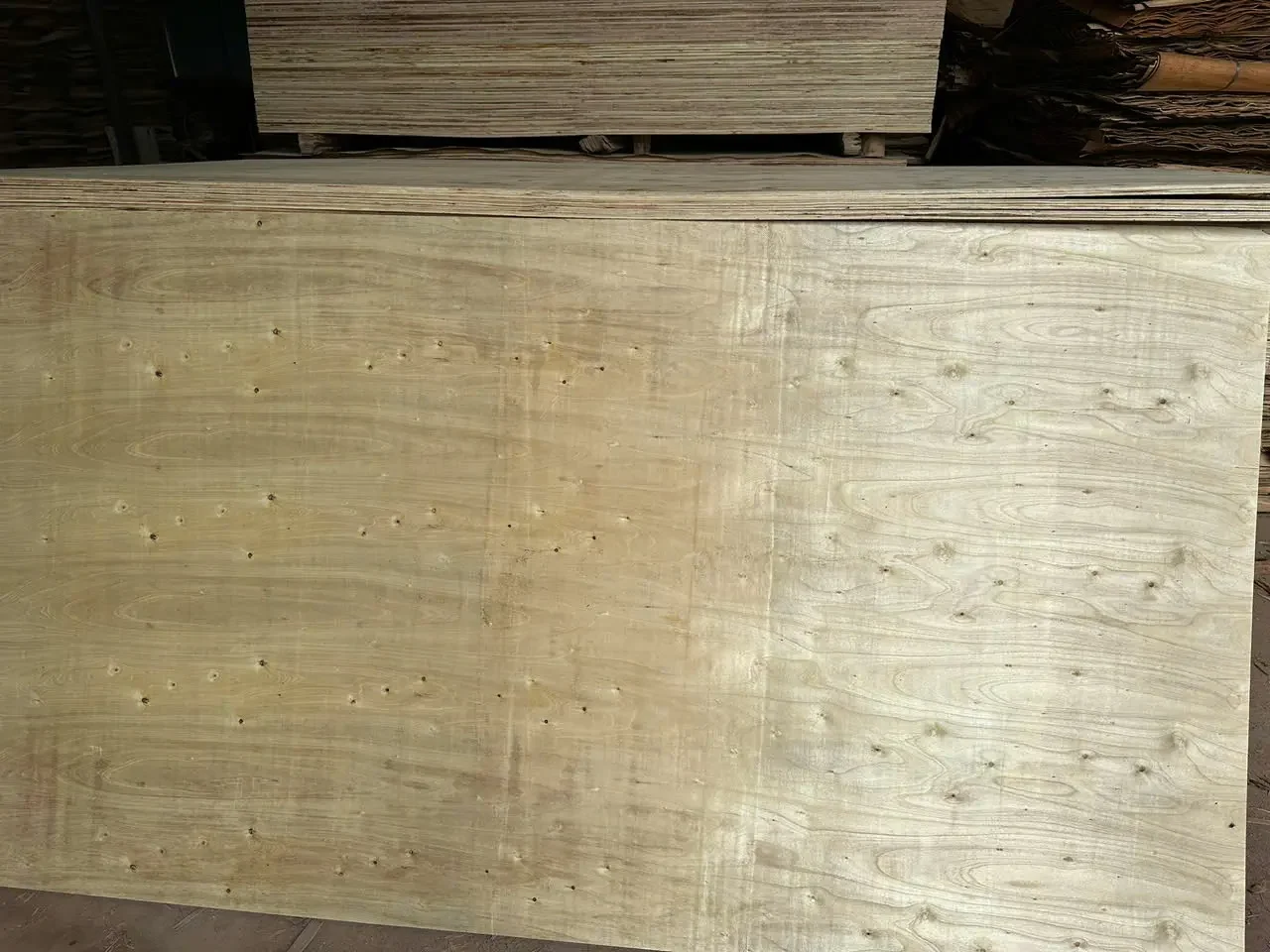
Local grade is designed for domestic distribution and short-haul transport within Southeast Asia — trucks, inland waterways, and regional routes where the goods travel under 7 days and are not exposed to monsoon conditions.
The cost savings come from several compromises:
Core: Mixed Species, Loose-Lay Construction
Local grade factories use mixed core veneer — acacia combined with off-cuts, lower-grade plantation wood, or poorly graded pieces. The core construction is often loose-laid (xếp chồng) rather than stitched, which creates internal gaps. These gaps reduce compressive strength and become delamination points when moisture enters.
For context on core construction differences, see our full guide on plywood core types from Vietnam.
Glue: Urea-Formaldehyde (UF)
UF glue is the cheapest available option. It has near-zero moisture resistance. In a sealed 40HC container crossing the Indian Ocean, relative humidity regularly reaches 85–95%. UF-bonded panels exposed to this environment for 3–6 weeks soften and delaminate.
Tolerance: ±1.0mm or Wider
Local grade mills do not calibrate their press thickness systematically. Panel-to-panel variation is significant.
No Pre-Shipment Inspection
Local grade is sold ex-works to domestic buyers without third-party inspection. For international shipments, this means no documented quality baseline.
🔧 What Drives the Price Gap?
The $90–$120/CBM gap between export and local grade is not supplier markup. It reflects real cost differences at every production stage.
-
Core Material Selection
Acacia and eucalyptus plantation veneer from certified Northern Vietnam sources costs more than mixed tropical scraps. Grade-A core veneer is cut to consistent thickness (typically 1.5–1.7mm per ply) and sorted before gluing. -
Glue Type
MR melamine resin costs approximately 20–30% more per unit than UF adhesive. WBP phenolic resin adds another 15–25% on top of MR pricing. The glue cost per panel is small in absolute terms but multiplies across large order volumes. -
Moisture Control and Kiln Drying
Running kiln dryers to controlled targets adds energy cost and production time. Local grade mills skip or reduce this step, accepting higher moisture content as a cost trade-off. -
QC and Sorting
Export grade production includes post-press moisture checks, thickness spot-checks, and surface grading before palletization. These QC steps add labor and slow throughput per shift — which is reflected in the price. -
Pre-Shipment Documentation
Export grade orders can be supported with test reports, moisture certificates, and third-party PSI if buyers require it. Local grade has no equivalent documentation infrastructure.
📐 Thickness and CBM — How Grade Affects Container Economics
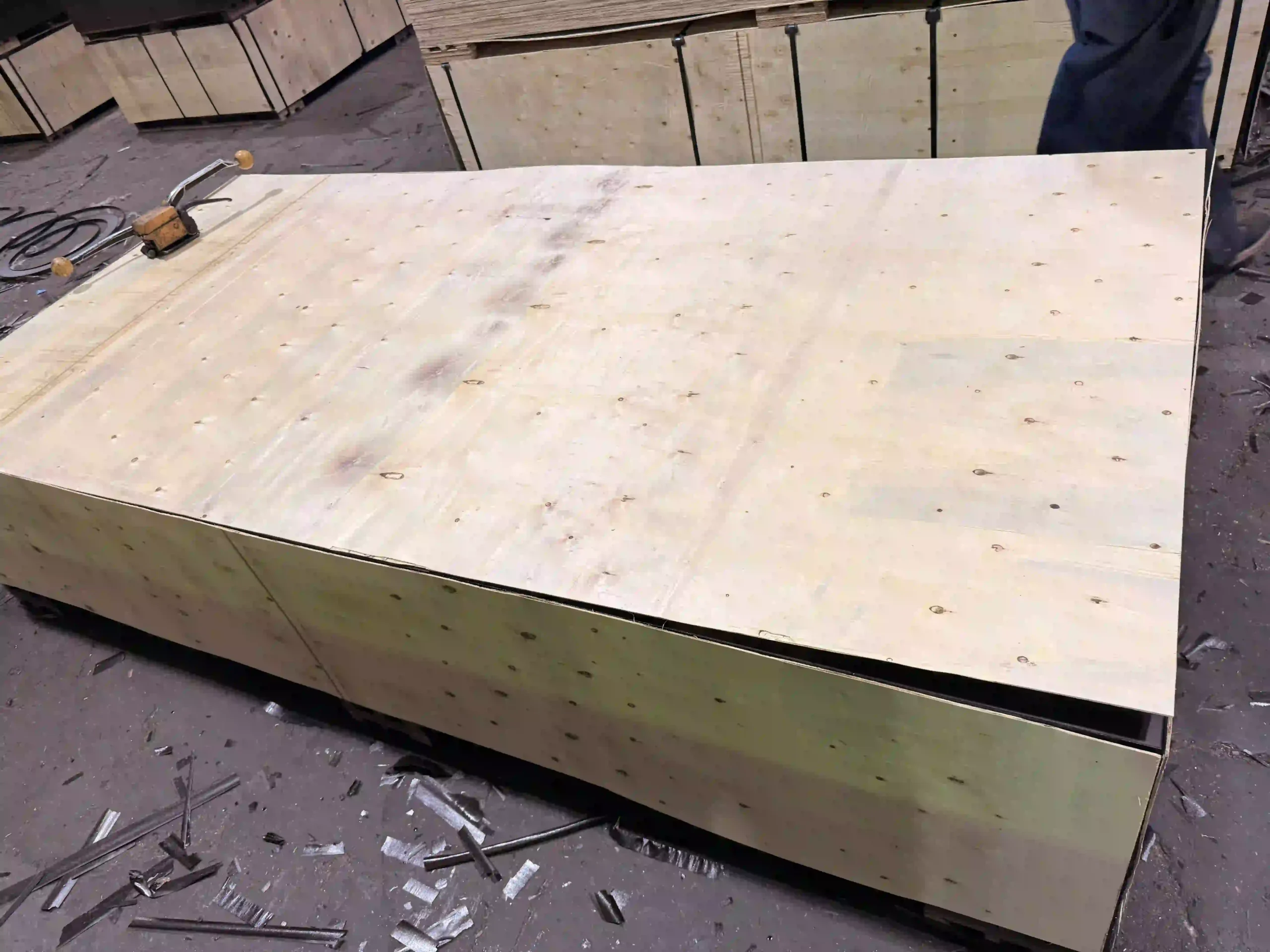
Packing plywood is typically ordered in 4–18mm thickness. The most common export grade sizes are 9mm, 12mm, and 15mm. Here is how core species and grade affect your container yield, using factory-level 40HC packing data:
| Core | Density | Pallets/40HC | Approx. CBM | Payload |
|---|---|---|---|---|
| Acacia (export grade) | ~580 kg/m³ | 16 | ~47.5 CBM | ~27.5 MT |
| Eucalyptus (export grade) | 650–750 kg/m³ | 15 | ~44.5 CBM | ~28 MT |
Local grade orders shipped internationally use the same container dimensions. However, because moisture content is higher and panels may warp before loading, actual pallet count can fall below the theoretical calculation.
For buyers comparing landed cost between export and local grade, the CBM calculation must account for both FOB price and freight efficiency. A cheaper per-CBM price loses value if warped panels create loading problems or damage claims at destination.
🛠 Which Grade Is Right for Your Application?
The right grade depends on three factors: transit duration, destination climate, and goods value.
Choose Export Grade When:
- Ocean freight exceeding 14 days
- Destination has monsoon or high-humidity conditions (India, West Africa, Southeast Asia coastal)
- Goods have high value — electronics, machinery, auto parts
- Third-party inspection or insurance documentation is required
- Buyer requires certified moisture content below 14%
Choose Local Grade When:
- Domestic Vietnam distribution only
- Short-haul truck transport, no ocean crossing
- Goods are low-value and replaceable if damaged
- Buyer has no certification or documentation requirements
- Price is the only variable and conditions are fully controlled
Mixed-Spec Containers
Some experienced buyers load export grade for primary crating and local grade as filler or secondary packaging within the same 40HC. Mika Plywood produces mixed-spec containers regularly. The total weight must be recalculated per combination — acacia-core export grade loads differently from a mixed-species local grade panel set.
For pallet configuration options, see our guide on packing plywood Vietnam export grade specifications.
📋 Case Study: Indian Electronics Buyer
One of Mika Plywood’s regular Indian buyers switched from local grade to export grade packing plywood after three consecutive monsoon-season shipments arrived with water-damaged crates. The sequence:
- Before: Local grade, UF glue, 18mm panels, $130/CBM FOB. Three containers — moisture damage on 12–15% of goods per container.
- After: Export grade, MR glue, 15mm panels, $210/CBM FOB. Zero damaged-goods claims over the next 11 shipments.
The per-CBM cost increased by $80. The eliminated damage claims — product replacements, insurance disputes, and customer relationship costs — exceeded $4,000 per container on the previous arrangement. (Mika Plywood customer records, 2025)
This outcome aligns with what industry data shows: the primary source of international packing failure is glue bond failure under humidity, not panel thickness or face grade. (Vietnam Timber and Forest Products Association, 2024)
🌏 Market Trends in 2026
Demand for export grade packing plywood from Vietnam has grown across three markets in 2025–2026:
Africa and the Middle East: Construction material imports from Vietnam increasingly require proper packaging for long sea routes. Buyers have shifted from bare steel strapping to export-grade plywood crates after goods-in-transit damage rates were published by regional logistics operators. (ITTO Tropical Timber Market Report, 2025)
India: India remains the largest buyer of Vietnamese packing plywood. Post-COVID supply chain restructuring pushed more Indian importers toward documented export grade with moisture certificates, as insurance claims required material certification.
Southeast Asia: Domestic-use local grade continues to dominate intra-ASEAN trade for short-route applications. However, buyers shipping Vietnamese goods onward to Australia, Japan, or Europe must use export grade even when sourcing through regional distributors.
✅ How to Specify Packing Plywood for Your Inquiry
When requesting a quote for Vietnam packing plywood, provide these five parameters:
- Thickness — 9mm, 12mm, 15mm, or 18mm (most common for export packing)
- Sheet size — 1220×2440mm (4×8 ft) standard, or 1250×2500mm for European metric
- Core species — Acacia (standard cost) or Eucalyptus (higher density)
- Glue type — MR melamine (standard) or WBP phenolic (monsoon destinations)
- Volume — Number of 40HC containers or CBM per shipment
Mika Plywood can provide a same-day quotation for standard configurations. Samples are available for specification review before placing an order.
Get a Free Quote for Packing Plywood
No commitment required. Response within 24 business hours.
Disclosure: This article is published by Mika Plywood, a Vietnam-based plywood manufacturer and export operator. While we aim to provide objective industry guidance, readers should consider our perspective as a market participant when evaluating recommendations.
🔗 Related Articles
- Packing Plywood Vietnam — Export Grade Specifications
- Plywood Container Packing Calculation 40HC — Factory Data
- Acacia Core Plywood Vietnam — Budget Grade Guide
- Plywood Glue Types and Emission Standards Guide
- Commercial Plywood Vietnam — Multi-Purpose Applications
🏁 Conclusion
Vietnam packing plywood prices reflect a real specification gap between export and local grade — not supplier margins. Export grade at $200–$280/CBM delivers controlled moisture, tested glue bond, documented quality, and 16 pallets per 40HC. Local grade at $110–$160/CBM is appropriate only when ocean crossing, humidity, and goods value are all low.
The most expensive mistake in packing plywood procurement is buying local grade for export conditions. One damaged-goods claim typically exceeds the entire FOB savings from choosing the lower grade.
For specification advice on your specific shipping route and product category, contact Mika Plywood directly. Jay handles export quotations and can turn around pricing within one business day.
Frequently Asked Questions
What is the price range for Vietnam packing plywood in 2026?Export grade packing plywood from Vietnam is priced at $200–$280 per CBM FOB Hai Phong (approximately $5.80–$8.50 per sheet for 8–18mm thickness). Local grade runs $110–$160 per CBM for domestic or short-haul applications. Prices depend on core species, glue type, thickness, and order volume.What is the difference between export grade and local grade packing plywood?Export grade uses higher-density cores (eucalyptus or acacia), MR or WBP glue, tighter thickness tolerance (±0.5mm), controlled moisture content (below 14%), and passes pre-shipment inspection. Local grade uses mixed cores, basic urea-formaldehyde glue, rougher surfaces, and looser tolerances — acceptable only for domestic or short-distance transport.Can I mix export grade and local grade in one container?Yes. Mika Plywood regularly arranges mixed-spec 40HC containers. Export grade handles your critical loads; local grade covers lighter, secondary packaging. Total container weight must be recalculated per core species and thickness combination.Does export grade packing plywood require WBP glue?Not always. For dry-climate destinations or short sea routes, MR melamine glue performs adequately and costs less. WBP phenolic glue is recommended for monsoon climates (India, Southeast Asia, West Africa) or goods stored outdoors for extended periods.Which core species should I specify for packing plywood?Acacia core (~580 kg/m³) is the standard for packing plywood — cost-effective, adequate strength, loads 16 pallets per 40HC. Eucalyptus core (650–750 kg/m³) is heavier and stronger but yields only 15 pallets and approaches the 28.5 MT payload limit faster.
Ready to order?
Get a Free Quote for Packing Plywood

Written by
Jay
International Sales Manager
Content contributor at Vietnam Plywood.
On this page
- 📊 Price Comparison at a Glance
- 📦 What Is Export Grade Packing Plywood?
- 💎 What Is Local Grade Packing Plywood?
- 🔧 What Drives the Price Gap?
- 📐 Thickness and CBM — How Grade Affects Container Economics
- 🛠 Which Grade Is Right for Your Application?
- 📋 Case Study: Indian Electronics Buyer
- 🌏 Market Trends in 2026
- ✅ How to Specify Packing Plywood for Your Inquiry
- 🔗 Related Articles
- 🏁 Conclusion
On this page
- 📊 Price Comparison at a Glance
- 📦 What Is Export Grade Packing Plywood?
- 💎 What Is Local Grade Packing Plywood?
- 🔧 What Drives the Price Gap?
- 📐 Thickness and CBM — How Grade Affects Container Economics
- 🛠 Which Grade Is Right for Your Application?
- 📋 Case Study: Indian Electronics Buyer
- 🌏 Market Trends in 2026
- ✅ How to Specify Packing Plywood for Your Inquiry
- 🔗 Related Articles
- 🏁 Conclusion
Industry Newsletter
Stay Updated with
Plywood Industry Insights
Factory prices, spec guides, market trends and export tips — delivered weekly to B2B buyers and importers in 20+ countries.