
Vietnamese plywood face veneer thickness standard is 0.2–0.4mm. How it affects sanding, appearance, price — and what to specify in your purchase order.
Face veneer thickness is one of the most overlooked specifications on a plywood purchase order. Buyers spend hours negotiating species and glue grade, then leave thickness at whatever the factory defaults to. That default matters — and it is not the same at every factory.
In Vietnam, face veneer ranges from 0.16mm at the thinnest production extreme to 1.0mm for specialty heavy-faced panels. The commercial standard for furniture and construction export sits firmly at 0.2–0.4mm (Mika Plywood production data, 2026). Within that 0.2mm window, real differences exist in surface durability, sanding allowance, and panel appearance.
This guide explains what those differences are and when they matter for importers buying container quantities.
📐 What Face Veneer Thickness Actually Means
Face veneer is the thin wood layer bonded to the outer surfaces of a plywood panel. It determines visible grain, color, texture, and species identity. When you buy “birch plywood,” you are buying a plywood panel with birch veneer on the face — not a panel made of solid birch.
Veneer is produced by rotary peeling — logs are mounted on a lathe and rotated against a stationary knife, unrolling a continuous ribbon of wood sheet. The knife advance per revolution sets the veneer thickness. Rotary peeling accounts for 80–90% of commercial veneer production globally because it maximizes log yield and produces wide full-length sheets (USDA Forest Service, research literature).
The full production range at Vietnamese factories:
| Thickness Range | Category | Typical Use |
|---|---|---|
| 0.15–0.2mm | Thin commercial | Budget packing, low-grade commercial — see 0.2mm veneer face plywood |
| 0.2–0.3mm | Standard | Commercial furniture, bintangor, okoume mass market — see 0.3mm veneer face plywood |
| 0.3–0.4mm | Premium standard | Furniture export, birch, EV, sanded finish required — see 0.4mm thick veneer face plywood |
| 0.5–1.0mm | Specialty heavy-face | Marine overlay, some decorative applications |
Vietnamese export plywood most commonly ships with 0.2–0.4mm face veneer. The specific thickness within this range depends on the factory segment and product application.
🔧 How Face Thickness Affects Sanding — The Critical Variable
Sanding is where face veneer thickness makes or breaks a panel specification.
Every factory sanding pass removes material. A calibration pass takes 0.05–0.1mm. A finish pass takes another 0.03–0.07mm. A two-stage sand (standard for furniture-grade export) consumes 0.1–0.15mm total from each face.
This means:
- 0.4mm starting face → 0.25–0.3mm remaining after two-stage factory sand. Adequate for one field re-sand if needed.
- 0.3mm starting face → 0.15–0.2mm remaining after sanding. Functional but no re-sand margin.
- 0.2mm starting face → 0.05–0.1mm remaining after sanding. Dangerously thin — high risk of sanding through to core in production or application.
⚠️ Important: If your purchase order requires factory sanding (standard for furniture-grade panels), confirm starting face thickness is minimum 0.3mm. Panels ordered “sanded” on 0.2mm face veneer frequently show through-points or core staining at edges.
This is not a theoretical concern. Our team at Mika Plywood rejects multiple batches per quarter where thin-face panels arrive from core suppliers showing sand-through along edges — the weakest point where log diameter taper naturally produces thinner peeled sheets.
“The practical minimum for furniture-grade sanded panels is 0.3mm face starting thickness. Below that, you are gambling on peel consistency across the full log diameter.” — Jay, International Sales Manager, Mika Plywood
💰 Price Impact: Species Matters More Than Thickness
The honest answer to “does thicker face cost more?” is: yes, but you will not notice it in FOB pricing.
Face veneer is thin. An 18mm plywood panel with 0.4mm face contains roughly 0.8mm total face material out of 18mm total thickness — that is 4.4% of the panel by depth. Shifting from 0.2mm to 0.4mm face approximately doubles face veneer material volume per panel, but at the log-to-panel production scale, this adds only USD 2–5 per CBM to the FOB price (Mika Plywood production data, 2026).
Compare this to species pricing across the full plywood face veneer types guide:
| Face Species | Approx. FOB Price Range | Typical Face Thickness |
|---|---|---|
| Bintangor | Lower commercial | 0.2–0.35mm |
| Okoume | Low-mid commercial | 0.25–0.4mm |
| EV (Engineered Veneer) | Mid-range | 0.3–0.4mm |
| Gurjan | Premium | 0.3–0.4mm |
| Birch D/E/F | Premium to highest | 0.3–0.4mm |
Switching from bintangor to birch face shifts your price by tens of USD per CBM. Switching face thickness from 0.2mm to 0.4mm within the same species moves it by low single digits. Species selection dominates face cost — thickness is a secondary lever.
That said, thickness still matters for quality assurance. Premium-species panels on thin faces are a false economy: birch on 0.2mm face shipped unsanded can sand through during downstream furniture manufacturing. The species premium is wasted.
🎨 Appearance: Thickness and Grain Depth
Thicker face veneer produces visually richer grain. This is not subjective aesthetics — it is physics.
Wood grain is a three-dimensional cellular structure. When veneer is peeled thicker, more of the subsurface cell structure contributes to light interaction at the surface. The result:
- Deeper grain figure — striped or figured species like okoume show more pronounced grain on 0.4mm vs 0.2mm faces
- More consistent color — thin veneers can show core color bleeding through lighter-toned species, especially on styrax or acacia cores
- Better stain absorption — furniture factories applying finishing stains get more predictable results on 0.3–0.4mm faces
For mass commercial applications — packing, general construction substrate — 0.2mm face is entirely adequate. The face exists to identify the product and provide a clean surface, not to contribute to visual depth. Buyers in the Indian commercial market frequently specify 0.2mm bintangor face specifically to reduce cost without affecting functional performance (Mika Plywood sales records, 2026).
For furniture export to the EU, Korea, or Japan — markets with high surface quality expectations — specify 0.3–0.4mm face explicitly in your purchase order. Do not leave it to factory default.
📦 What to Specify in Your Purchase Order
Face veneer thickness is not automatically listed on most factory quotations. You need to ask for it and put it in writing.
Recommended specification format:
Face veneer: [Species] [Grade], starting thickness 0.3mm (minimum 0.28mm after calibration sanding)Additional parameters to confirm:
- Sanding: Factory sanded (2-stage) / Unsanded / Light calibration only
- Moisture content at face: Target 6–8% (Mika Plywood internal QC standard)
- Species confirmation by batch: Request veneer origin certificate for premium species (birch, gurjan)
For premium furniture-grade birch plywood, Mika Plywood ships with 0.3–0.4mm birch D/E grade face as standard, two-stage sanded. For commercial bintangor or okoume panels, face thickness is typically 0.2–0.3mm unless a premium specification is requested.
The full panel thickness specification — board-level, not face-level — is covered in the plywood sizes and thickness specification guide, which includes standard thicknesses from 3–40mm and ±0.3mm tolerance tables.
Request face veneer samples with thickness certification from Mika Plywood
🏭 How Vietnamese Factories Control Face Veneer Thickness
Production consistency on face thickness is a core QC parameter at Mika Plywood’s furniture facility.
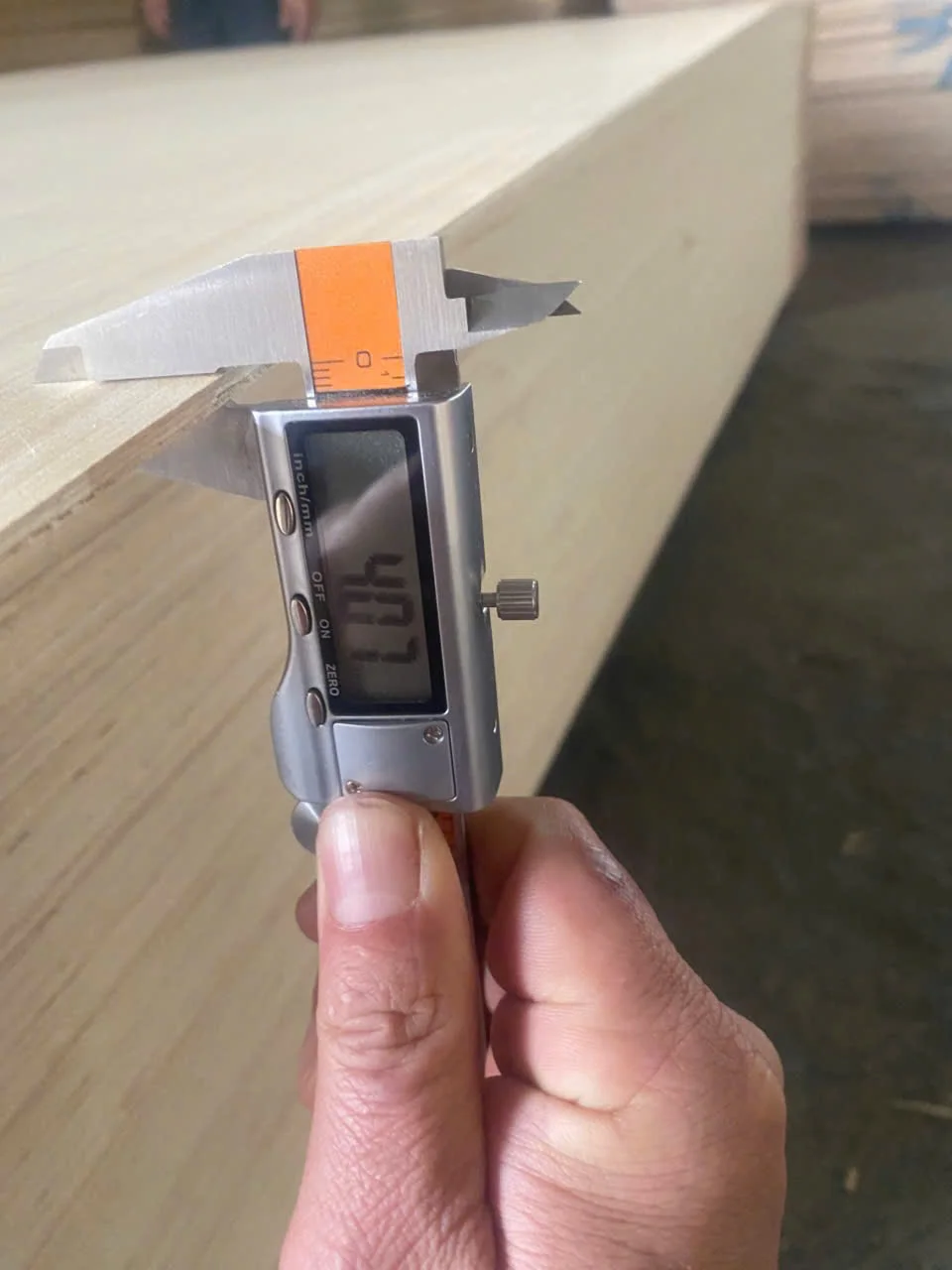
The peeling knife advance is set to target thickness ± 0.03mm. Veneer sheets are batch-tested with digital calipers across three points per sheet — center, left quarter, right quarter — to catch taper variation from log diameter changes near the core.
Sheets with measured thickness below 0.27mm on a 0.3mm target order are rejected from face-grade stock and redirected to core applications. This 10% tolerance from target is tighter than the industry norm of ±15%.
Before each container is loaded, thickness is re-measured on 5% of sheets from each pallet — a protocol aligned with Mika Plywood’s ISO 9001 quality management system. Results are documented and available for inclusion in the QC package shipped with the container.

✅ Summary: Face Veneer Thickness Decisions
| Decision | Recommendation |
|---|---|
| Budget commercial (packing, crates) | 0.2mm face — functional, cost-effective |
| Commercial furniture (bintangor, okoume) | 0.25–0.3mm — adequate for factory sand |
| Premium furniture (birch, EV, gurjan) | 0.3–0.4mm — required for safe sanding margin |
| Field re-sand needed by customer | 0.4mm — only option with margin |
| Unsanded panel, downstream lamination | 0.2mm acceptable — face not finishing surface |
Face veneer thickness sits in the detail of a purchase order that most buyers never examine. At premium furniture grade, getting it wrong costs more in downstream rejection than the USD 2–5/CBM it would have cost to specify correctly.
Get a free quote with face thickness certification included — our team specifies face veneer thickness on every order confirmation as standard.
Disclosure: This article is published by Mika Plywood, a Vietnam-based plywood manufacturer and export operator. While we aim to provide objective industry guidance, readers should consider our perspective as a market participant when evaluating recommendations.
🔗 Related Articles
- Plywood Face Veneer Types — Complete Buyer Guide — species comparison, grading, price tiers
- Plywood Sizes & Thickness Specification Guide — board-level thickness 3–40mm, ±0.3mm tolerance
- Birch Plywood Vietnam — D/E/F Grade Manufacturer — premium face species with certified thickness
Frequently Asked Questions
What is the standard face veneer thickness for plywood exported from Vietnam?Vietnamese plywood factories apply face veneer at 0.2–0.4mm as standard. Thinner peels (0.15–0.2mm) reduce material cost and suit budget commercial grades. Premium furniture panels typically use 0.3–0.4mm faces — thick enough to sand twice without breaking through to the core.Does face veneer thickness change the plywood price?Yes, but modestly. Face veneer is a fraction of total panel thickness — a 0.4mm face on 18mm plywood represents about 2.2% of total material. A step from 0.2mm to 0.4mm face veneer adds roughly USD 2–5 per CBM to the panel cost, far less than switching core species or improving glue grade. The bigger price driver within face veneer is species (birch vs bintangor) and grade (A vs B).Can thicker face veneer be re-sanded in the field?A 0.4mm face veneer allows one careful field re-sand (removing 0.1–0.15mm). Panels with 0.2mm faces should not be field-sanded — there is too little material above the core to remove safely. Factory sanding consumes 0.05–0.1mm per pass. If a panel ships sanded and you request a second factory re-sand, confirm the starting face thickness can handle it.Why do Vietnamese factories use rotary-peeled face veneer rather than sliced?Rotary peeling is the dominant method in Vietnam because it produces continuous wide sheets with maximum log yield — over 80% of all commercial plywood face veneer worldwide is rotary peeled (USDA Forest Service). Sliced veneer is reserved for premium decorative applications where figure and grain direction matter more than cost. For B2B export plywood, rotary-peeled face at 0.2–0.4mm is the industry standard.What is the minimum face veneer thickness that still allows factory sanding?0.25mm is the practical minimum for factory calibration sanding. Below that threshold, the risk of sanding through to the core increases substantially. Most furniture-grade plywood factories in Vietnam peel face veneer at 0.3–0.4mm specifically to accommodate two-stage sanding (calibration pass + finish pass) while maintaining face integrity.
Ready to order?
Request face veneer samples with thickness certification

Written by
David
Export Project Leader
Content contributor at Vietnam Plywood.
On this page
- 📐 What Face Veneer Thickness Actually Means
- 🔧 How Face Thickness Affects Sanding — The Critical Variable
- 💰 Price Impact: Species Matters More Than Thickness
- 🎨 Appearance: Thickness and Grain Depth
- 📦 What to Specify in Your Purchase Order
- 🏭 How Vietnamese Factories Control Face Veneer Thickness
- ✅ Summary: Face Veneer Thickness Decisions
- 🔗 Related Articles
On this page
- 📐 What Face Veneer Thickness Actually Means
- 🔧 How Face Thickness Affects Sanding — The Critical Variable
- 💰 Price Impact: Species Matters More Than Thickness
- 🎨 Appearance: Thickness and Grain Depth
- 📦 What to Specify in Your Purchase Order
- 🏭 How Vietnamese Factories Control Face Veneer Thickness
- ✅ Summary: Face Veneer Thickness Decisions
- 🔗 Related Articles
Industry Newsletter
Stay Updated with
Plywood Industry Insights
Factory prices, spec guides, market trends and export tips — delivered weekly to B2B buyers and importers in 20+ countries.