
0.4mm thick veneer face plywood: the premium face standard for sanded furniture export. Species, specs, and how to order.
Plywood face veneer thickness rarely appears on supplier quotations. Most factories default to whatever they peel — and that default is often 0.2–0.25mm for commercial grades. For premium furniture panels that will be sanded, stained, or field-refinished, that default is not enough.
0.4mm thick veneer face plywood is the specification choice when surface durability, sanding tolerance, and downstream workability matter. As a premium face veneer plywood grade, it is the standard at Mika Plywood for furniture export panels destined for European cabinetry, Korean interiors, and high-spec Indian furniture manufacturing (Mika Plywood production data, 2026).
This guide explains what 0.4mm face veneer means in practice, which applications require it, which species it applies to, and exactly how to specify it in a purchase order.
📐 What 0.4mm Face Veneer Actually Means
Face veneer is the outermost thin wood layer bonded to both surfaces of a plywood panel. It determines visible species, grain character, color, and sanding behavior. Panel classification is named by face species — birch plywood, okoume plywood, gurjan plywood — regardless of what core species sits inside.
Vietnamese factories produce face veneer by rotary peeling: a log rotates on a lathe against a fixed knife, unwinding a continuous sheet. The knife advance setting per revolution determines veneer thickness. The full production range in Vietnam runs 0.16mm (absolute thin limit) to 1.0mm (specialty heavy-face), but commercial export panels almost exclusively use 0.2–0.4mm face (Mika Plywood production data, 2026).
Key Insight: 0.4mm is the upper end of the standard commercial range. It is not an exotic specification — it is the premium tier within the everyday production window.
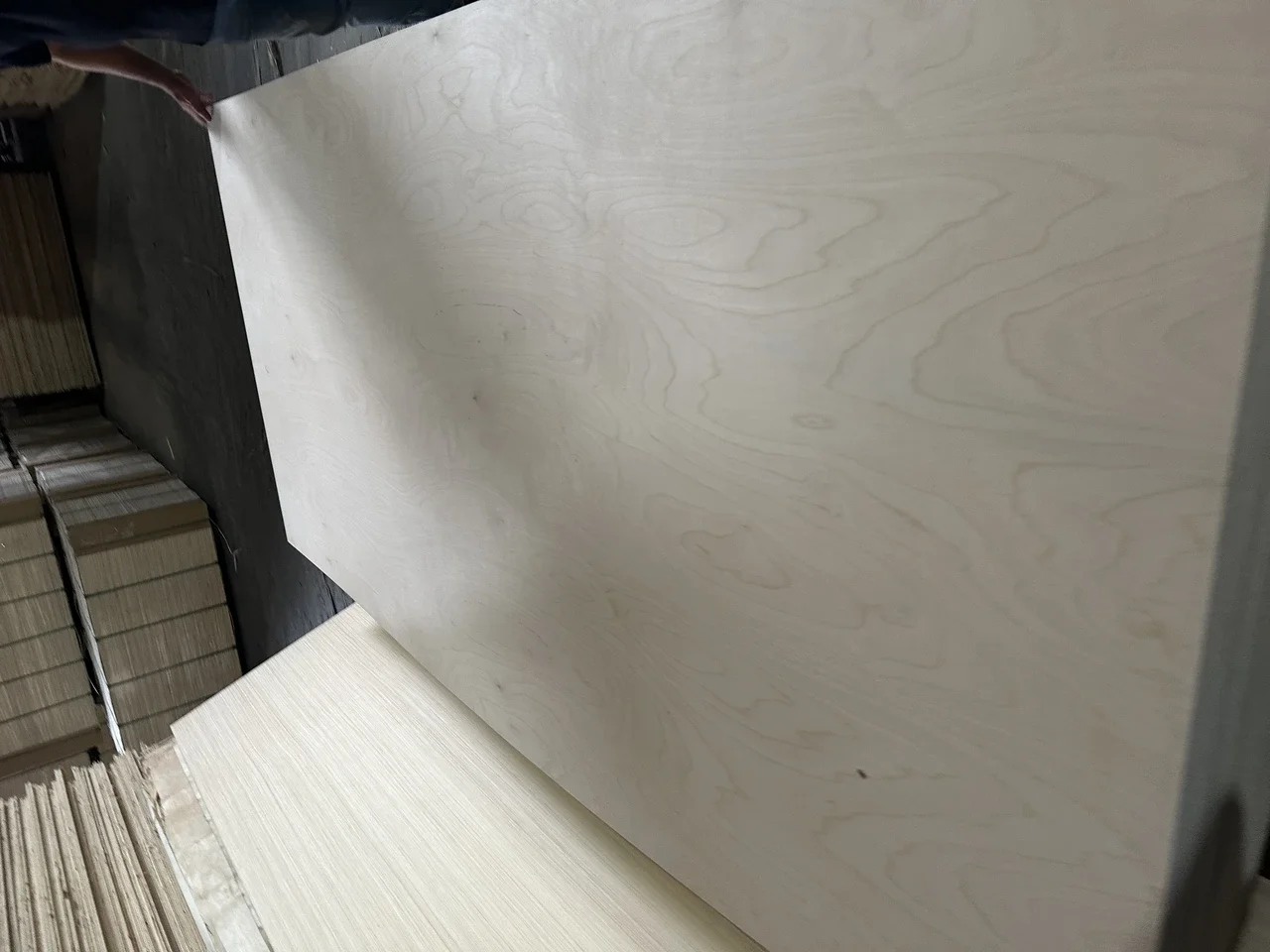
The production range by category:
| Face Thickness | Grade Category | Typical Application |
|---|---|---|
| 0.15–0.2mm | Thin commercial | Budget packing, low-grade commercial, crates |
| 0.2–0.3mm | Standard commercial | Bintangor furniture, okoume mass market |
| 0.3–0.4mm | Premium standard | Furniture export, birch D/E/F, EV, gurjan |
| 0.5–1.0mm | Specialty heavy-face | Marine overlay, decorative architectural panels |
0.4mm sits at the top of the premium standard band — thick enough for two-stage factory sanding with material remaining, but produced on standard peeling equipment without special tooling.
🔧 Why Sanding Margin Is the Critical Benefit
The primary reason to specify 0.4mm face veneer is sanding. This is not aesthetic preference — it is a material science constraint.
Every sanding pass removes wood. A calibration pass on a wide-belt sander removes 0.05–0.10mm from each face. A finish pass removes another 0.03–0.07mm. Standard two-stage factory sanding for furniture export consumes 0.10–0.15mm total from each face surface.
Starting from 0.4mm:
- After two-stage factory sand: 0.25–0.30mm face remaining
- Field re-sand allowance: 0.08–0.12mm — adequate for one careful re-sand
- Net usable face: Full sanding without core exposure risk
Starting from 0.2mm:
- After two-stage factory sand: 0.05–0.10mm face remaining
- Field re-sand allowance: None — any additional sanding risks break-through
- Risk in production: Edge zones where log taper produces thin peeled sheets may sand through during factory production
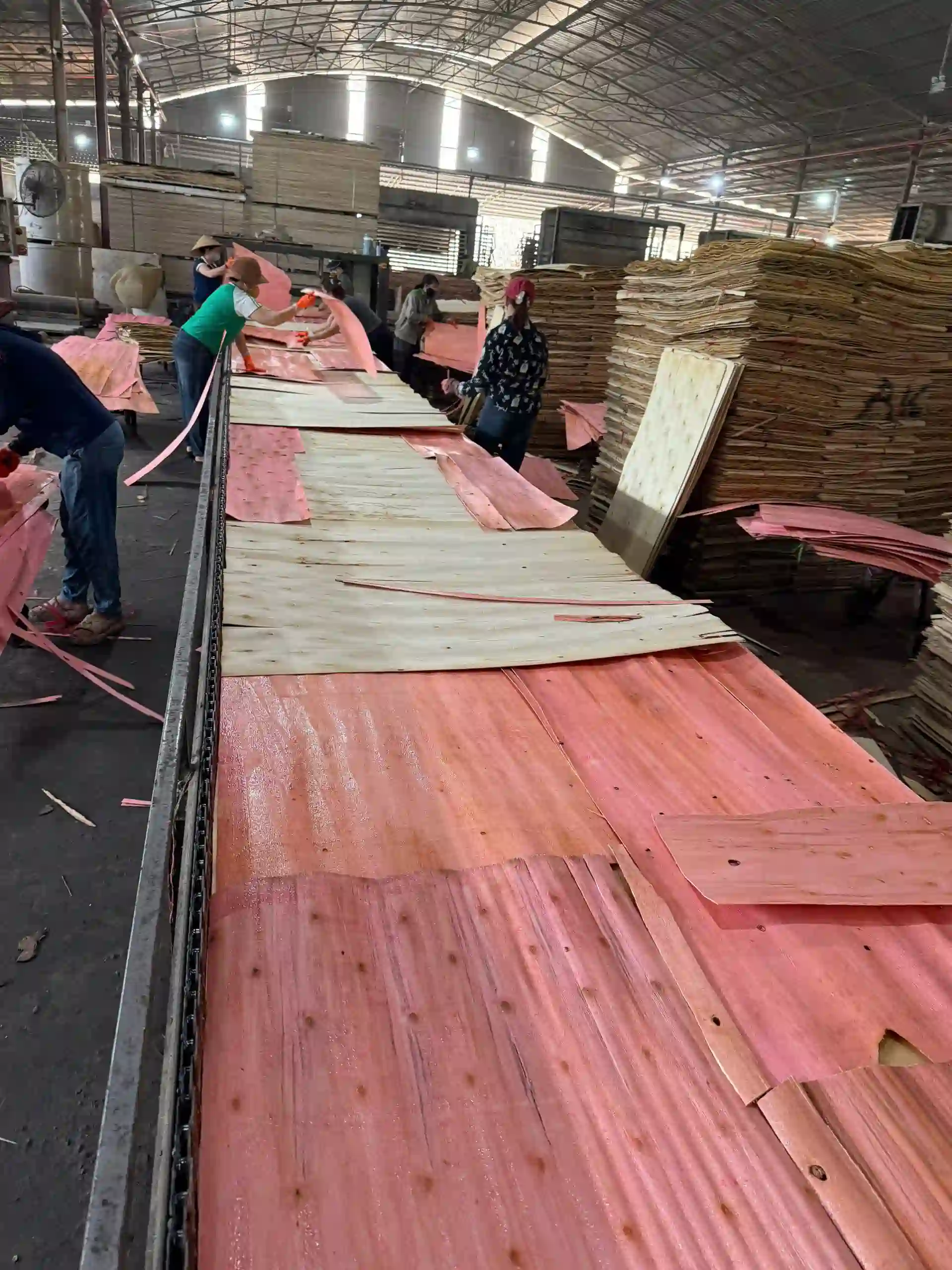
⚠️ Important: Ordering “sanded” panels on 0.2mm face veneer is a specification conflict. The factory may complete the sand — but you receive panels with minimal face remaining. Any downstream sanding by a furniture manufacturer will break through to core. Specify starting face thickness, not just “sanded.”
“When a buyer requests birch panels sanded to F18 Japan standard, we always confirm 0.4mm starting face. The sanding specification and face thickness specification are linked — you cannot achieve clean sanded finish on 0.2mm starting material.” — Jay, International Sales Manager, Mika Plywood
🌲 Which Face Species Justify 0.4mm Thickness
Not all species benefit equally from 0.4mm face. The investment makes most sense when the face species has commercial value that downstream sanding could damage.
Birch (Grade D/E/F)
Birch face veneer commands the highest price of any species in Vietnamese export production. D-grade birch produces tight, pale, consistent surfaces for premium European furniture. Shipping birch on thin 0.2mm face wastes the species premium — cabinet factories receiving 0.2mm birch cannot sand without risk, negating the reason they chose birch. Standard for birch plywood exported from Vietnam at Mika Plywood is 0.3–0.4mm starting face.
Gurjan
Gurjan’s density and hardwood grain make it the dominant premium face for Indian furniture and South Asian marine applications. At 0.4mm, gurjan shows deeper color saturation and more pronounced interlocked grain figure. Indian importers specifying gurjan for interior paneling frequently request 0.35–0.4mm face explicitly.
EV (Engineered Veneer)
EV uses reconstituted wood fiber pressed into consistent grain sheets. Its value proposition is perfect grain uniformity — a quality visible only on sanded surfaces. At 0.2mm, EV panels risk exposing backing fiber through thin spots. At 0.4mm, EV delivers its core quality promise without compromise.
Okoume and Bintangor (selective)
Okoume and bintangor at 0.4mm are less common but make sense for high-end applications demanding re-sand margin — furniture restoration stock, premium packaging with visible face, architectural panels. Mass-market okoume or bintangor for Indian or Southeast Asian commercial furniture typically ships at 0.2–0.3mm without penalty.
📊 Price Impact: Thickness vs Species vs Core
Buyers new to face veneer specification often assume 0.4mm doubles the face cost. The math is more modest.
Face veneer is a thin fraction of total panel material. On 18mm plywood, 0.4mm face on both sides equals 0.8mm of face material out of 18mm total — 4.4% of panel depth. Moving from 0.2mm to 0.4mm face veneer roughly doubles face material volume but represents approximately USD 2–5 per CBM increase in FOB price at standard commercial volume (Mika Plywood production data, 2026).
Compare this to other specification changes on the same panel:
| Spec Change | Approx. FOB Impact (per CBM) |
|---|---|
| Face 0.2mm → 0.4mm (same species) | +USD 2–5 |
| Bintangor face → Okoume face | +USD 8–15 |
| Bintangor face → Birch D/E face | +USD 30–60 |
| Acacia core → Styrax core | +USD 8–15 |
| Loose-lay core → Full stitched core | +USD 10–20 |
| Melamine MR → Phenolic WBP glue | +USD 5–12 |
0.4mm face veneer is the lowest-cost quality upgrade available in plywood specification. As a premium face veneer plywood option, it adds less than 3% to FOB price on most grades while eliminating a significant downstream risk for furniture manufacturers.
For premium species panels — birch, gurjan, EV — the cost difference is even more negligible as a percentage of total FOB because these species already carry a substantial face premium.
Get a factory-direct quote with 0.4mm face thickness included — Mika Plywood specifies face thickness on every order confirmation as standard practice.
🏭 How Factories Control 0.4mm Face Veneer Consistency
Target thickness on the peeling knife is set to 0.4mm ± 0.03mm. This is tighter than the industry standard ± 0.05mm because furniture-grade panels destined for two-stage sanding cannot absorb variation beyond 7.5%.
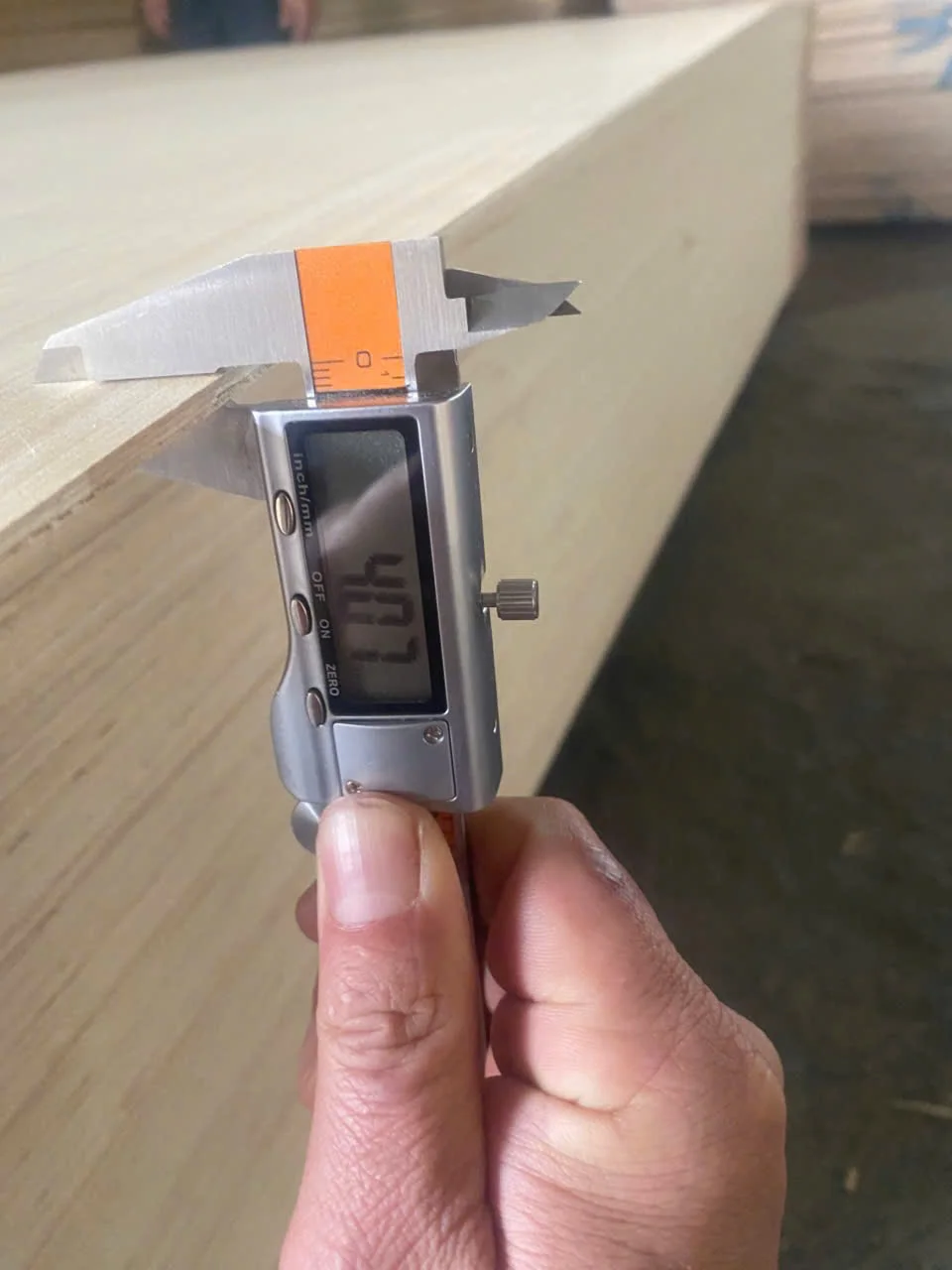
Veneer sheets are batch-tested with digital calipers at three points per sheet — center, left quarter, right quarter. This three-point protocol catches taper variation that occurs naturally as the log diameter decreases toward the core. Near-core veneer is inherently thinner for a given knife setting.
Sheets measuring below 0.37mm on a 0.4mm target are rejected from face-grade stock and redirected to core applications. This 7.5% rejection threshold is documented per batch and reported in the QC package accompanying each shipment.
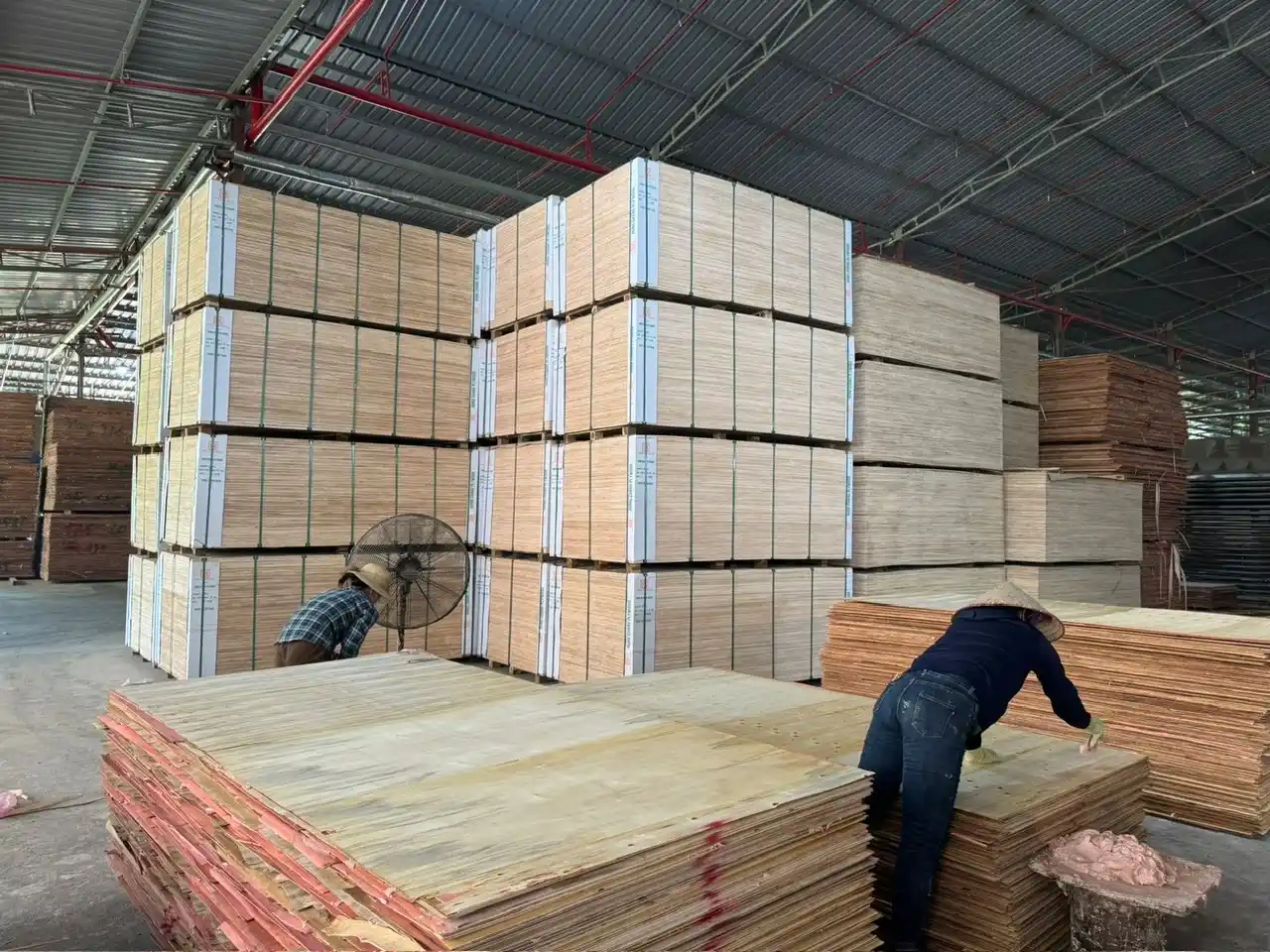
Before container loading, face thickness is re-measured on 5% of sheets per pallet — a frequency aligned with Mika Plywood’s ISO 9001 quality management system requirements (ISO 9001, 2015 revision). Results form part of the shipping QC documentation available to buyers on request.
This level of control matters because face thickness is not visible from the finished panel surface. Without documented QC data, a buyer receiving “0.4mm face” panels has no verification that the target was met across the batch. Requesting thickness measurement data in the QC package is standard procedure for any premium furniture specification.
📋 How to Specify 0.4mm Face Veneer in a Purchase Order
Face veneer thickness rarely appears on standard quotation sheets. Factories issue price per CBM against a species and grade — face thickness is assumed at their default unless you specify otherwise.
Recommended specification wording:
Face veneer: [Species] [Grade], starting (pre-sand) thickness 0.38–0.42mm
Post-sanding face thickness: minimum 0.25mm
Sanding: Two-stage (calibration + finish)
QC documentation: Face thickness measurement report per batch
Additional parameters to confirm in writing:
- Moisture content of face veneer: Target 6–8% before pressing (Mika Plywood internal standard)
- Batch origin certificate: For premium species (birch, gurjan), request veneer origin statement to confirm imported species identity
- Rejection protocol: Confirm supplier’s rejection threshold for thin-face sheets — ask for the written QC standard, not verbal assurance
- Field re-sand allowance: State whether downstream manufacturing requires field re-sand capability, so supplier can confirm post-sand face remaining
For reference, the full plywood face veneer types guide covers species selection across all face options. The plywood face grade explained guide covers A/B and D/E/F grading systems relevant to birch specification. And for overall panel sizes and board-level thickness tolerances, see the plywood sizes and thickness specification guide.
🔍 0.4mm Face vs Standard Faces — Side-by-Side Summary
| Attribute | 0.2mm Standard Face | 0.4mm Premium Face |
|---|---|---|
| Sanding margin after 2-stage factory sand | 0.05–0.10mm | 0.25–0.30mm |
| Field re-sand by downstream manufacturer | Not possible | 1× careful re-sand |
| Grain depth and visual richness | Moderate | Stronger — more subsurface structure |
| Stain absorption consistency | Variable | More consistent |
| Core color bleed-through (light species) | Risk on thin spots | Eliminated at full thickness |
| FOB price premium vs 0.2mm | Baseline | +USD 2–5/CBM |
| Typical species | Bintangor, okoume budget | Birch D/E/F, gurjan, EV, premium okoume |
| Suitable for export to EU/Korea/Japan | Risk without QC | Standard specification |
✅ Conclusion: When to Specify 0.4mm Face
0.4mm face veneer is not universal — it is a specification decision based on application.
Specify 0.4mm face when:
- Downstream manufacturing includes sanding, staining, or lacquering
- End market is EU, Korea, Japan, or any market with high surface quality expectations
- Face species is birch, gurjan, or EV where species value justifies protection
- Customer orders require field re-sand capability after installation
- QC documentation with face thickness data is required by the import order
0.2–0.3mm face is adequate when:
- Panels are used as packing substrate or structural material where face is not visible
- Budget commercial applications in price-sensitive markets (India bulk commercial, Southeast Asia)
- Downstream lamination covers the face — surface quality before lamination is irrelevant
The cost to upgrade from 0.2mm to 0.4mm face is USD 2–5 per CBM. The cost of receiving a container of birch panels with sand-through defects is a full container rejection claim plus replacement lead time. For any premium face veneer plywood application where sanding or surface finish is part of production, the specification decision is straightforward.
Contact Mika Plywood to request 0.4mm face veneer samples with thickness measurement certificates — factory-direct pricing, standard lead time 15–20 days from order confirmation.
Disclosure: This article is published by Mika Plywood, a Vietnam-based plywood manufacturer and export operator. While we aim to provide objective industry guidance, readers should consider our perspective as a market participant when evaluating recommendations.
🔗 Related Articles
- Plywood Face Veneer Types — Complete Buyer Guide — all face species compared with price tiers and applications
- Plywood Face Veneer Thickness Guide: 0.2–0.4mm Standard — full range from budget to premium explained
- Birch Plywood Vietnam — Premium D/E/F Grade Manufacturer — primary species where 0.4mm face is standard
- Plywood Face Grade Explained — A/B vs D/E/F grading systems for face veneer
Frequently Asked Questions
What does 0.4mm thick veneer face mean in plywood?0.4mm face veneer is the thickest standard face veneer applied in Vietnamese commercial plywood production. It provides a sanding margin of 0.25–0.30mm after two-stage factory sanding — enough for one field re-sand if downstream furniture factories need to refinish. Panels with 0.2mm face lack this margin and cannot be safely re-sanded.Which plywood species typically come with 0.4mm face veneer?Premium species that justify 0.4mm face include birch (grade D/E/F), gurjan, and EV (engineered veneer). These species are used in high-end furniture where surface quality determines product value. Budget species like bintangor are frequently shipped at 0.2–0.3mm because downstream applications don't demand re-sanding.Does 0.4mm face veneer cost significantly more?The price difference between 0.2mm and 0.4mm face veneer is approximately USD 2–5 per CBM at factory level (Mika Plywood production data, 2026). This is minor compared to species premium (birch vs bintangor face adds USD 30–60/CBM) or core upgrade (acacia to styrax adds USD 8–15/CBM). Specifying 0.4mm on a premium species panel adds less than 3% to FOB cost.Can I specify 0.4mm face veneer on any species?Yes. Face thickness is independent of face species — you can request 0.4mm on bintangor, okoume, birch, gurjan, or EV face. The factory adjusts peeling knife advance to hit the thickness target. However, 0.4mm makes most economic sense on premium species that will receive further sanding or finishing. On packing-grade bintangor destined for crates, the extra thickness adds cost with no functional benefit.How do I verify 0.4mm face thickness in a factory inspection?Request a pre-shipment digital caliper measurement of face veneer before pressing — loose veneer sheets can be measured directly. After pressing, the sanded panel face can be measured by cross-section micro-cut at the edge. Mika Plywood provides face thickness measurement data as part of the QC package, measured at three points per sheet (center and both quarter-points).
Ready to order?
Request 0.4mm face veneer samples with thickness certification

Written by
David
Export Project Leader
Content contributor at Vietnam Plywood.
On this page
- 📐 What 0.4mm Face Veneer Actually Means
- 🔧 Why Sanding Margin Is the Critical Benefit
- 🌲 Which Face Species Justify 0.4mm Thickness
- 📊 Price Impact: Thickness vs Species vs Core
- 🏭 How Factories Control 0.4mm Face Veneer Consistency
- 📋 How to Specify 0.4mm Face Veneer in a Purchase Order
- 🔍 0.4mm Face vs Standard Faces — Side-by-Side Summary
- ✅ Conclusion: When to Specify 0.4mm Face
- 🔗 Related Articles
On this page
- 📐 What 0.4mm Face Veneer Actually Means
- 🔧 Why Sanding Margin Is the Critical Benefit
- 🌲 Which Face Species Justify 0.4mm Thickness
- 📊 Price Impact: Thickness vs Species vs Core
- 🏭 How Factories Control 0.4mm Face Veneer Consistency
- 📋 How to Specify 0.4mm Face Veneer in a Purchase Order
- 🔍 0.4mm Face vs Standard Faces — Side-by-Side Summary
- ✅ Conclusion: When to Specify 0.4mm Face
- 🔗 Related Articles
Industry Newsletter
Stay Updated with
Plywood Industry Insights
Factory prices, spec guides, market trends and export tips — delivered weekly to B2B buyers and importers in 20+ countries.