How okoume plywood is made in Vietnam — 7 factory steps, QC checkpoints, export specs, and certifications. For buyers sourcing from Vietnamese factories.
Vietnam exported over 11 million cubic metres of wood-based panels in 2024 (FAO, 2024). Okoume plywood manufacturing accounts for a growing share of that volume as European and furniture-segment buyers shift away from tropical hardwood faces toward lighter, more sustainable alternatives. For the best face veneers for export-quality plywood from Vietnam, see our comparison guide. Mika Plywood’s furniture-grade production facility in Phu Tho province processes okoume face veneer daily — running 50-100 containers per month across all product lines (Mika Plywood production data, 2026).
This article walks through all 7 factory steps of okoume plywood manufacturing as they happen on the production floor. Each of these steps includes the process parameters, quality checkpoints, and the specific tolerances that separate export-grade panels from rejects.
🔧 What Is Okoume Plywood? Okoume Plywood Manufacturing Basics
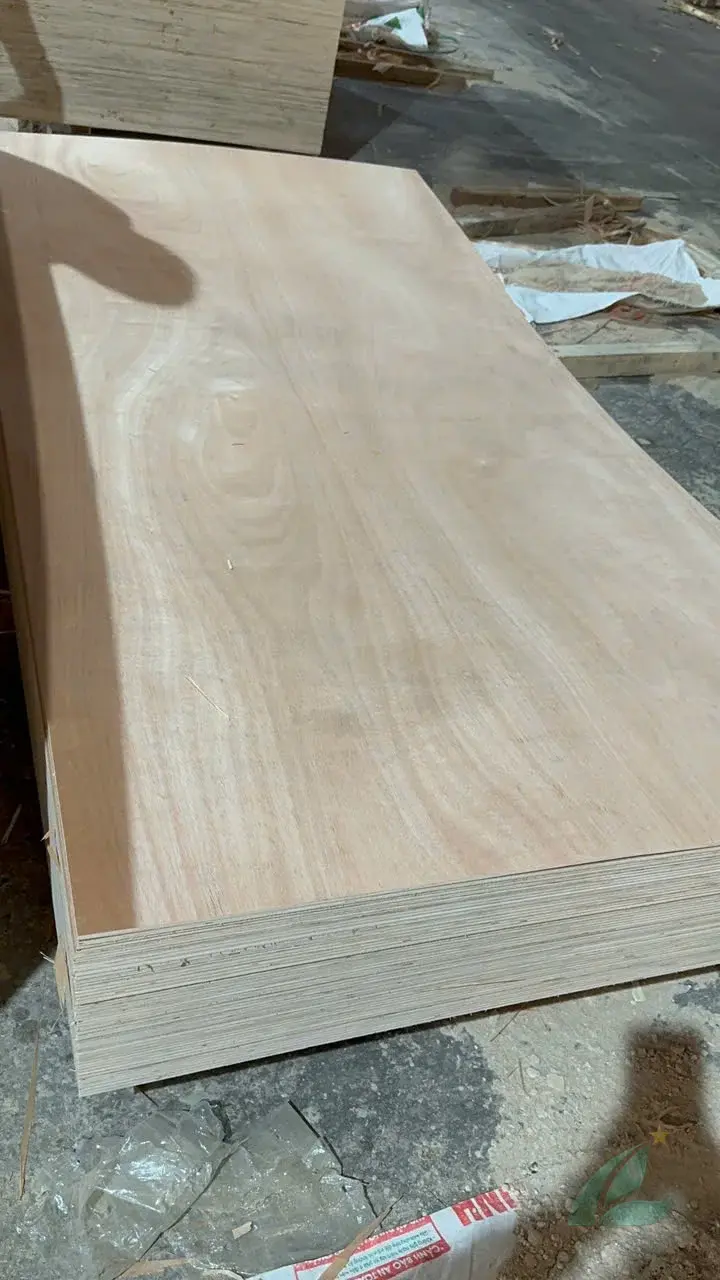
Okoume plywood is a panel product with okoume (Aucoumea klaineana) face veneer bonded to a multi-layer hardwood core. The okoume tree is native to Central Africa — primarily Gabon, which controls over 70% of global okoume log supply (ITTO Tropical Timber Market Report, 2024).
Vietnam does not grow okoume. Vietnamese factories import okoume veneer from Gabon and bond it to locally grown core species: styrax (480-500 kg/m³) or eucalyptus (650-750 kg/m³). This combination delivers a panel with an attractive, lightweight face and a structurally sound Vietnamese hardwood core.
📌 Okoume Plywood Quick Specifications
| Parameter | Value |
|---|---|
| Face veneer | Okoume, Grade A/B |
| Face thickness | 0.2-0.4 mm |
| Core species | Styrax or eucalyptus |
| Glue options | Melamine (MR) or Phenolic (WBP) |
| Emission standards | E0, E1, E2 available |
| Panel thickness | 3-30 mm |
| Standard sizes | 1220×2440 mm, 1250×2500 mm |
| Thickness tolerance | ±0.3 mm |
| Sanding | Yes (furniture grade) |
| Certifications | FSC, CARB P2, CE, EUDR |
Key Insight: Okoume face is the second most popular veneer at Mika Plywood after bintangor plywood — but okoume commands a USD 5-12 per CBM premium because the veneer is imported from Africa rather than sourced regionally (Mika Plywood production data, 2026).
🏭 Step 1 — Okoume Veneer Reception & Grading
Okoume plywood manufacturing starts before the press line — at the incoming veneer inspection station. Okoume face veneer arrives at the Mika Plywood facility in pre-sliced sheets from Gabon-based processors. Each shipment is inspected against four criteria before it enters the production queue.
Veneer grading checklist:
- Color consistency — Okoume ranges from pale pink to light salmon. Sheets with dark mineral streaks or discoloration beyond 10% of surface area are sorted to B grade
- Thickness uniformity — Target 0.2-0.4 mm, measured with digital calipers at 5 points per sheet. Deviation beyond ±0.05 mm triggers regrading
- Moisture content — Incoming veneer must read 6-10% on a pin-type moisture meter. Above 10% requires additional drying before pressing
- Physical defects — Splits, knotholes, worm trails, and bark inclusions. Grade A allows zero open defects on the face
“We reject approximately 3-5% of incoming okoume veneer at reception — mainly for color variation and moisture above 10%. Catching these issues before pressing saves us from rejecting finished panels later.” — Jay, International Sales Manager, Mika Plywood
⚙️ Step 2 — Core Veneer Preparation & Drying
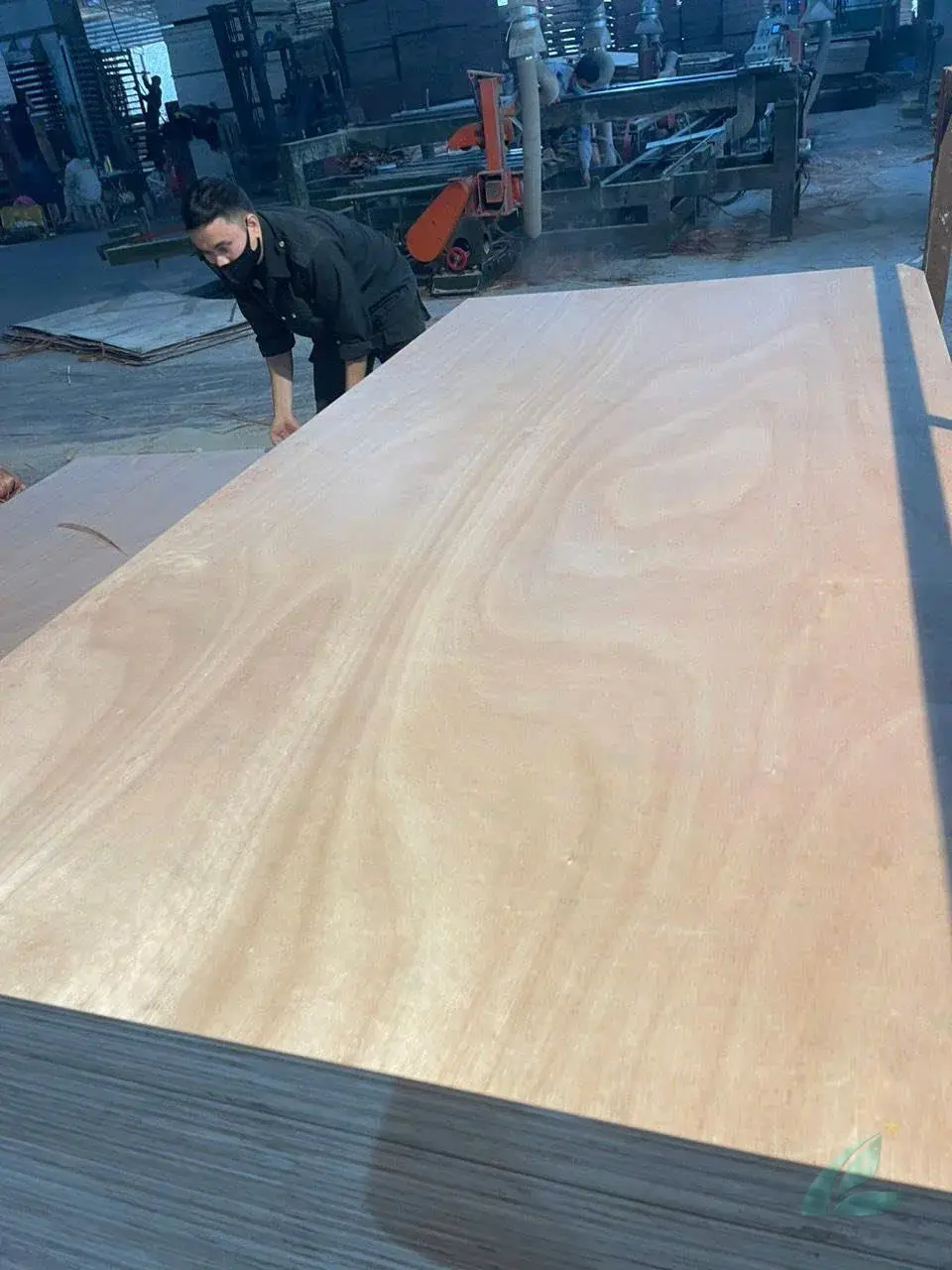
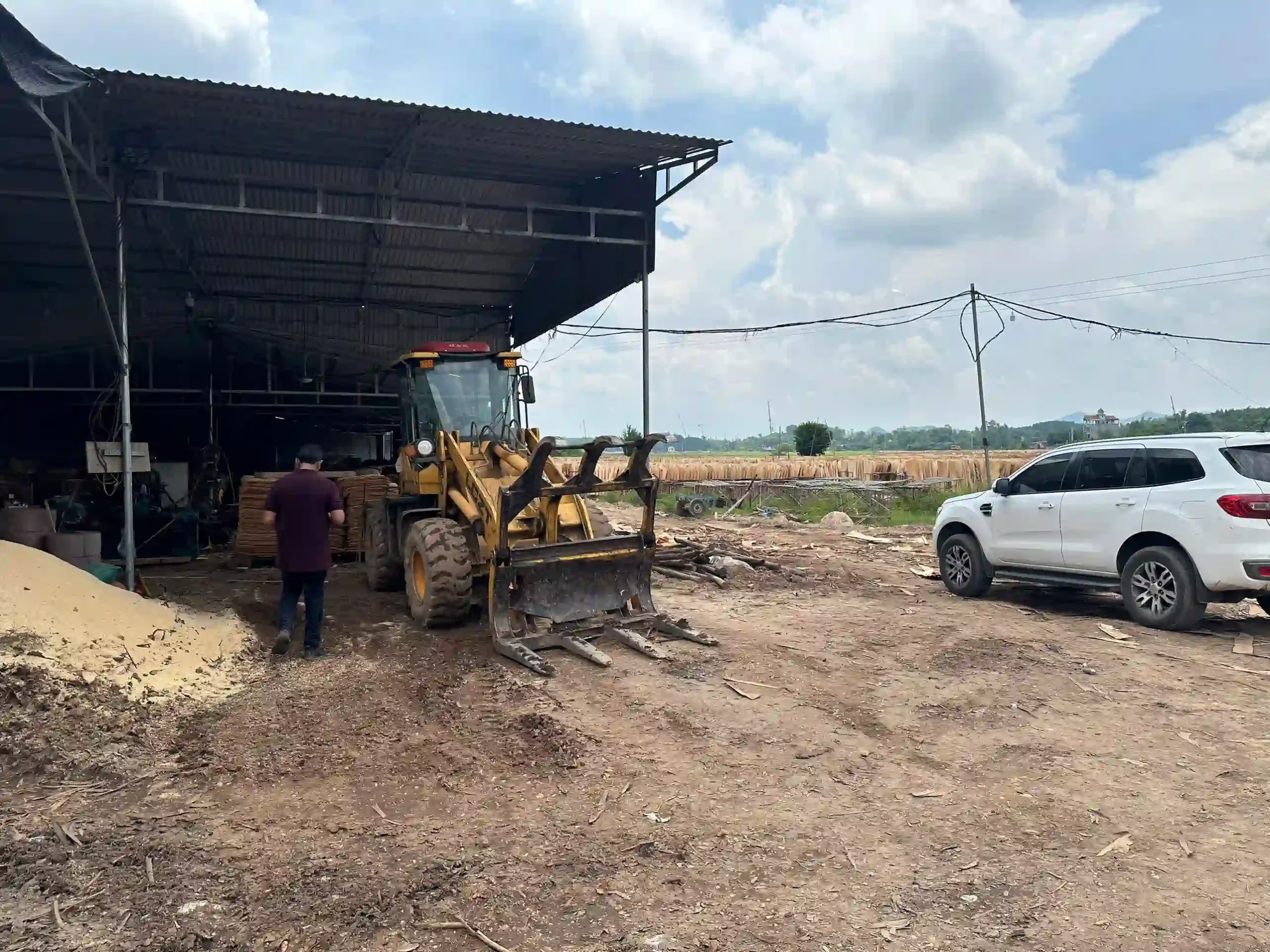
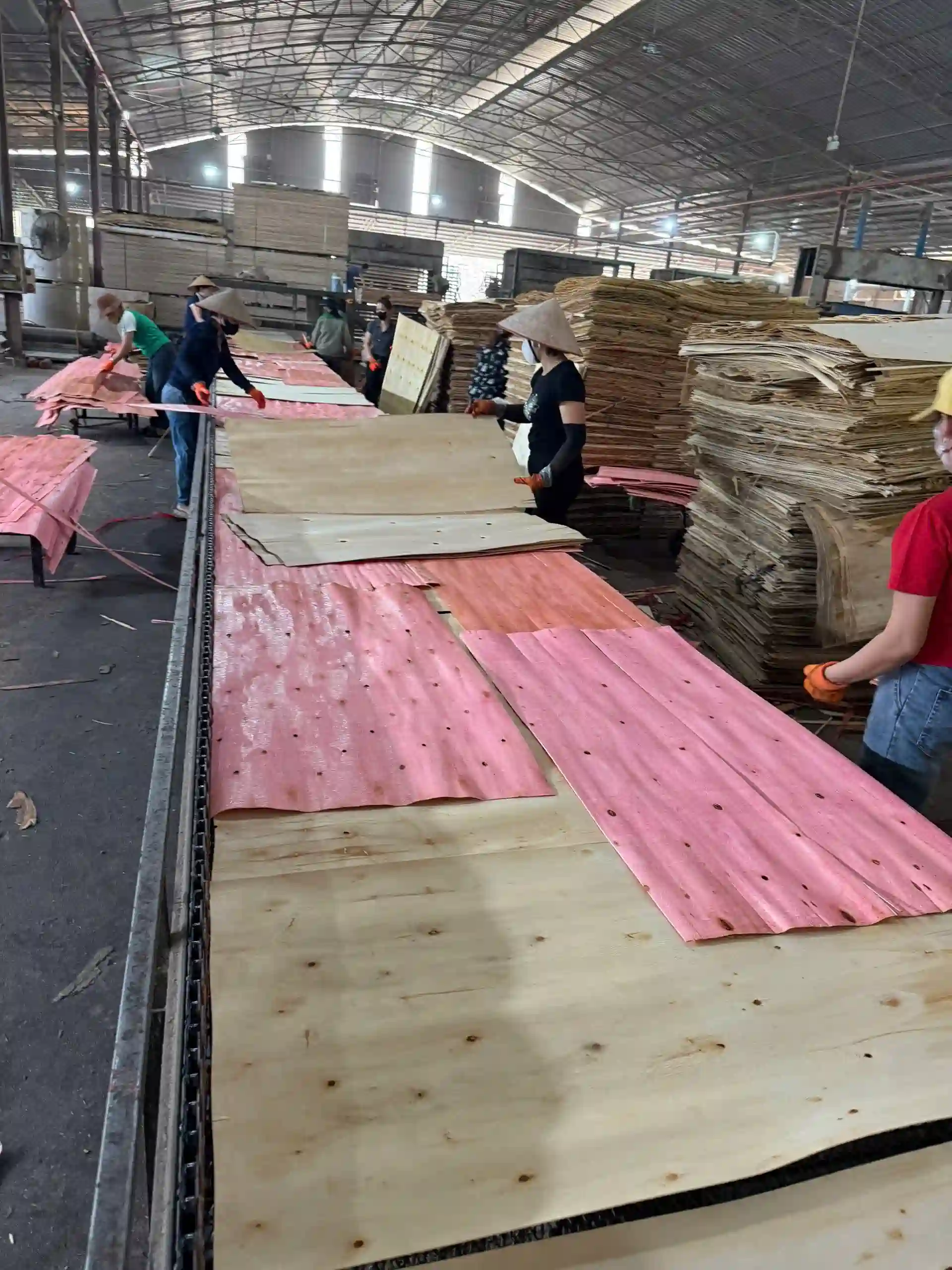
While okoume face veneer is imported, core veneer is produced on-site. Mika Plywood’s core veneer production line processes local hardwood logs into rotary-peeled sheets that form the structural backbone of every panel.
Core preparation process:
- Log debarking and conditioning — Logs are soaked in hot water (60-80 degrees Celsius) for 8-24 hours to soften fibres
- Rotary peeling — A lathe spins the log against a fixed blade, peeling continuous veneer at 1.2-2.0 mm thickness
- Clipping and sorting — Continuous veneer ribbon is cut to sheet size, sorted by quality
- Drying — Core sheets enter a roller dryer at 160-180 degrees Celsius until moisture content reaches 6-10%
📌 Core Construction Quality Levels
| Construction | Method | Quality | Cost |
|---|---|---|---|
| Full stitched | Thread-sewn across full sheet | Highest — no gaps | Highest |
| Stitched outer + trimmed inner | Outer plies stitched, inner edge-trimmed | Good balance | Medium |
| Finger-jointed | Interlocking teeth | Adequate | Medium |
| Loose-laid | Sheets stacked without joining | Lowest | Lowest |
For furniture-grade okoume plywood, Mika Plywood uses full stitched or stitched-outer core construction. This eliminates the gaps and overlaps that cause surface telegraphing — visible bumps that show through the thin 0.2-0.4 mm okoume face.
📐 Step 3 — Glue Mixing & Application
Adhesive selection determines whether the finished okoume plywood is rated for interior furniture or exterior marine applications. Two glue systems are used in okoume plywood manufacturing at Mika Plywood.
Melamine (MR) glue — interior/furniture grade:
- Passes 12-hour boiling water test
- Emission available at E0 (below 0.05 ppm formaldehyde), E1, or E2
- Spread rate: 180-220 g/m² (Mika Plywood production data, 2026)
- Suitable for furniture, cabinetry, interior paneling
Phenolic (WBP) glue — exterior/marine grade:
- Passes 72-hour boiling water test
- Inherently low formaldehyde emission
- Spread rate: 200-240 g/m²
- Required for marine, construction, and moisture-exposed applications
⚠️ Important: Glue type (Melamine/Phenolic) and emission class (E0/E1/E2) are separate specifications. “WBP E0” or “MR glue” are the correct pairings. Buyers who confuse these two parameters risk ordering panels that fail either the bonding test or the emission test at destination.
The glue mixing station combines resin, hardener, and filler in calibrated proportions. A glue roller machine applies adhesive to both sides of each core veneer sheet at controlled thickness. Uneven application — too thin causes delamination, too thick causes bleed-through on the face.
📌 How Glue Choice Affects Okoume Plywood Pricing
Phenolic (WBP) glue costs 20-30% more than melamine (MR) per kilogram of resin. For a standard 18 mm okoume panel, the glue cost difference translates to approximately USD 3-5 per CBM at factory level. Buyers ordering for interior furniture applications rarely need WBP bonding — MR with E0 emission satisfies EU and US market requirements at lower cost. Marine and construction buyers should always specify WBP to prevent bonding failure in wet service conditions.
CARB P2 compliance (required for US import since the TSCA Title VI enforcement in 2018) adds approximately USD 2-3 per CBM in testing and documentation costs (US EPA, 2023). This applies regardless of whether the buyer selects MR or WBP glue.
🔥 Step 4 — Assembly, Cold Press & Hot Press
This is the stage where okoume plywood manufacturing transforms loose sheets into a bonded structural panel. Assembly follows a strict layering sequence.
Assembly rules:
- Odd number of plies (3, 5, 7, 9, 11 depending on thickness)
- Cross-grain orientation — each ply rotated 90 degrees from the adjacent ply
- Okoume face veneer placed grain-parallel to the long dimension of the panel
- Back veneer matched to similar species and thickness as the face
Cold press (pre-press):
- Duration: 20-40 minutes at room temperature
- Purpose: Initial adhesive tack, removes trapped air between plies
- Pressure: 5-8 kg/cm²
Hot press:
- Temperature: 110-120 degrees Celsius for melamine, 130-135 degrees Celsius for phenolic
- Duration: 8-12 minutes (varies by thickness and ply count)
- Pressure: 10-14 kg/cm²
- The press opens, and panels move to cooling racks before trimming
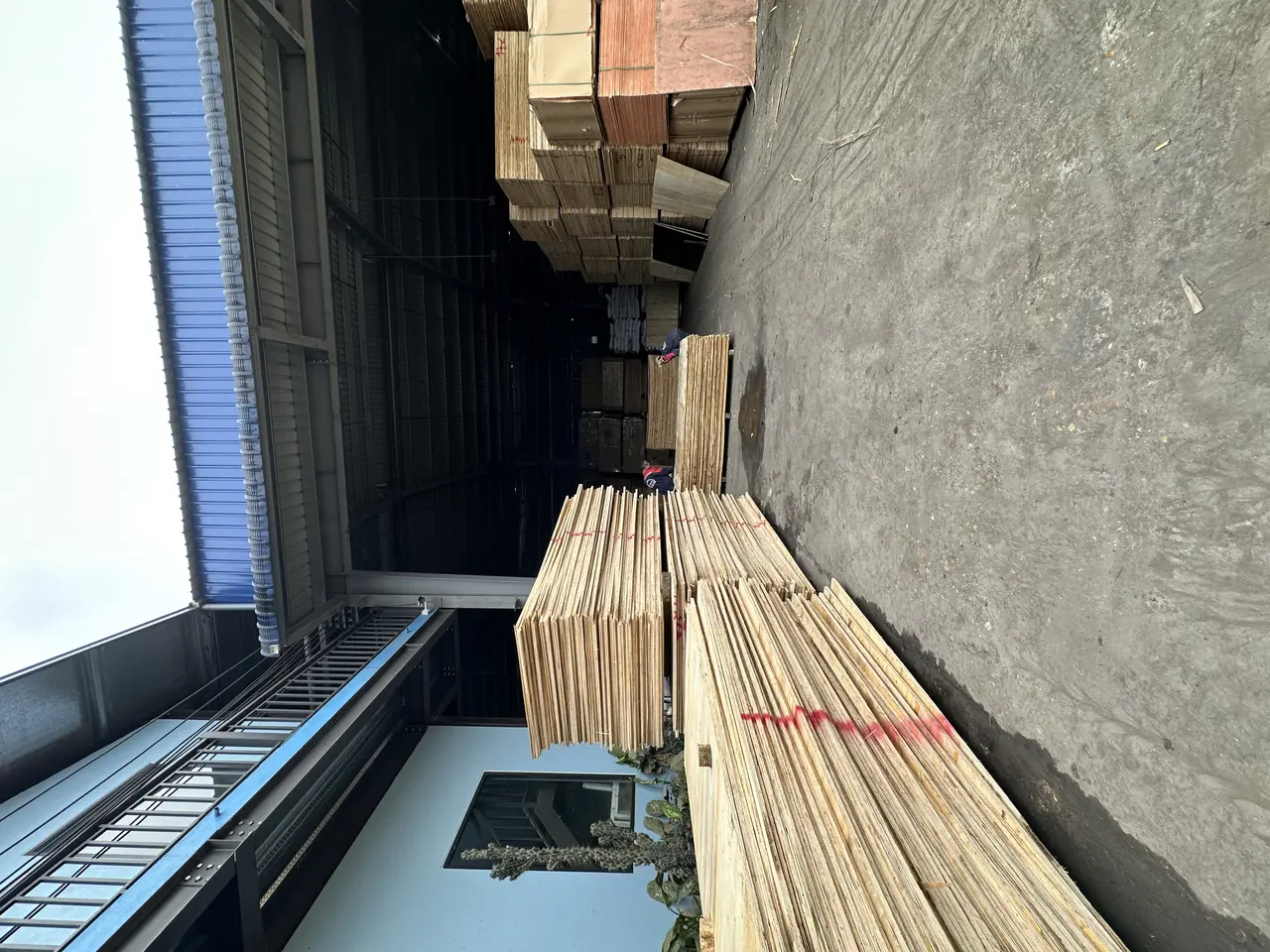
Temperature monitoring is continuous. Thermocouples embedded in the press platens feed data to a PLC controller. If any zone drops below minimum temperature, the press cycle extends automatically. Under-cured adhesive is the root cause of field delamination — and the single largest warranty claim in the plywood export business.
The cross-grain assembly method is what gives plywood its dimensional stability advantage over solid wood. Each ply counteracts the expansion and shrinkage forces of adjacent plies. For okoume plywood manufacturing, this cross-lamination is particularly important because the thin okoume face veneer (0.2-0.4 mm) would crack under seasonal moisture cycling if the core did not provide structural resistance in both directions.
Request Okoume Plywood Specifications & Pricing — free samples, no commitment required.
📋 Step 5 — Trimming, Sanding & Surface Finishing
After the press, raw panels require finishing before they meet export specification.
Trimming:
- Edge saws cut panels to final dimensions: 1220×2440 mm or 1250×2500 mm
- Dimensional tolerance: ±2 mm on length and width
- Square-check: diagonal measurement difference must be below 3 mm
Sanding (furniture grade):
- Wide-belt sander with 3 heads: coarse (80 grit), medium (120 grit), fine (150-180 grit)
- Final surface roughness target: Ra below 12 micrometres
- Sanding removes 0.2-0.5 mm from total thickness — accounted for in initial layup
- Okoume face veneer thickness after sanding: 0.15-0.35 mm effective
Surface quality check:
- Visual inspection under raking light (45-degree angle fluorescent)
- Checks for sanding marks, face cracks, veneer patches, bleed-through
- Each panel stamped with grade mark: A/B (both sides graded), or A/B back (front face A, back face B)
Key Insight: Unlike film-faced plywood or packing plywood, furniture-grade okoume panels are ALWAYS sanded. Unsanded okoume exists only as a substrate for lamination or overlay — not as a finished product.
✅ Step 6 — Quality Control & Export Inspection
Quality control in okoume plywood manufacturing spans every step described above — but the final pre-shipment inspection is where pass/fail decisions happen. Mika Plywood’s QC team inspects against an 8-point checklist before any panel enters the packing station.
📌 8-Point Export QC Checklist
| Check | Method | Pass Criteria |
|---|---|---|
| 1. Thickness | Digital caliper, 5 points per panel | ±0.3 mm of target |
| 2. Dimensions | Tape measure at 3 locations | ±2 mm of nominal |
| 3. Squareness | Diagonal measurement | Difference below 3 mm |
| 4. Surface | Visual under raking light | No cracks, patches, or bleed-through |
| 5. Bonding | Boiling water test (sample basis) | MR: 12h, WBP: 72h — no delamination |
| 6. Moisture | Pin moisture meter, 3 points | 8-12% |
| 7. Emission | Lab test (batch certificate) | E0/E1/E2 per order spec |
| 8. Face grade | Visual grading per customer standard | A/B or as ordered |
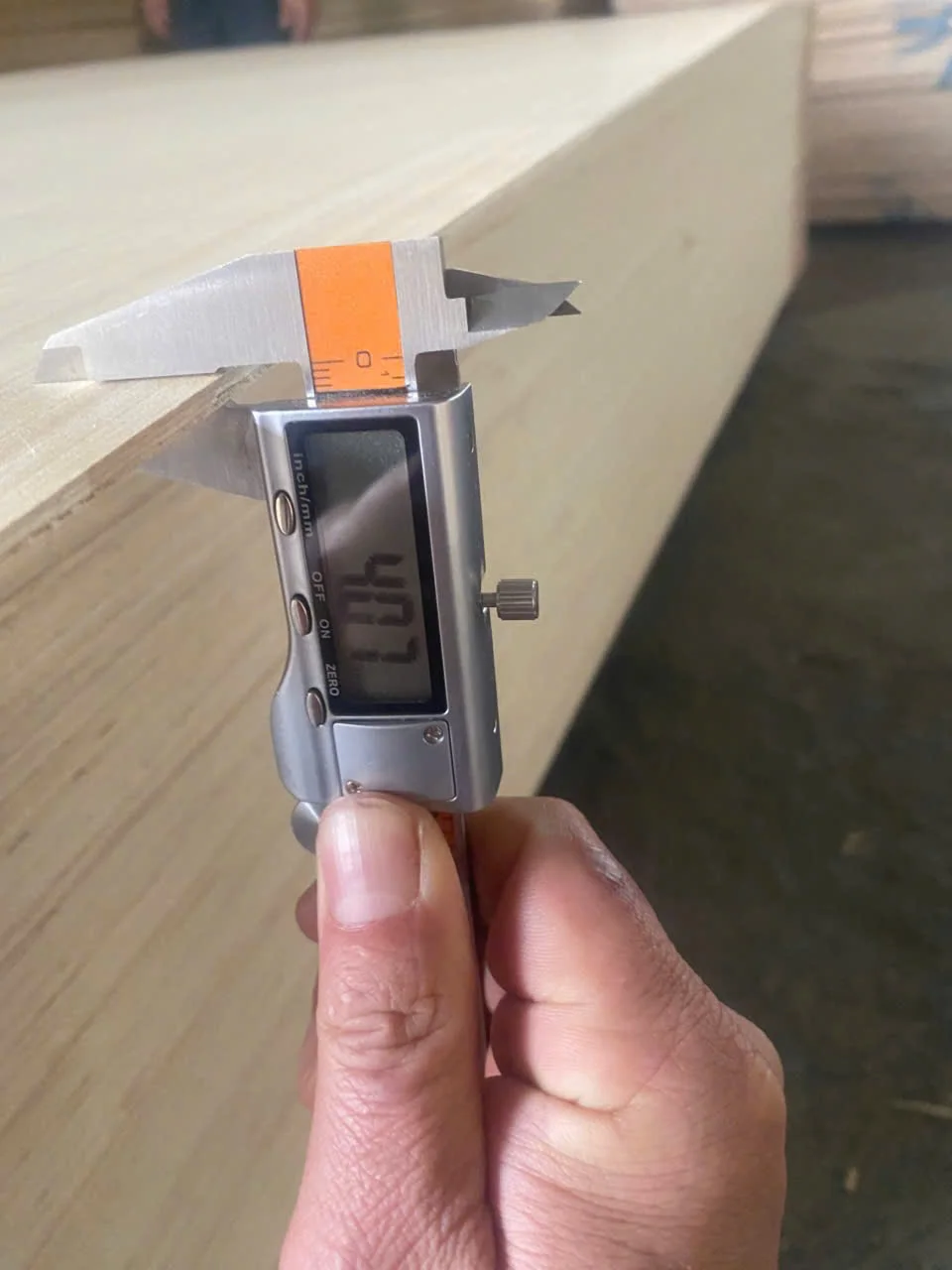
Rejection at this stage triggers one of three outcomes: downgrade to lower face grade, reclassify to commercial/packing use, or scrap. Mika Plywood’s overall rejection rate on okoume lines runs 2-4% — with face veneer cracking as the primary cause (Mika Plywood production data, 2026).
Certification documents issued per shipment:
- FSC Chain of Custody certificate (CoC)
- CARB P2 test report (formaldehyde emission)
- CE declaration of conformity
- EUDR due diligence documentation
- Phytosanitary certificate, fumigation certificate, certificate of origin, commercial invoice, packing list, bill of lading
For detailed certification requirements by market, see the plywood certifications guide.
📦 Step 7 — Packing & Container Loading
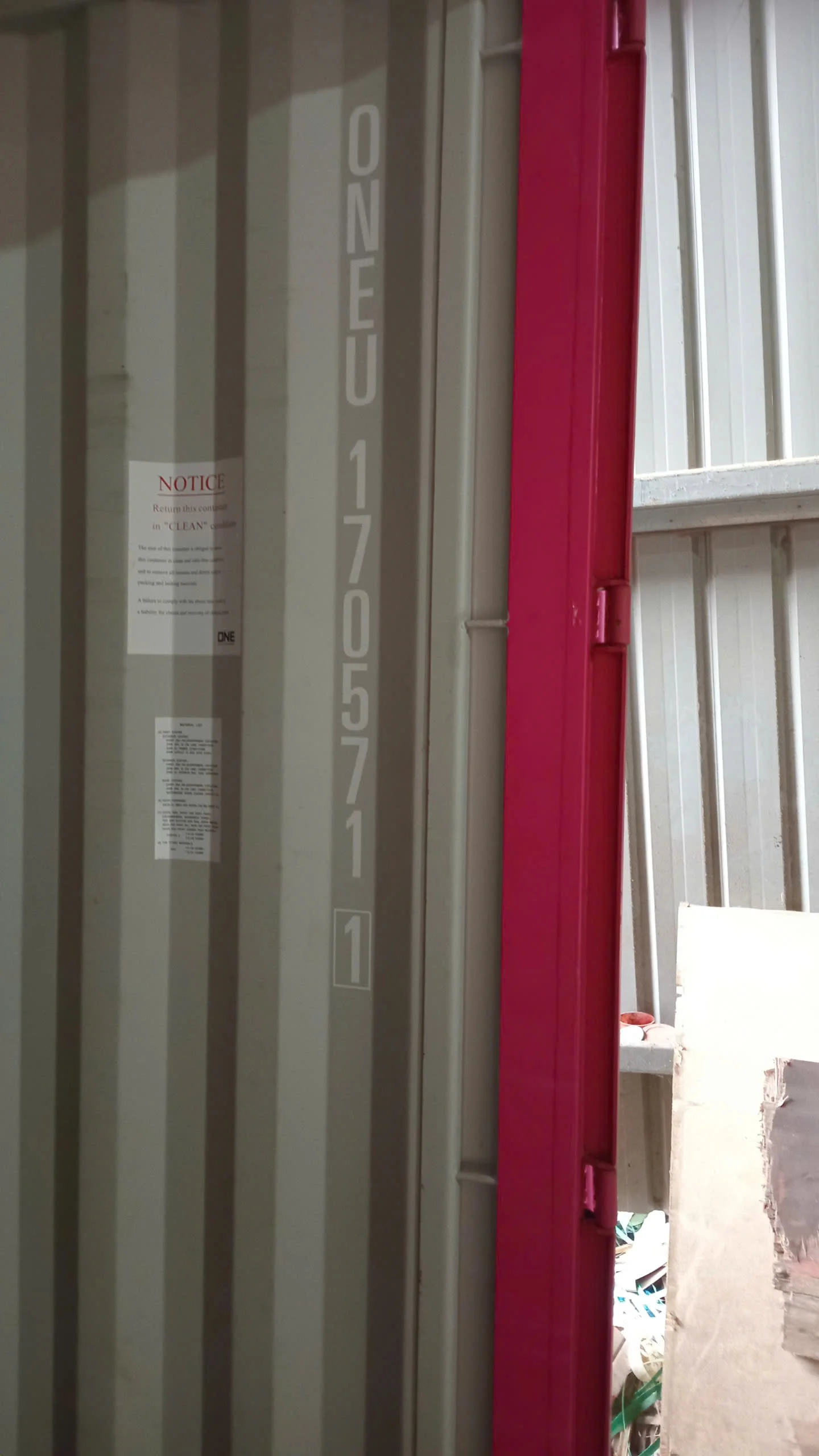
The final stage of okoume plywood manufacturing is packing and loading. Panel protection during ocean transit determines whether the buyer receives the same quality that left the factory.
Packing standard:
- Panels stacked face-to-face (protecting okoume surface)
- Hardboard or plywood edge protectors on all four sides
- Steel strapping: minimum 3 bands per pallet
- Waterproof wrapping: PE shrink wrap or stretch film
- Pallet height: 1000 mm maximum (forklift-safe, structurally stable)
Container loading for okoume plywood (1220×2440 mm):
| Core Species | Density | Pallets per 40HC | CBM per 40HC | Weight per 40HC |
|---|---|---|---|---|
| Styrax | 480-500 kg/m³ | 18 | ~53 CBM | ~26.5 MT |
| Eucalyptus | 650-750 kg/m³ | 15 | ~44.5 CBM | ~28 MT |
Styrax core okoume plywood ships the most volume per container — 18 pallets versus 15 for eucalyptus core. For buyers optimizing landed cost per sheet, styrax core reduces freight cost per unit by approximately 15-20% compared to eucalyptus core.
Maximum payload for a 40HC container is 28.5 MT (hard stop). Eucalyptus core okoume plywood approaches this limit at 15 pallets. Adding a 16th pallet of eucalyptus core risks exceeding the weight limit and incurring overweight penalties at port.
For detailed packing calculations by thickness and core species, see the container packing calculation guide.
🌍 Okoume Plywood Applications & Market Demand
Okoume plywood manufacturing serves three primary market segments, each with distinct specification requirements.
Furniture & cabinetry (Europe, Korea, Japan):
- Face: Okoume A/B, 0.3-0.4 mm
- Core: Styrax, full stitched
- Glue: Melamine (MR), E0 or E1
- Thickness: 9-18 mm
- Sanded on both faces
Marine & boat building:
- Face: Okoume A/B, 0.3-0.4 mm
- Core: Eucalyptus for maximum strength
- Glue: Phenolic (WBP)
- Thickness: 6-25 mm
- Sanded, sealed edges recommended
Interior paneling & doors:
- Face: Okoume A/B, 0.2-0.3 mm
- Core: Styrax (lightweight for wall mounting)
- Glue: Melamine (MR), E0 or E1
- Thickness: 3-9 mm
- Sanded one face, calibrated back
Okoume plywood’s natural pink-salmon color and fine grain make it a preferred choice for visible applications where the panel face remains exposed. Unlike birch plywood — which commands the highest face veneer price — okoume delivers a similar aesthetic at a lower price point with 30-40% less panel weight when paired with styrax core.
Why European Buyers Choose Vietnam-Made Okoume Plywood
Vietnam’s okoume plywood exports have grown steadily as the EU Timber Regulation (EUTR) and now EUDR requirements push European buyers toward supply chains with full traceability documentation (European Commission, 2025). Mika Plywood provides complete EUDR due diligence packages with every okoume shipment.
The supply chain logic works in Vietnam’s favor. Gabon restricts raw log exports — processors must add value locally before shipping (Gabon Forest Code, 2023). Vietnamese factories import pre-sliced okoume veneer (not logs), bond it to FSC-certified domestic core species, and export finished panels with full chain-of-custody documentation. This model satisfies EUDR traceability requirements because the core wood origin (Vietnamese plantations) and face veneer origin (Gabon) are both documented at source.
European furniture manufacturers in Germany, Poland, Spain, and France are the primary importers of Vietnamese okoume plywood. The typical order pattern: 18 mm panels with styrax core, MR glue, E0 emission, sanded both faces, packed 18 pallets per 40HC container. Lead time from order confirmation to port loading runs 15-20 days at Mika Plywood’s facility.
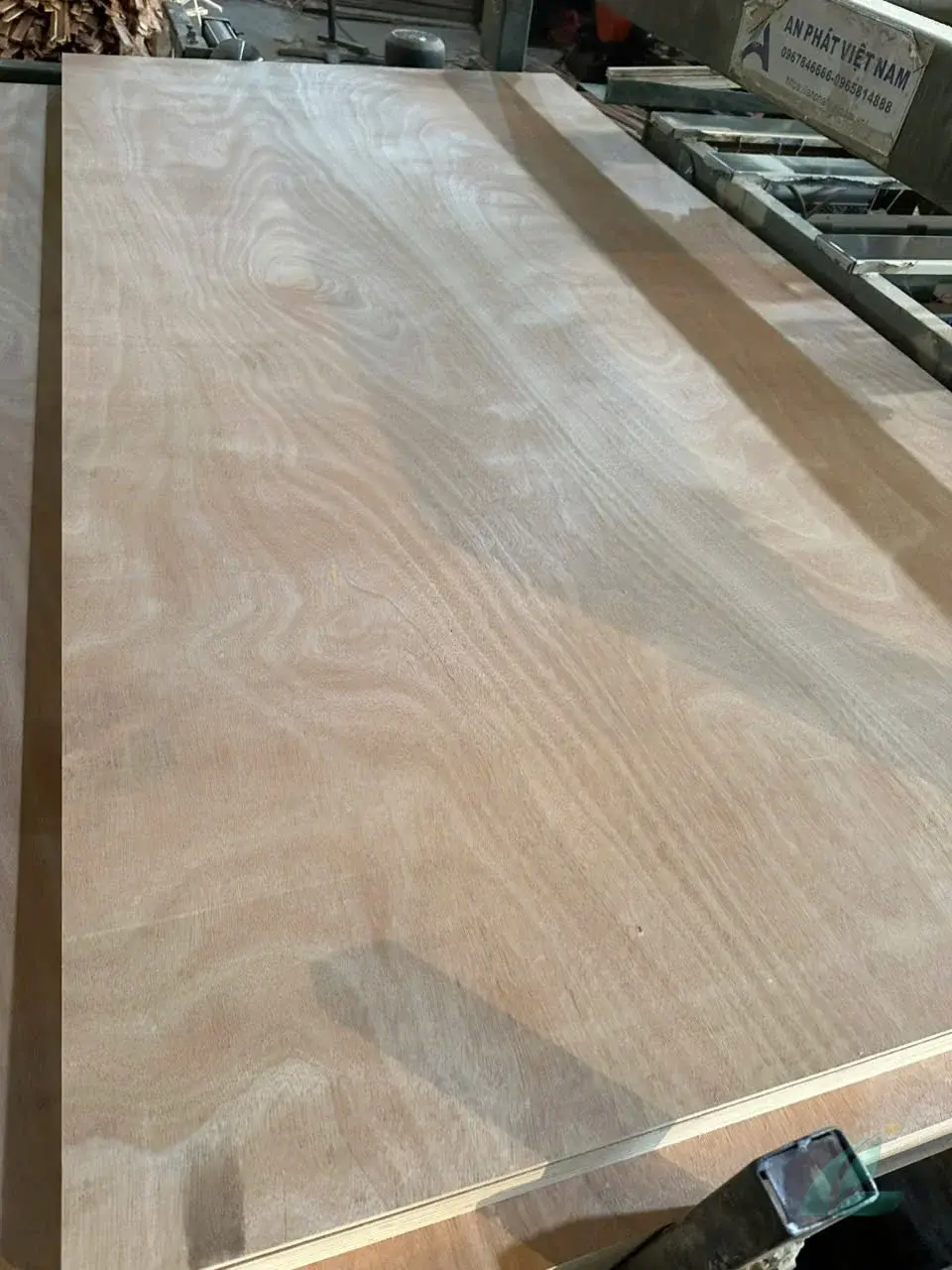
📊 Okoume vs Other Face Veneers: Cost & Weight
Buyers often evaluate okoume against competing face veneer options. This table shows how okoume compares on the two factors that matter most for B2B importers: panel weight and relative cost.
| Face Veneer | Relative Price | Typical Core | Panel Weight (18mm, styrax core) | Primary Market |
|---|---|---|---|---|
| Bintangor | Lowest | Acacia/Styrax | ~9.0 kg/m² | SE Asia, Africa, Middle East |
| Okoume | Low-medium | Styrax/Eucalyptus | ~9.0 kg/m² | Europe, marine, furniture |
| Pine | Medium | Acacia/Styrax | ~9.0 kg/m² | Decorative, packaging |
| EV (Engineered) | Medium | Styrax/Eucalyptus | ~9.0 kg/m² | Modern interiors |
| Birch | Highest | Styrax | ~9.0 kg/m² | Premium EU/US furniture |
Key Insight: At styrax core density (480-500 kg/m³), an 18 mm panel weighs approximately 9 kg/m² regardless of face veneer — because the face is only 0.2-0.4 mm thick. The price difference is driven by face veneer cost, not weight. Okoume face adds USD 5-12 per CBM over bintangor face (Mika Plywood production data, 2026).
For a detailed side-by-side comparison, read Bintangor vs Okoume Plywood.
Contact Mika Plywood for Okoume Plywood Quotation — mixed specs in one 40HC container, factory-direct pricing, no minimum order complexity.
🔗 Conclusion: Factory-Direct Okoume Plywood from Vietnam
Okoume plywood manufacturing in Vietnam follows a precise 7-step sequence — from imported veneer grading through core preparation, glue application, hot pressing, sanding, quality control, and container loading. Each step has measurable parameters and documented checkpoints that determine whether a panel ships as export grade or gets downgraded.
For buyers evaluating okoume plywood from Vietnam, the manufacturing process is the differentiator. Two panels with identical specifications on paper can perform very differently in the field — depending on core construction quality, glue spread accuracy, press temperature control, and sanding grit sequence. This article gives you the benchmarks to verify what your supplier claims.
Understanding okoume plywood manufacturing at this level of detail allows procurement teams to ask the right questions during factory audits. Request press temperature logs. Ask about core construction method. Verify glue spread rates. These are the checkpoints that separate a reliable long-term supplier from a company selling specification sheets without the production discipline to back them.
Disclosure: This article is published by Mika Plywood, a Vietnam-based plywood manufacturer and export operator. While we aim to provide objective industry guidance, readers should consider our perspective as a market participant when evaluating recommendations.
Get a Free Quote for Okoume Plywood — samples, spec sheets, and factory QC reports shipped within 7 days.
Frequently Asked Questions
What temperature is used for hot pressing okoume plywood?Hot press temperature for okoume plywood ranges from 110-135 degrees Celsius depending on glue type. Melamine (MR) glue requires 110-120 degrees Celsius with 8-12 minutes press time. Phenolic (WBP) glue requires 130-135 degrees Celsius. Press pressure is maintained at 10-14 kg per square centimetre across the panel surface.What core species work with okoume face veneer in Vietnam?Vietnam factories pair okoume face with two main core species: styrax (480-500 kg per cubic metre, lightweight, white color) and eucalyptus (650-750 kg per cubic metre, high density, strong). Styrax core is preferred for furniture-grade okoume plywood. Eucalyptus core is used when extra structural strength is required.How thick is okoume face veneer on plywood panels?Standard okoume face veneer thickness ranges from 0.2 to 0.4 mm in Vietnamese production. Thicker 0.3-0.4 mm face is preferred for sanded panels where finish quality matters. Thinner 0.2 mm face is adequate for panels that will receive overlay or lamination after purchase.Can okoume plywood pass FSC and CARB P2 certification?Yes. Mika Plywood produces okoume plywood with FSC Chain of Custody certification, CARB P2 formaldehyde emission compliance, CE marking, and EUDR traceability. FSC certification requires documented supply chain from forest to finished panel. CARB P2 requires formaldehyde emission below 0.05 ppm for hardwood plywood.What is the QC rejection rate for export-grade okoume plywood?Mika Plywood maintains a 2-4 percent rejection rate on okoume plywood production lines. Common rejection causes include face veneer cracks (40 percent of rejects), thickness deviation beyond plus or minus 0.3 mm (25 percent), and surface roughness after sanding (20 percent). Rejected panels are downgraded to commercial or packing grade rather than discarded.
Ready to order?
Get Okoume Plywood Samples & Pricing

Written by
David
Export Project Leader
Content contributor at Vietnam Plywood.
On this page
- 🔧 What Is Okoume Plywood? Okoume Plywood Manufacturing Basics
- 📌 Okoume Plywood Quick Specifications
- 🏭 Step 1 — Okoume Veneer Reception & Grading
- ⚙️ Step 2 — Core Veneer Preparation & Drying
- 📌 Core Construction Quality Levels
- 📐 Step 3 — Glue Mixing & Application
- 📌 How Glue Choice Affects Okoume Plywood Pricing
- 🔥 Step 4 — Assembly, Cold Press & Hot Press
- 📋 Step 5 — Trimming, Sanding & Surface Finishing
- ✅ Step 6 — Quality Control & Export Inspection
- 📌 8-Point Export QC Checklist
- 📦 Step 7 — Packing & Container Loading
- 🌍 Okoume Plywood Applications & Market Demand
- 📊 Okoume vs Other Face Veneers: Cost & Weight
- 🔗 Conclusion: Factory-Direct Okoume Plywood from Vietnam
On this page
- 🔧 What Is Okoume Plywood? Okoume Plywood Manufacturing Basics
- 📌 Okoume Plywood Quick Specifications
- 🏭 Step 1 — Okoume Veneer Reception & Grading
- ⚙️ Step 2 — Core Veneer Preparation & Drying
- 📌 Core Construction Quality Levels
- 📐 Step 3 — Glue Mixing & Application
- 📌 How Glue Choice Affects Okoume Plywood Pricing
- 🔥 Step 4 — Assembly, Cold Press & Hot Press
- 📋 Step 5 — Trimming, Sanding & Surface Finishing
- ✅ Step 6 — Quality Control & Export Inspection
- 📌 8-Point Export QC Checklist
- 📦 Step 7 — Packing & Container Loading
- 🌍 Okoume Plywood Applications & Market Demand
- 📊 Okoume vs Other Face Veneers: Cost & Weight
- 🔗 Conclusion: Factory-Direct Okoume Plywood from Vietnam
Industry Newsletter
Stay Updated with
Plywood Industry Insights
Factory prices, spec guides, market trends and export tips — delivered weekly to B2B buyers and importers in 20+ countries.