Laminated plywood Vietnam — melamine faced, HPL & UV coated boards explained. Substrates, specs, emission standards, and how to order from factory.
Three buyers order “laminated plywood from Vietnam” in the same week. One receives melamine paper boards, another gets HPL-faced panels, and the third ends up with UV-lacquered birch — all technically correct responses to the same search term.
Laminated plywood is not a single product. It is a category covering any plywood substrate with a bonded surface treatment. The surface type, substrate species, emission class, and core construction each affect cost, durability, and which end applications the panel actually suits. This guide breaks down all three surface types, explains substrate selection, and gives the specification details needed to order correctly from Vietnam.
📋 What Is Laminated Plywood?
Laminated plywood is a plywood panel — built from cross-layered veneers bonded under heat and pressure — with a decorative or functional surface material applied to one or both faces after the core panel is produced.
The lamination step is distinct from the core manufacturing step. A factory first produces the substrate (matt, EV, birch, or other face plywood), calibrates it to thickness tolerance (±0.3mm standard), and sands both faces. The lamination facility then bonds the surface material in a separate press cycle.
This two-step process is why laminated plywood buyers need to specify both the substrate and the surface treatment. A single “laminated plywood” order without these details will trigger a supplier clarification — or result in a mismatch.
The three surface types exported from Vietnam at commercial volumes in 2026:
| Surface Type | Thickness | Process | Relative Cost |
|---|---|---|---|
| Melamine paper | 0.05–0.12mm | Short-cycle press, 170–220°C | Lowest |
| HPL (High-Pressure Laminate) | 0.6–1.2mm | Multi-layer press, 1,000+ psi | Medium–High |
| UV lacquer | 0.02–0.05mm | UV curing line | Medium |
📦 Melamine Faced Plywood Vietnam
Melamine faced plywood is the highest-volume laminated product exported from Vietnam. It accounts for the majority of laminated board shipments to India, the Middle East, and Southeast Asia.
📌 How Melamine Lamination Works
Melamine paper is a kraft or decorative paper impregnated with melamine-formaldehyde resin. In the short-cycle press, the paper bonds directly to the sanded substrate face at 170–220°C under 25–35 kg/cm² pressure. The resin cures in 30–60 seconds, creating a surface that is:
- Scratch resistant (Taber abrasion tested)
- Stain resistant (most standard cleaners)
- Moisture resistant at the surface (not the same as WBP waterproof glue)
- Available in wood grain, solid colors, and abstract patterns
The paper is sourced from Europe (Impress, Pfleiderer-Interprint), Asia, or domestically depending on the factory tier. European papers carry consistent color batches and tighter grain registration — a relevant spec for kitchen cabinet manufacturing where door panels must match across deliveries.
📌 Substrate for Melamine Lamination
The standard substrate for melamine lamination in Vietnam is matt plywood — an unfaced raw core panel with both sides sanded to receive the paper. Matt plywood can be produced with acacia, eucalyptus, or styrax core depending on the density requirement.
Melamine paper can also be applied to birch face or EV face plywood when the order requires a specific substrate thickness range or structural characteristic not achievable with a pure matt panel.
⚠️ Important: Melamine paper lamination does not change the substrate’s emission class. The formaldehyde emission comes from the core adhesive (melamine glue or phenolic glue), not from the decorative paper overlay. Specify the substrate emission standard (E0, E1, E2) separately.
📌 Melamine Faced Plywood Specs (Vietnam Export Grade)
| Parameter | Specification |
|---|---|
| Substrate | Matt plywood (acacia/styrax/eucalyptus core) |
| Surface | Melamine paper, 60–120 gsm |
| Colors | Standard decors: white, beige, walnut, oak, wenge, teak, custom |
| Thickness | 4–25mm (popular: 9, 12, 15, 18mm) |
| Sheet size | 1220×2440mm, 1250×2500mm |
| Glue (core) | Melamine MR |
| Emission | E0, E1, E2 available |
| Sanding | Both faces sanded before lamination |
| Certification | FSC, CARB P2 (with E0 substrate), ISO 9001 |
Request Melamine Plywood Samples & Pricing
📦 HPL Plywood Vietnam
HPL (High-Pressure Laminate) plywood uses a thicker, multi-layer composite surface material pressed at pressures exceeding 1,000 psi. The result is a panel with meaningfully better impact resistance, edge hardness, and surface durability compared to standard melamine paper boards.
📌 How HPL Is Made
HPL is manufactured separately from the plywood substrate — it is a standalone composite product consisting of:
- Core layers: multiple sheets of kraft paper impregnated with phenolic resin
- Decorative layer: printed paper with design or wood grain
- Overlay layer: transparent protective sheet with aluminum oxide or melamine
These layers are pressed together at high temperature and pressure (120–160°C, 1,000–1,500 psi) for 30–60 minutes to form a 0.6–1.2mm composite sheet. This HPL sheet is then post-bonded to the plywood substrate using contact adhesive or cold press.
The production of the HPL sheet itself and the post-bonding to the substrate are typically handled by different facilities — in Vietnam, the HPL sheet is often imported from Korea, Japan, or Thailand, then bonded locally. This affects lead time and minimum order structure.
“International buyers in the European market increasingly specify HPL-faced plywood for kitchen and commercial furniture because the surface outperforms standard melamine in wear tests by a factor of 3–5x at comparable decorative quality.” — Jay, International Sales Manager, Mika Plywood
📌 HPL vs Melamine: Which to Specify?
| Criterion | Melamine Paper | HPL |
|---|---|---|
| Surface thickness | 0.05–0.12mm | 0.6–1.2mm |
| Impact resistance | Moderate | High |
| Scratch resistance | Good | Excellent |
| Edge durability | Fair (chips under stress) | Better |
| Color/pattern range | Very wide | Wide |
| Cost premium over base | Low | 30–50% higher |
| Best application | Cabinets, shelving, light furniture | Countertops, shopfitting, high-traffic surfaces |
| Vietnam factory availability | Very high | Medium (post-bond service) |
For residential furniture and cabinet boxes where surfaces see light daily contact, melamine paper performs adequately. For kitchen worktops, retail display counters, and commercial fitout where surfaces sustain daily impact and cleaning cycles, HPL is the specification to use.
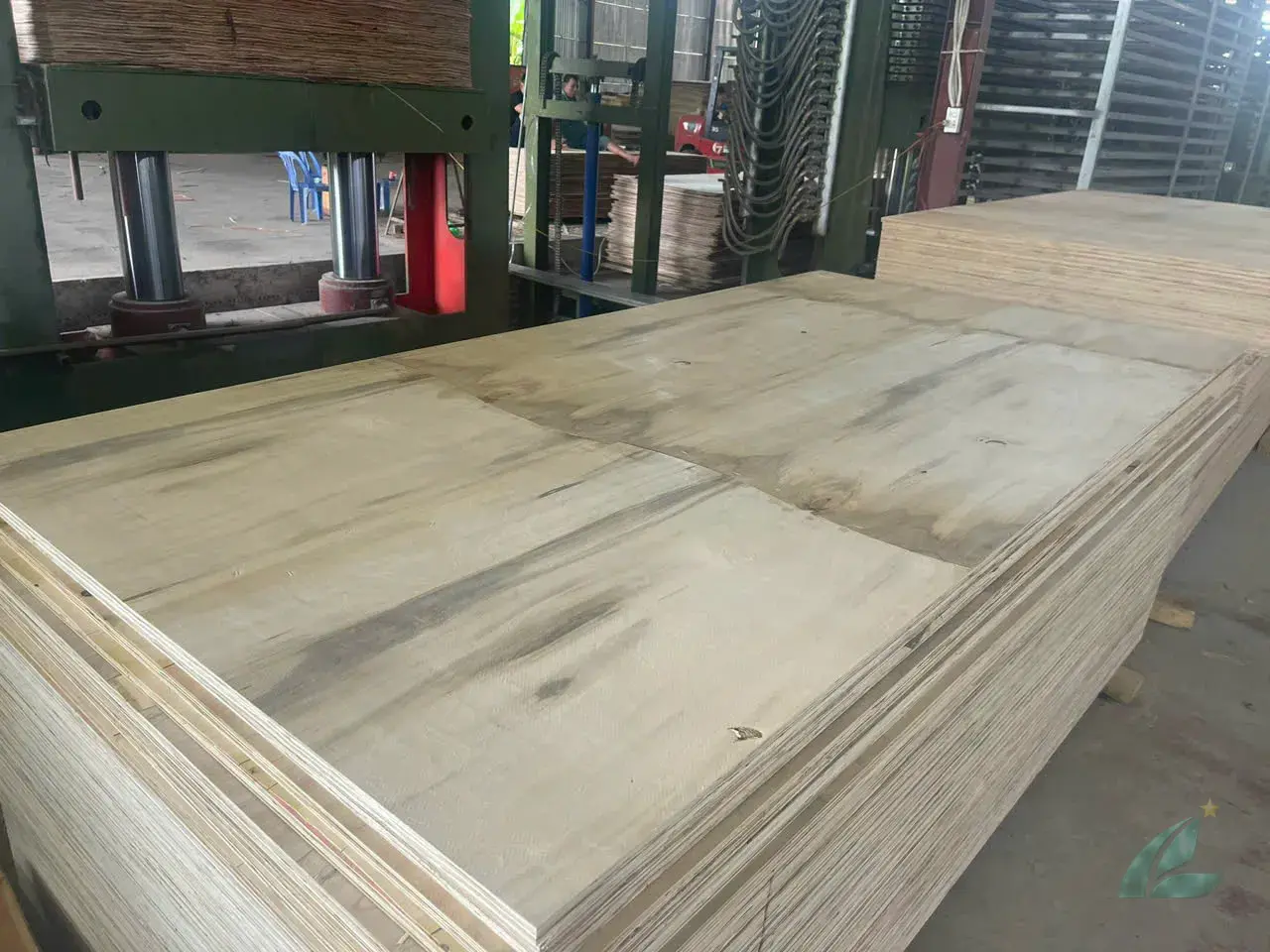
📦 UV Coated Plywood Vietnam
UV coated plywood uses a clear lacquer applied to the face — typically birch, EV, or a high-grade sanded substrate — and cured instantly by ultraviolet light. The UV process produces a hard, consistent finish without solvent emissions or extended drying time.
UV Coating Process
The plywood substrate enters a roller coater that applies 2–4 passes of UV lacquer (sealer, filler, topcoat). After each pass, the panel passes through a UV curing lamp that polymerizes the coating in seconds. The result is:
- A hard, clear surface (hardness rating: 2H–4H pencil test)
- Scratch and stain resistance without concealing the face grain
- Zero solvent off-gassing after cure (relevant for E0 emission compliance)
- Ready for immediate packaging — no drying room required
UV coating preserves the natural appearance of birch grain or engineered veneer patterns. For buyers evaluating this finish type, our UV coated plywood from Vietnam guide covers suppliers and specifications in detail, and the birch UV coated plywood product page shows the most popular substrate option. This makes it the preferred surface for furniture factories that want visible wood character with factory-applied protection, eliminating on-site spray finishing.
Understand the distinction clearly: UV coating provides surface hardness and stain resistance but does not make the panel waterproof. Water resistance is determined by the core adhesive — melamine (MR) for moisture resistance, phenolic (WBP) for weather and boil resistance. Read the plywood glue types and emission guide for a full breakdown.
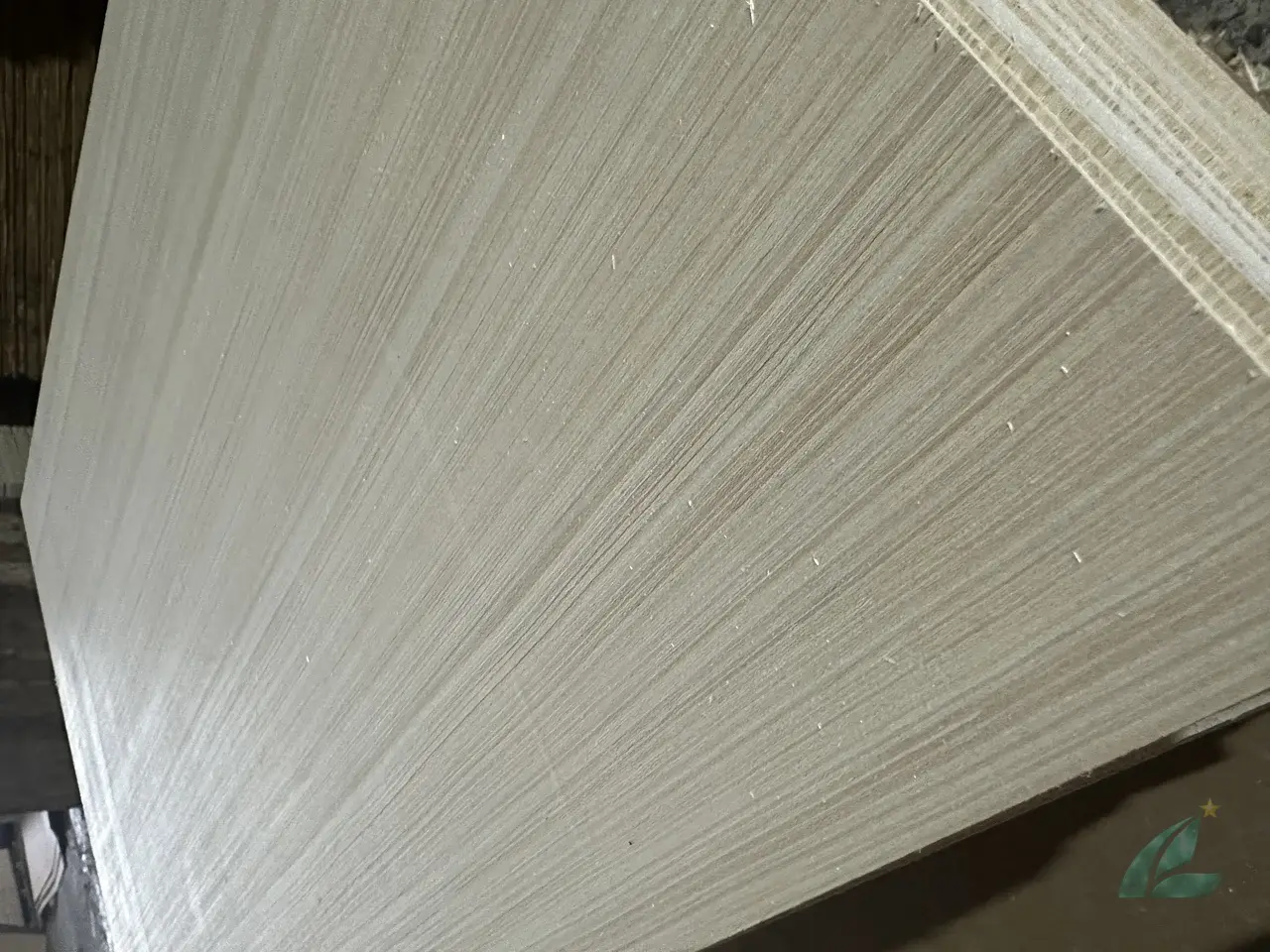
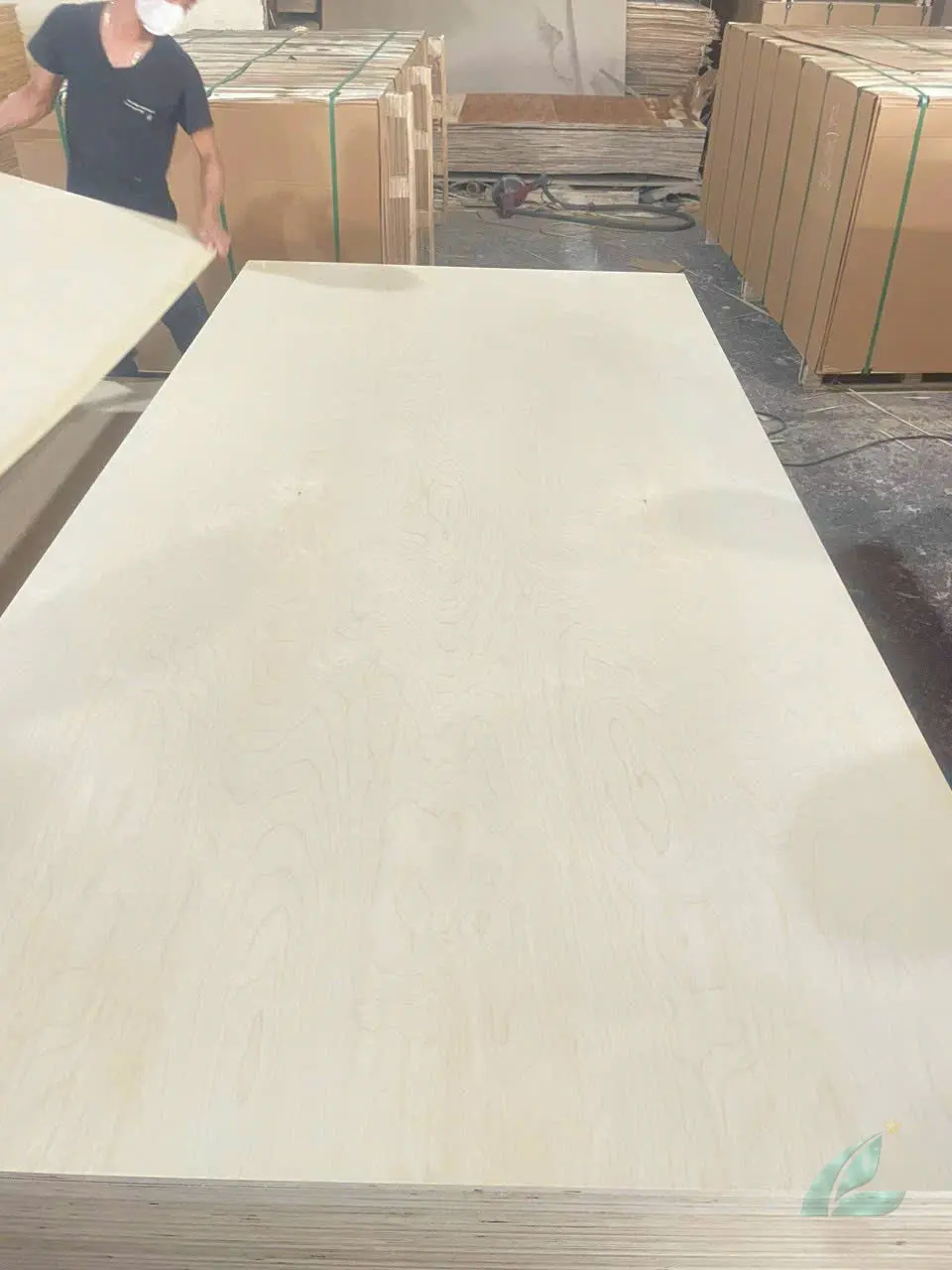
UV Coated Plywood Substrates
The three substrates used for UV coating from Vietnam:
-
Birch face plywood (grade D/E) — most common for European and Korean furniture factories. The birch grain shows through the clear coat. Core is styrax (480–500 kg/m³), the standard birch-core substitute from Northern Vietnam.
-
EV (Engineered Veneer) plywood — consistent grain pattern, no knots, uniform color. Preferred by buyers who need matched faces across large volumes. EV plywood from Vietnam typically uses styrax or eucalyptus core.
-
Matt (raw core) plywood — used when the buyer’s facility will apply additional processing (painting, vinyl wrap) and only needs the UV coat as a sealing primer layer.
📊 Substrate Comparison: Matt vs EV vs Birch for Lamination
The substrate choice affects the final board’s density, cost, and surface compatibility:
| Substrate | Core Options | Density (kg/m³) | Surface Before Lamination | Best For |
|---|---|---|---|---|
| Matt (unfaced) | Acacia, Styrax, Eucalyptus | 480–750 (varies by core) | Sanded, no veneer | Melamine paper, HPL post-bond |
| EV (Engineered Veneer) | Styrax, Eucalyptus | 480–650 | Sanded, uniform EV face | UV lacquer, semi-transparent finishes |
| Birch face | Styrax | ~500 | Sanded birch D/E grade | UV lacquer, premium melamine |
💡 Tip: For buyers specifying melamine paper to be applied at their own facility (self-laminating), order matt plywood from Vietnam as the substrate. Specify calibrated thickness (±0.3mm) and double-sided sanding. Core species selection should be guided by your density requirement: styrax for lighter panels, eucalyptus for heavy-duty applications.
🔧 Emission Standards for Laminated Plywood
This is the most common specification error in laminated plywood orders.
The decorative surface (melamine paper, HPL, UV lacquer) does not control formaldehyde emission. Emission class is determined entirely by the adhesive used in the substrate core. Specifying “E0 melamine plywood” means the core adhesive must comply with E0 limits — not that the melamine paper itself is low-emission.
| Emission Class | Max Formaldehyde | Target Market |
|---|---|---|
| E0 / CARB P2 | ≤0.5 mg/L | US, EU, Japan, Korea — indoor furniture |
| E1 | ≤1.5 mg/L | EU general interior, most Asian markets |
| E2 | ≤5.0 mg/L | Industrial, packaging, outdoor — NOT indoor furniture |
For European buyers, E1 is the minimum for any panel entering a habitable space. For US buyers, CARB P2 (≡E0) is mandatory. For kitchen cabinets in the Korean or Japanese market, E0 is the standard — see the detailed melamine E0 plywood specification for the Japan market. Always confirm which emission class the substrate carries — not just which surface type is applied.
See the complete plywood glue types and emission standards guide for market-by-market requirements.
🏭 Ordering Laminated Plywood from Vietnam: What to Specify
A complete specification for laminated plywood covers seven parameters:
- Surface type: melamine paper / HPL / UV lacquer
- Substrate type: matt / EV / birch face
- Core species: acacia / styrax / eucalyptus (density implication — see plywood face veneer types guide)
- Thickness: nominal (e.g., 18mm) + tolerance (±0.3mm standard, tighter on request)
- Sheet size: 1220×2440mm or 1250×2500mm
- Emission class: E0, E1, or E2 with supporting test certificate
- Color / decor: for melamine paper — specify decor code if reordering from a known source; for UV — specify gloss level (matte, semi-gloss, high-gloss)
Missing any of these parameters increases the risk of a specification gap that triggers production delays or, worse, a shipment that doesn’t fit the end application.
📐 Standard Sizes and Container Loading
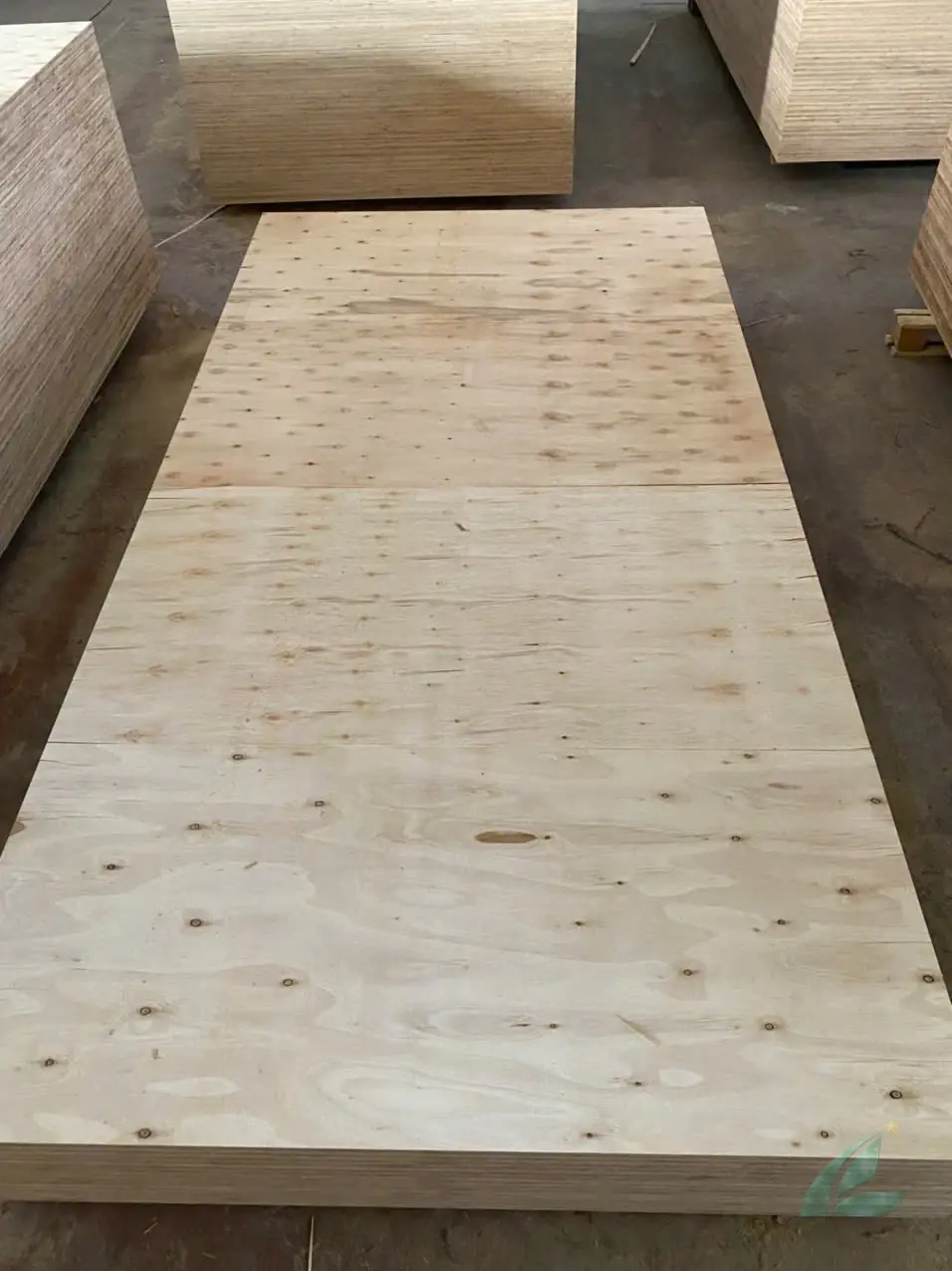
Laminated plywood from Vietnam ships in standard sheet sizes:
- 1220×2440mm (4×8ft) — dominant for most markets
- 1250×2500mm — preferred for European metric-standard markets
Thickness range for laminated boards: 4–25mm. The most common export thicknesses are 9mm, 12mm, 15mm, and 18mm.
Container loading capacity depends on the substrate’s core species density:
- Styrax core: ~18 pallets per 40HC, ~26.5 MT
- Acacia core: ~16 pallets per 40HC, ~27.5 MT
- Eucalyptus core: ~15 pallets per 40HC, ~28 MT
Lamination adds minimal weight (melamine paper: <0.5 kg/sheet at 18mm). Container loading calculations use the substrate core density directly. (Mika Plywood production data, 2026)
✅ Certifications Available
- FSC (Forest Stewardship Council) — chain-of-custody for substrates
- CARB P2 — with E0 substrate, for US market compliance (California Air Resources Board, Title 17)
- ISO 9001 — factory quality management
- EUDR — EU Deforestation Regulation compliance for EU-bound shipments from 2025 (European Commission, Regulation 2023/1115)
- Test reports: formaldehyde emission (E0/E1), boiling test (MR 12h), moisture content
🔗 Conclusion: Getting the Specification Right
Laminated plywood from Vietnam offers three distinct surface types — melamine paper, HPL, and UV lacquer — each suited to different performance requirements and cost points. The substrate choice (matt, EV, birch) and emission class (E0, E1, E2) are specified independently of the surface type and must be confirmed explicitly in every order.
Melamine paper remains the standard for cabinet and furniture box production where color consistency and cost efficiency matter most. HPL is the correct specification for high-traffic commercial surfaces. UV lacquer preserves visible face grain while providing factory-applied hardness for furniture that ships direct to the end consumer.
Mika Plywood operates factory-direct across all three product segments with certified documentation (FSC, CARB P2, ISO 9001) and a 15–20 day production lead time from spec confirmation.
Disclosure: This article is published by Mika Plywood, a Vietnam-based plywood manufacturer and export operator. While we aim to provide objective industry guidance, readers should consider our perspective as a market participant when evaluating recommendations.
Request Laminated Plywood Samples & Factory Pricing
Frequently Asked Questions
What is laminated plywood?Laminated plywood is a standard plywood panel with a decorative or functional surface applied to one or both faces. The three common surface types are melamine paper (low cost, high volume), HPL (high-pressure laminate, thicker and more durable), and UV lacquer (clear hard coat, preserves wood appearance). The plywood substrate — typically matt, EV, or birch — is produced separately, then laminated as a finishing step.What is the difference between melamine plywood and HPL plywood?Melamine paper is a thin impregnated sheet (60–120 gsm) bonded to the substrate under heat and pressure in a short-cycle press. HPL is a multi-layer composite (0.6–1.2mm thick) pressed at much higher pressures, giving superior impact and scratch resistance. HPL costs 30–50% more than melamine but outperforms in high-traffic surfaces like kitchen worktops and commercial casework.Which substrate is best for melamine lamination from Vietnam?Matt (unfaced raw core) plywood is the standard substrate for melamine lamination in Vietnam because it provides a clean, sanded surface with no existing veneer to interfere with adhesion. EV (engineered veneer) and birch face plywood are also used when the face grain must show through a semi-transparent finish or UV lacquer.What emission standard should I specify for laminated plywood from Vietnam?For furniture and cabinet markets in the EU, US, Japan, and Korea, specify E0 emission (≤0.5 mg/L formaldehyde), equivalent to CARB P2. The lamination surface itself does not add formaldehyde — the emission class refers to the core adhesive in the substrate panel. Always confirm the substrate's emission certificate separately from the surface finish type.What is the minimum order for laminated plywood from Vietnam?Minimum order is 1 × 40HC container. Mixed specifications — different thicknesses, face colors, or surface types — can be combined in one container. Mika Plywood manages production across 3 specialized facilities in Northern Vietnam with 15–20 day lead time after spec confirmation.
Ready to order?
Request Laminated Plywood Samples & Specs

Written by
David
Export Project Leader
Content contributor at Vietnam Plywood.
On this page
- 📋 What Is Laminated Plywood?
- 📦 Melamine Faced Plywood Vietnam
- 📌 How Melamine Lamination Works
- 📌 Substrate for Melamine Lamination
- 📌 Melamine Faced Plywood Specs (Vietnam Export Grade)
- 📦 HPL Plywood Vietnam
- 📌 How HPL Is Made
- 📌 HPL vs Melamine: Which to Specify?
- 📦 UV Coated Plywood Vietnam
- 📊 Substrate Comparison: Matt vs EV vs Birch for Lamination
- 🔧 Emission Standards for Laminated Plywood
- 🏭 Ordering Laminated Plywood from Vietnam: What to Specify
- 📐 Standard Sizes and Container Loading
- ✅ Certifications Available
- 🔗 Conclusion: Getting the Specification Right
On this page
- 📋 What Is Laminated Plywood?
- 📦 Melamine Faced Plywood Vietnam
- 📌 How Melamine Lamination Works
- 📌 Substrate for Melamine Lamination
- 📌 Melamine Faced Plywood Specs (Vietnam Export Grade)
- 📦 HPL Plywood Vietnam
- 📌 How HPL Is Made
- 📌 HPL vs Melamine: Which to Specify?
- 📦 UV Coated Plywood Vietnam
- 📊 Substrate Comparison: Matt vs EV vs Birch for Lamination
- 🔧 Emission Standards for Laminated Plywood
- 🏭 Ordering Laminated Plywood from Vietnam: What to Specify
- 📐 Standard Sizes and Container Loading
- ✅ Certifications Available
- 🔗 Conclusion: Getting the Specification Right
Industry Newsletter
Stay Updated with
Plywood Industry Insights
Factory prices, spec guides, market trends and export tips — delivered weekly to B2B buyers and importers in 20+ countries.