Construction plywood Vietnam: film-faced formwork, anti-slip scaffolding, flooring substrate. Phenolic WBP specs and core selection.
Construction plywood from Vietnam splits into three distinct product families — and ordering the wrong one costs you money. Formwork buyers specify film-faced with phenolic WBP. Scaffolding contractors want anti-slip wire-mesh surface. Flooring substrate buyers need high-density eucalyptus core. Each has a different film, glue, core species, and price point.
This guide breaks down all three types with factory-level specs, so you can write a technically accurate purchase order the first time.
🏗️ What Is Construction Plywood?
Construction plywood refers to structural-grade panels engineered for on-site loading conditions: wet concrete pressure, foot traffic on scaffold decks, and subfloor loads. These panels are not sanded, not emission-controlled to E0, and not designed for furniture aesthetics. They are built for mechanical performance and reusability under harsh conditions.
Three types dominate Vietnam’s construction plywood export:
| Type | Surface | Core | Glue | Primary Use |
|---|---|---|---|---|
| Film-Faced Plywood | Phenolic or melamine film | Acacia or Eucalyptus | Phenolic WBP | Concrete formwork, shuttering |
| Anti-Slip Plywood | AICA wire-mesh film 220gsm | Acacia or Eucalyptus | Phenolic WBP | Scaffolding decks, truck floors, walkways |
| Flooring Substrate | Unsanded eucalyptus face | Eucalyptus (full) | Phenolic WBP or MR | Structural subfloor, flooring underlay |
The key shared specification across all three: phenolic WBP glue. This is non-negotiable for wet-environment construction use. Melamine (MR) glue passes a 12-hour boil test; phenolic WBP passes a 72-hour boil test — the difference is critical when panels sit under poured concrete for 7–14 days before stripping (BS EN 314-2, Class 3).
🎬 Film-Faced Formwork Plywood — The Core Product
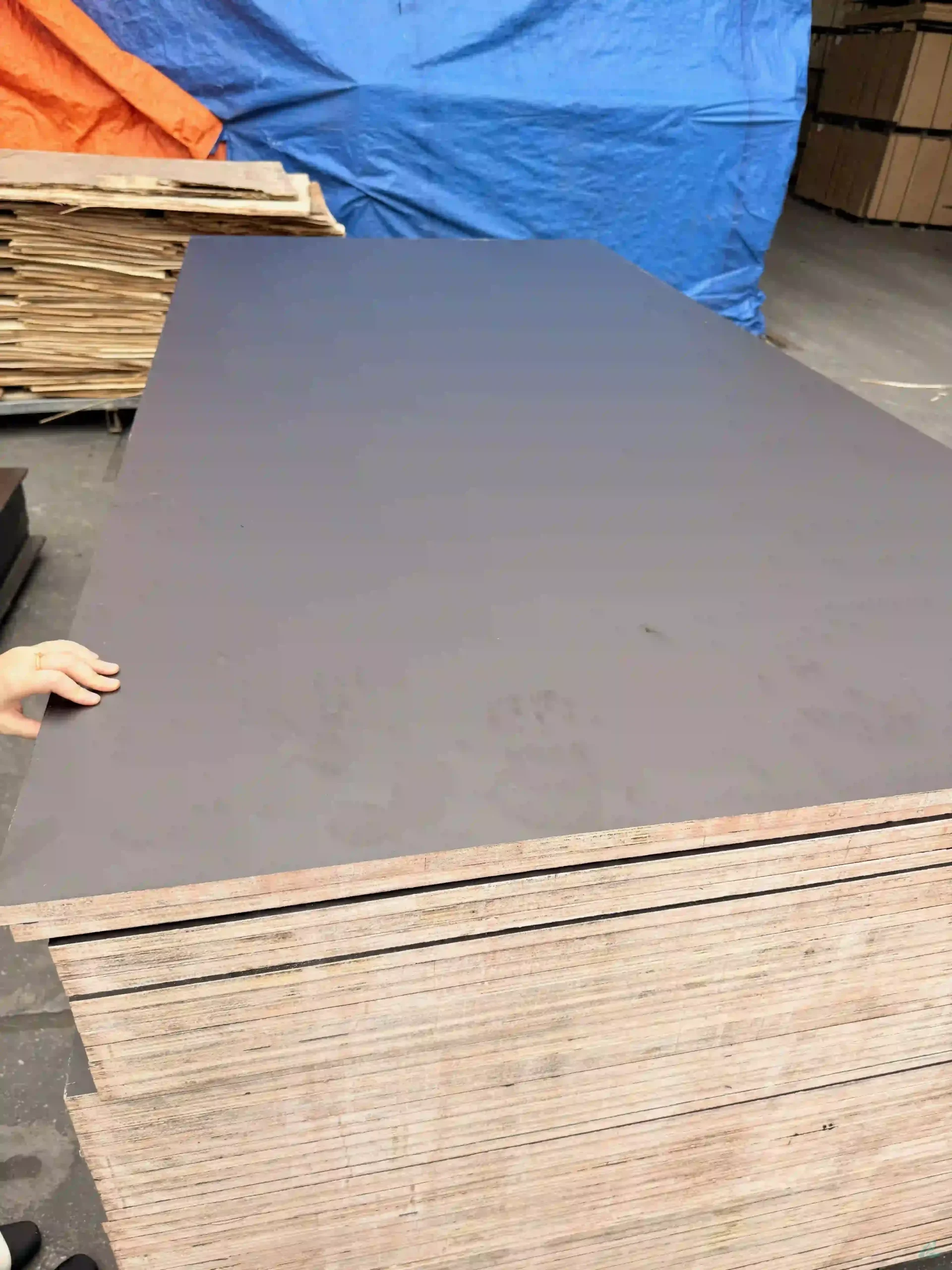
Film-faced plywood is Vietnam’s most exported construction grade. The panels are covered on both faces with resin-impregnated paper — phenolic on the working face, melamine on the reverse — then bonded to a structural core under heat and pressure.
📌 Film Types: Premium vs Budget
The film is where the quality split happens. Two market-level products exist:
Premium (Export-Grade):
- Film: AICA (Japan) 135gsm minimum, typically 160–200gsm
- Surface hardness: resists abrasion and concrete adhesion
- Edge sealing: factory-sealed with phenolic paint
- Reuse potential: 15–20 cycles (Mika Plywood production data, 2026)
Budget (Domestic/Southeast Asia):
- Film: Vietnamese or Chinese film, 100–120gsm
- Lower surface hardness, higher concrete bond risk
- Edges often unsealed
- Reuse potential: 4–8 cycles only
The practical implication: a premium panel at $32–38 USD/sheet amortized over 18 pours costs $1.78–2.11/pour. A budget panel at $18–22 USD amortized over 6 pours costs $3.00–3.67/pour. Premium grade is cheaper per use on projects with 10+ pours (Mika Plywood internal pricing model, 2026).
📌 Core Species for Formwork
Formwork plywood carries concrete pressure during pours — typically 24–48 kPa for standard wall forms, higher for column work. Core density directly determines bending stiffness.
| Core | Density | Recommended for |
|---|---|---|
| Eucalyptus | 650–750 kg/m³ | Heavy-load column formwork, high-rise slabs |
| Acacia | ~580 kg/m³ | Standard wall and slab formwork |
| Styrax | 480–500 kg/m³ | Not recommended for formwork — insufficient stiffness |
⚠️ Important: Styrax core is widely used in furniture plywood but should never be specified for concrete formwork. The lower density means higher deflection under concrete pressure, leading to wavy concrete surfaces and premature panel failure.
Standard formwork thickness: 12mm (light walls), 15mm (standard slabs), 18mm (heavy columns and beams), 21mm (high-load industrial). Most export orders specify 18mm with eucalyptus or acacia core.
For more on core species performance data, see Plywood Core Types — Acacia vs Eucalyptus vs Styrax.
Get a Free Quote for Film-Faced Formwork Plywood
🦺 Anti-Slip Construction Plywood — Scaffolding & Transport Grade
Anti-slip plywood uses the same phenolic WBP bonding as formwork grade, but the face film is different. Instead of smooth phenolic, the working face carries an AICA wire-mesh film at 220gsm — the wire mesh is laminated into the film layer during hot-pressing, creating a permanent raised texture.
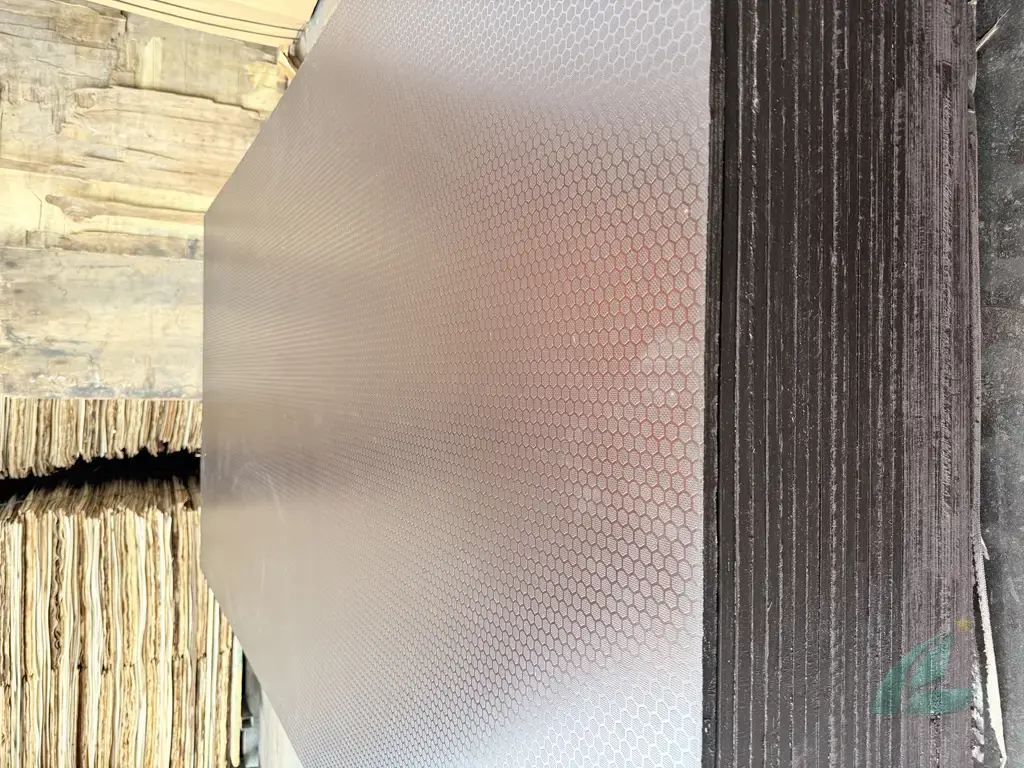
Applications:
- Scaffold deck boards (walking surface on frame scaffolding)
- Truck and trailer loading floors
- Construction vehicle platforms
- Temporary pedestrian walkways on site
- Crane outrigger pads
Standard specifications:
| Spec | Value |
|---|---|
| Film | AICA anti-slip 220gsm, wire-mesh surface |
| Core | Acacia or Eucalyptus |
| Glue | Phenolic WBP |
| Thickness | 12–21mm (12mm and 15mm most common for scaffolding) |
| Size | 1220×2440mm or 1250×2500mm |
| Reverse face | Smooth film or plain phenolic |
Key Insight: Anti-slip plywood and film-faced formwork plywood share the same structural core and WBP bonding. The only difference is the surface film. Many buyers successfully use anti-slip plywood for formwork applications where the textured face is not an issue — though smooth film-faced is preferred where a clean concrete finish is specified.
The slip resistance of 220gsm wire-mesh film meets safety requirements for occupational working platforms in most markets. European construction sites referencing EN 13374 Class B (inclined walking surfaces) specify anti-slip coefficient ≥0.3, which wire-mesh plywood surface satisfies (Mika Plywood production data, 2026).
See full product specifications: Anti-Slip Plywood Vietnam
🪵 Flooring-Grade Construction Plywood — Structural Subfloor
Flooring-grade construction plywood is the least discussed but high-volume segment for markets with timber-frame and light-steel-frame construction. Unlike formwork or anti-slip panels, flooring substrate does not carry a specialty film. It relies on the density and stability of the core itself.
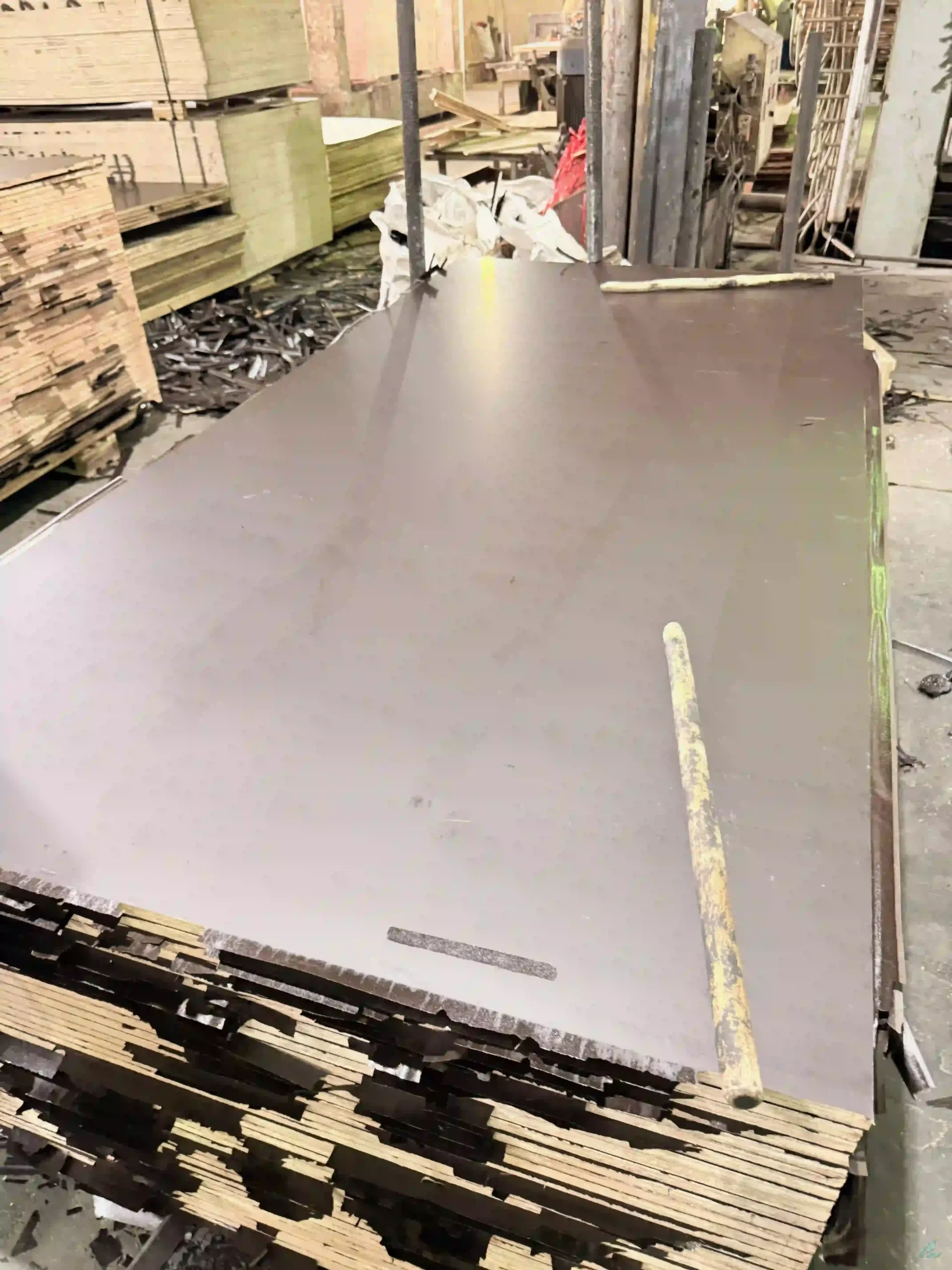
Key differences from formwork plywood:
| Property | Formwork Plywood | Flooring Substrate |
|---|---|---|
| Face | Phenolic film | Eucalyptus face veneer (unsanded) |
| Core | Acacia or Eucalyptus | Full eucalyptus, edge-jointed or stitched |
| Glue | Phenolic WBP | WBP or BWP |
| Thickness | 12–21mm | 15–18mm most common |
| Application | Temporary, stripped after curing | Permanent structural installation |
Full eucalyptus-core plywood at 650–750 kg/m³ provides the dimensional stability required for subfloor applications — minimal shrinkage/expansion with seasonal moisture changes. Markets using this grade: Australia (AS/NZS 2269 structural), South Korea (flooring underlayment), and Middle East commercial construction.
“For structural subfloor applications, buyers consistently specify full eucalyptus core rather than acacia — the density difference translates directly to screw-holding strength and long-term dimensional stability under cyclic moisture loading.” — Jay, International Sales Manager, Mika Plywood (6+ years export experience)
For understanding how core selection affects container loading efficiency, see Plywood Container Packing Calculation 40HC.
📊 Construction Plywood Specifications Comparison
Full comparison for procurement teams specifying Vietnam-origin construction plywood:
| Specification | Film-Faced Formwork | Anti-Slip Scaffold | Flooring Substrate |
|---|---|---|---|
| Surface film | Phenolic smooth | AICA wire-mesh 220gsm | None (face veneer) |
| Film weight | 135–200gsm | 220gsm | N/A |
| Core species | Eucalyptus / Acacia | Eucalyptus / Acacia | Eucalyptus (full) |
| Core density | 580–750 kg/m³ | 580–750 kg/m³ | 650–750 kg/m³ |
| Glue | Phenolic WBP | Phenolic WBP | Phenolic WBP / BWP |
| WBP boil test | 72 hours | 72 hours | 72 hours |
| Standard thickness | 12/15/18/21mm | 12/15mm | 15/18mm |
| Standard size | 1220×2440mm | 1220×2440mm | 1220×2440mm |
| Reuse cycles | 4–20 (grade-dependent) | 5–10 | Permanent |
| Emission class | N/A (construction) | N/A (construction) | N/A |
| Sanding | No | No | No |
| CE eligible | Yes | Yes | Yes (structural) |
🔍 How to Specify Construction Plywood Correctly
Procurement errors for construction plywood from Vietnam almost always come from under-specifying the film and core. A purchase order that reads “18mm film-faced plywood, phenolic WBP” will receive very different panels from different factories unless four parameters are locked:
-
Film weight (gsm): Minimum 135gsm for standard formwork. Specify 160gsm+ for 15+ reuses.
-
Core species: Eucalyptus for heavy-load and structural. Acacia for standard construction.
-
Core construction: Stitched or edge-jointed (not loose-laid). Loose-laid cores delaminate under formwork pressure.
-
Edge treatment: Phenolic paint sealed edges. Unsealed edges are the #1 cause of panel failure during pour.
Understanding the full specification matrix before requesting a quotation is covered in the Plywood Quotation Guide — which details all parameters needed to get comparable, accurate pricing from multiple suppliers.
For the technical differences between melamine and phenolic glue grades, see Plywood Glue Types & Emission Standards.
Request Construction Plywood Specifications from Mika Plywood
📋 Certifications for Construction Plywood Export
Construction plywood for European projects requires CE marking under EN 636. Mika Plywood holds CE certification for film-faced and anti-slip panels. Key certifications by market:
| Market | Required | Preferred |
|---|---|---|
| European Union | CE marking (EN 636) | FSC Chain-of-Custody |
| Australia | AS/NZS 2269 or F-grade | FSC |
| South Korea | KS F 3113 | ISO 9001 |
| Middle East | No mandatory standard | CE, ISO 9001 |
| India | BIS IS 4990 (formwork) | — |
FSC certification confirms that timber inputs originate from certified-sustainable forests. EUDR (EU Deforestation Regulation) compliance is mandatory for all timber products entering the EU from December 2025 — this requires full geographic traceability of wood inputs, not just FSC chain-of-custody (European Commission, 2023).
Mika Plywood supplies full export documentation: FSC certificate, CE Declaration of Performance, Phytosanitary Certificate, Fumigation Certificate, Bill of Lading, and Commercial Invoice.
Related reading:
- For current pricing, see film-faced plywood price guide.
- For premium formwork, read eucalyptus core high-reuse formwork plywood.
- See also Vietnam construction-grade plywood for structural use.
✅ Which Construction Plywood Grade Do You Need?
Quick selection guide:
Order Film-Faced Formwork Plywood when:
- Pouring concrete walls, slabs, columns, or beams
- Need smooth concrete finish (architectural or structural)
- Want 10+ reuse cycles — specify AICA film 160gsm+, eucalyptus core
Order Anti-Slip Plywood when:
- Building scaffold decking or access platforms
- Flooring truck beds, trailers, crane platforms
- Safety requirements mandate anti-slip surfaces
Order Flooring-Grade Construction Plywood when:
- Permanent structural subfloor in timber-frame buildings
- Underlayment needing dimensional stability over years
- Specify full eucalyptus core, WBP/BWP glue, edge-jointed or stitched
“The most common ordering mistake we see from first-time construction importers is specifying phenolic plywood without locking the film gsm and core species. We receive dozens of inquiries where buyers discover — after delivery — that they received local-film budget panels instead of export-grade. The specification sheet prevents this.” — Jay, International Sales Manager, Mika Plywood
Disclosure: This article is published by Mika Plywood, a Vietnam-based plywood manufacturer and export operator. While we aim to provide objective industry guidance, readers should consider our perspective as a market participant when evaluating recommendations.
Get a Free Quote for Construction Plywood from Vietnam
Frequently Asked Questions
What thickness of film-faced plywood is standard for concrete formwork?18mm is the most common formwork thickness globally. 15mm is used for lighter slab pours, 21mm for heavy-load columns. All use phenolic WBP glue and require eucalyptus or acacia core for load-bearing performance.How many times can Vietnam film-faced plywood be reused in formwork?Premium grade (AICA film, phenolic WBP, eucalyptus/acacia core, Grade C facility) achieves 15–20 reuses. Budget grade (local film, melamine glue, acacia loose-lay core) gives only 4–8 reuses. The difference depends entirely on film quality and core construction, not just thickness.What is the difference between film-faced and anti-slip construction plywood?Film-faced plywood has a smooth phenolic surface for concrete forming — the smooth face releases cleanly from cured concrete. Anti-slip plywood has a wire-mesh or embossed pattern on the surface, used for scaffolding decks, truck floors, and walkways where grip is needed. Both use phenolic WBP glue.Which core species is best for construction plywood in Vietnam?Eucalyptus core (650–750 kg/m³) is the strongest and densest — preferred for formwork bearing heavy concrete loads. Acacia core (~580 kg/m³) is the standard choice for most commercial construction plywood. Styrax core (480–500 kg/m³) is too lightweight for formwork, primarily used in furniture.Does construction plywood from Vietnam need any certification for export?For EU construction products, CE marking is required. FSC certification is increasingly requested for government tenders. EUDR compliance is mandatory for EU imports from 2025. For general construction markets (Middle East, Southeast Asia), no mandatory certification — but WBP phenolic glue grade should be confirmed.
Ready to order?
Get a Free Quote for Construction Plywood

Written by
David
Export Project Leader
Content contributor at Vietnam Plywood.
On this page
- 🏗️ What Is Construction Plywood?
- 🎬 Film-Faced Formwork Plywood — The Core Product
- 📌 Film Types: Premium vs Budget
- 📌 Core Species for Formwork
- 🦺 Anti-Slip Construction Plywood — Scaffolding & Transport Grade
- 🪵 Flooring-Grade Construction Plywood — Structural Subfloor
- 📊 Construction Plywood Specifications Comparison
- 🔍 How to Specify Construction Plywood Correctly
- 📋 Certifications for Construction Plywood Export
- ✅ Which Construction Plywood Grade Do You Need?
On this page
- 🏗️ What Is Construction Plywood?
- 🎬 Film-Faced Formwork Plywood — The Core Product
- 📌 Film Types: Premium vs Budget
- 📌 Core Species for Formwork
- 🦺 Anti-Slip Construction Plywood — Scaffolding & Transport Grade
- 🪵 Flooring-Grade Construction Plywood — Structural Subfloor
- 📊 Construction Plywood Specifications Comparison
- 🔍 How to Specify Construction Plywood Correctly
- 📋 Certifications for Construction Plywood Export
- ✅ Which Construction Plywood Grade Do You Need?
Industry Newsletter
Stay Updated with
Plywood Industry Insights
Factory prices, spec guides, market trends and export tips — delivered weekly to B2B buyers and importers in 20+ countries.