7 tests to check plywood strength before buying. Boil test, moisture check, core cross-section, thickness caliper — exact pass/fail targets for importers.
Every shipment of plywood that fails in the field traces back to one missed check before the order was placed. This guide covers 7 factory-proven tests to check plywood strength before buying from Vietnam suppliers — the exact same tests Mika Plywood’s on-site QC team runs before any container is loaded.
Whether you import furniture-grade panels for cabinets or structural plywood for construction formwork, these methods apply. No lab equipment required for most of them.
📋 Why Plywood Strength Tests Matter for Importers
Plywood from Vietnam ranges from premium furniture-grade (full-stitched styrax core, E0 emission, sanded face) to economy packing-grade (loose-laid acacia core, E2 emission, unsanded). Both products carry the same label: “plywood.”
Importers who skip pre-shipment strength checks commonly report three problems:
- Delamination on arrival — glue bond failed during ocean transit in high humidity
- Thickness variation — panels 0.8–1.5mm under spec, causing fit issues in manufacturing
- Core gaps — visible voids in cross-section causing structural weak points
A proper plywood strength test at the factory stage costs nothing but time. Discovering the problem after 53 CBM of panels arrive at your port costs significantly more. Plywood quality inspection before shipment is the single most effective measure against import disputes. (Mika Plywood production data, 2026)
Request a free sample with test report from Mika Plywood
🔍 Test 1 — Visual Surface Inspection to Check Plywood Strength
The first check is also the most revealing. Run it before cutting a single sample.
Place the panel on a flat surface and examine:
- Face veneer flatness — no bubbles, edge peeling, or hollow sounds when tapped
- Grain consistency — uniform color, no patches of different species mixed in
- Edge straightness — tolerance should be within ±2mm on length and width
- Warping — a bowed panel that does not lay flat on the floor has moisture imbalance or improper stacking during storage
- Surface repairs — putty fills are acceptable in commercial grades but count them; more than 3–4 repairs per sheet on furniture-grade is a reject
⚠️ Important: Warping is not always a permanent defect — panels can bow from short-term moisture exposure and recover after proper conditioning. The issue is when the core construction itself is asymmetric (odd-ply configuration with mismatched layer thicknesses).
For furniture-grade plywood with sanded faces, run your palm across the surface. Any raised grain, grit lines, or rough patches indicate calibration was skipped or the sanding belt was worn. Our face defect inspection guide covers all visible surface defects in detail.
🔍 Test 2 — Core Veneer Quality Check
Cut a 100mm cross-section from one corner and inspect the layers.
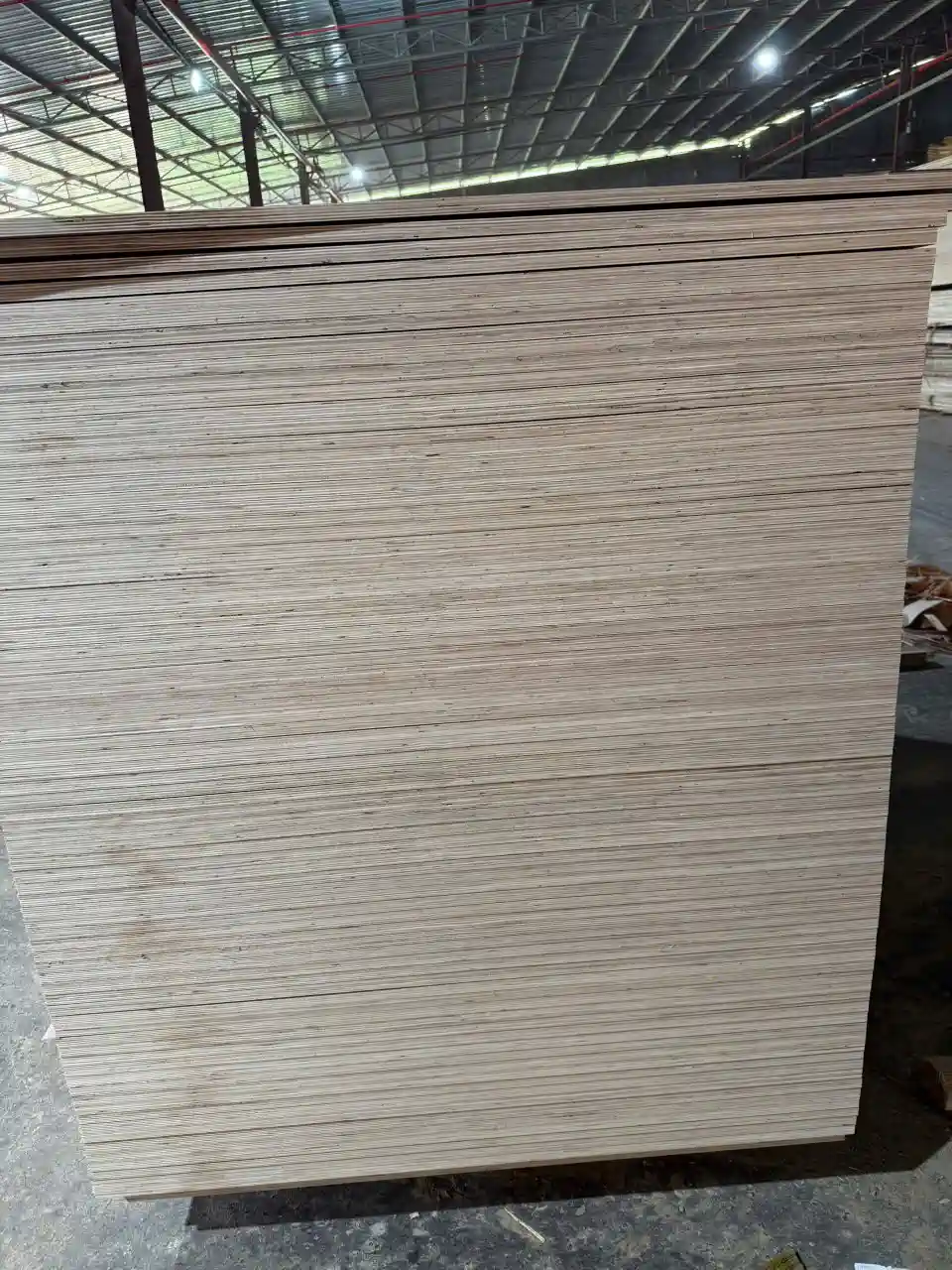
What to look for in the core cross-section:
Core construction grade:
| Construction | What You See | Strength Impact |
|---|---|---|
| Full stitched | No gaps between veneer pieces | Highest — no weak points |
| Edge-jointed | Tight butt joints, no overlap | Good — mid-grade panels |
| Loose-laid | Visible gaps between pieces | Lowest — budget packing grade only |
Layer symmetry — the core should be balanced. Equal thickness layers on both sides of the center ply prevent differential expansion under humidity changes.
Species identification:
- Acacia core — dark brown, ~580 kg/m³, budget grade
- Eucalyptus core — pale yellow, 650–750 kg/m³, heaviest, used for structural/flooring applications
- Styrax core — white, 480–500 kg/m³, lightweight, premium furniture and cabinet grade
💡 Tip: If your supplier claims “eucalyptus core” but the cross-section is dark brown, you received acacia core. Eucalyptus is distinctly pale yellow-white. Core substitution is the most common fraud in plywood imports.
For full details on plywood core types, including density comparisons and factory segments that use each species, see our core guide.
🔍 Test 3 — Glue Bond Strength Test
The glue bond determines how the panel performs under moisture, heat, and mechanical stress. Two tests apply depending on glue type.
WBP Phenolic Glue — Boil Test (EN 314-2 Class 3)
Cut a 25×75mm sample. Boil in water for 72 continuous hours. Remove and dry for 60 minutes. Apply a bending load — the layers must not delaminate. This is the standard for film-faced plywood and construction-grade panels.
MR Melamine Glue — Cold Soak Test
Submerge a 25×75mm sample in cold water for 24 hours. No layer separation should occur. This applies to furniture and commercial plywood. A 6-hour soak is the minimum field check if a 24-hour test is impractical.
⚠️ Note: Glue type and emission standard are different specifications. MR (melamine) and WBP (phenolic) describe water resistance. E0, E1, E2 describe formaldehyde emission. A panel can be MR glue with E0 emission, or WBP with E1 emission. Never mix these two specs in a purchase order. (See our plywood glue types guide for full explanation.)
“The boil test result is the single fastest indicator of glue quality. A panel that passes 72 hours will survive ocean transit and tropical warehouse storage without delamination.” — Jay, International Sales Manager, Mika Plywood
🔍 Test 4 — Moisture Content Measurement
Excessive moisture at the time of loading is the primary cause of mold and warping during ocean freight. For the full testing protocol, see our Vietnam plywood moisture content standards guide.
Equipment: Digital pin-type moisture meter (Ligno, Delmhorst, or equivalent)
Targets by application:
| Application | Target Moisture | Max Acceptable |
|---|---|---|
| Furniture / Cabinet | 8–10% | 12% |
| Construction / Formwork | 8–12% | 14% |
| Packing / Crating | 10–14% | 16% |
Measure at 3 points per sheet — center and two corners — and average the readings. Reject any individual reading above 16%.
Panels should be measured AFTER they have been stored indoors for at least 48 hours, not directly from outdoor storage. Freshly stacked panels from the press may still be equalizing. (Mika Plywood QC data, 2026)
🔍 Test 5 — Load-Bearing Bending Test
For structural applications — flooring underlayment, concrete formwork, scaffold decking — the panel must resist deflection under load without permanent deformation.
Field test method (two-point support):
- Support the panel at two points 1000mm apart (parallel to face grain)
- Apply a 50kg load at the center point
- Measure maximum deflection with a ruler
- Remove load and measure residual deflection after 60 seconds
Acceptable results:
- Maximum deflection under load: ≤12mm for 15mm thickness (EN 310 reference range)
- Residual deflection after removal: ≤2mm (elastic, not plastic deformation)
Panels with loose-laid cores fail this test at lower loads than stitched-core panels of the same thickness. This is why Mika Plywood’s premium construction panels use eucalyptus core with full-stitched core construction — the density (650–750 kg/m³) and construction together deliver the stiffness that structural applications require. (EN 310, European standard for wood-based panels bending properties)
🔍 Test 6 — Screw Pull-Out Capacity
For furniture, cabinets, and any application involving mechanical fasteners, screw pull-out strength determines whether joints hold over time.
Test method:
- Drive a 4×40mm wood screw into the panel face (perpendicular to surface)
- Apply withdrawal force using a pull gauge
- Repeat on panel edge (parallel to surface)
Relative performance by core species (density-correlated, no cited test report):
- Eucalyptus core (650–750 kg/m³): Highest screw-holding — dense veneer grips fasteners most firmly
- Acacia core (~580 kg/m³): Mid-range — adequate for standard furniture joints and cabinet hardware
- Styrax core (480–500 kg/m³): Lowest of the three — still sufficient for most interior furniture applications
⚠️ Key point: Check your supplier’s test report for screw-holding data specific to your core species and thickness. Published Newton-range estimates vary by test method, screw size, moisture content, and core construction — do not use generic figures for structural calculations. A buyer requiring maximum fastener retention should specify eucalyptus core and confirm with third-party EN 320 or equivalent test data.
For furniture applications where screw-holding drives design decisions, birch plywood Vietnam with styrax core offers a balance of light weight and sufficient fastener retention for European cabinet standards.
🔍 Test 7 — Thickness Calibration Check
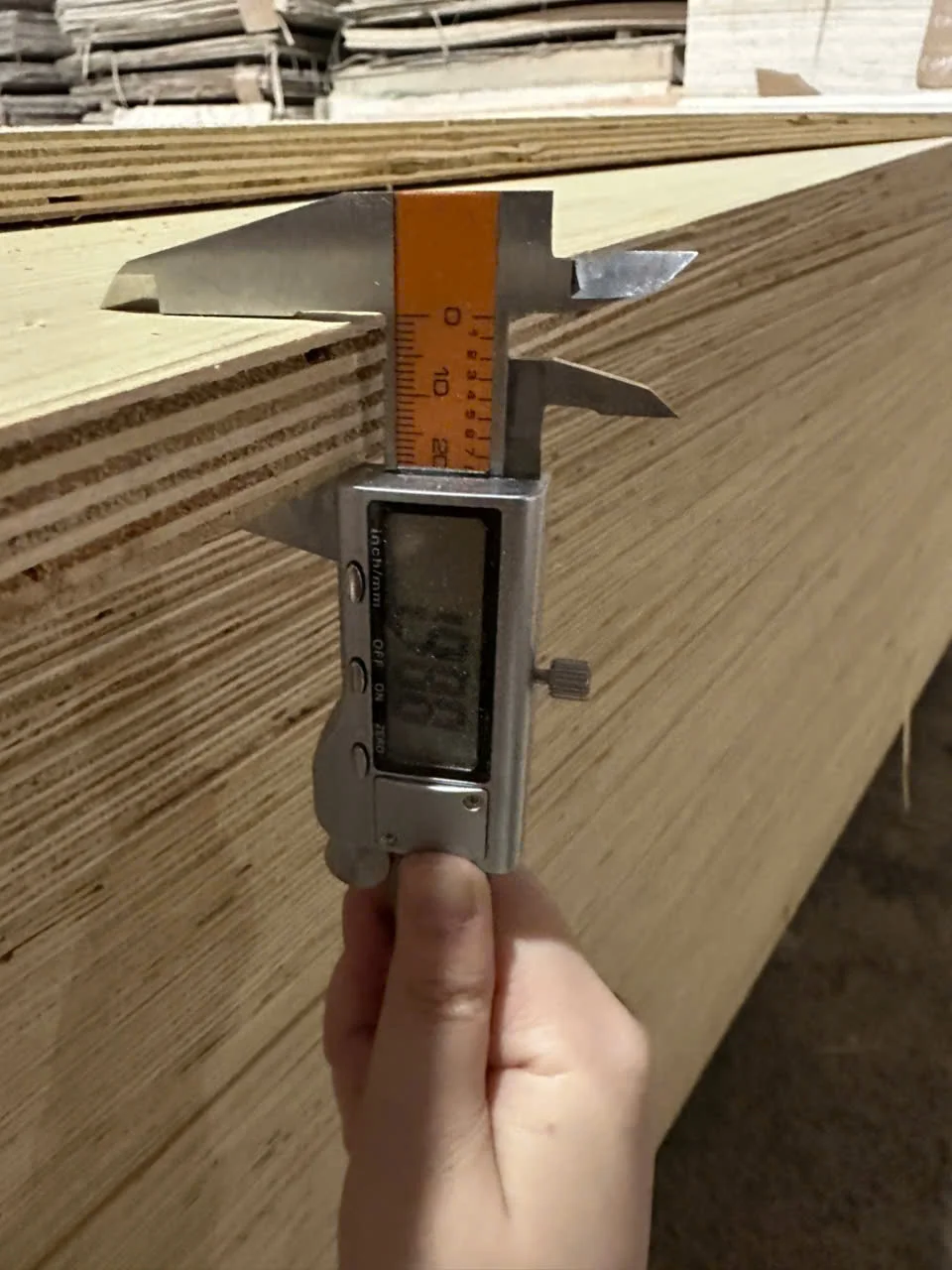
Thickness variation is the most common complaint in plywood import disputes. Vietnam’s export standard is ±0.3mm tolerance per sheet. Some factories — especially budget-grade operations — ship with ±0.8mm or wider variation.
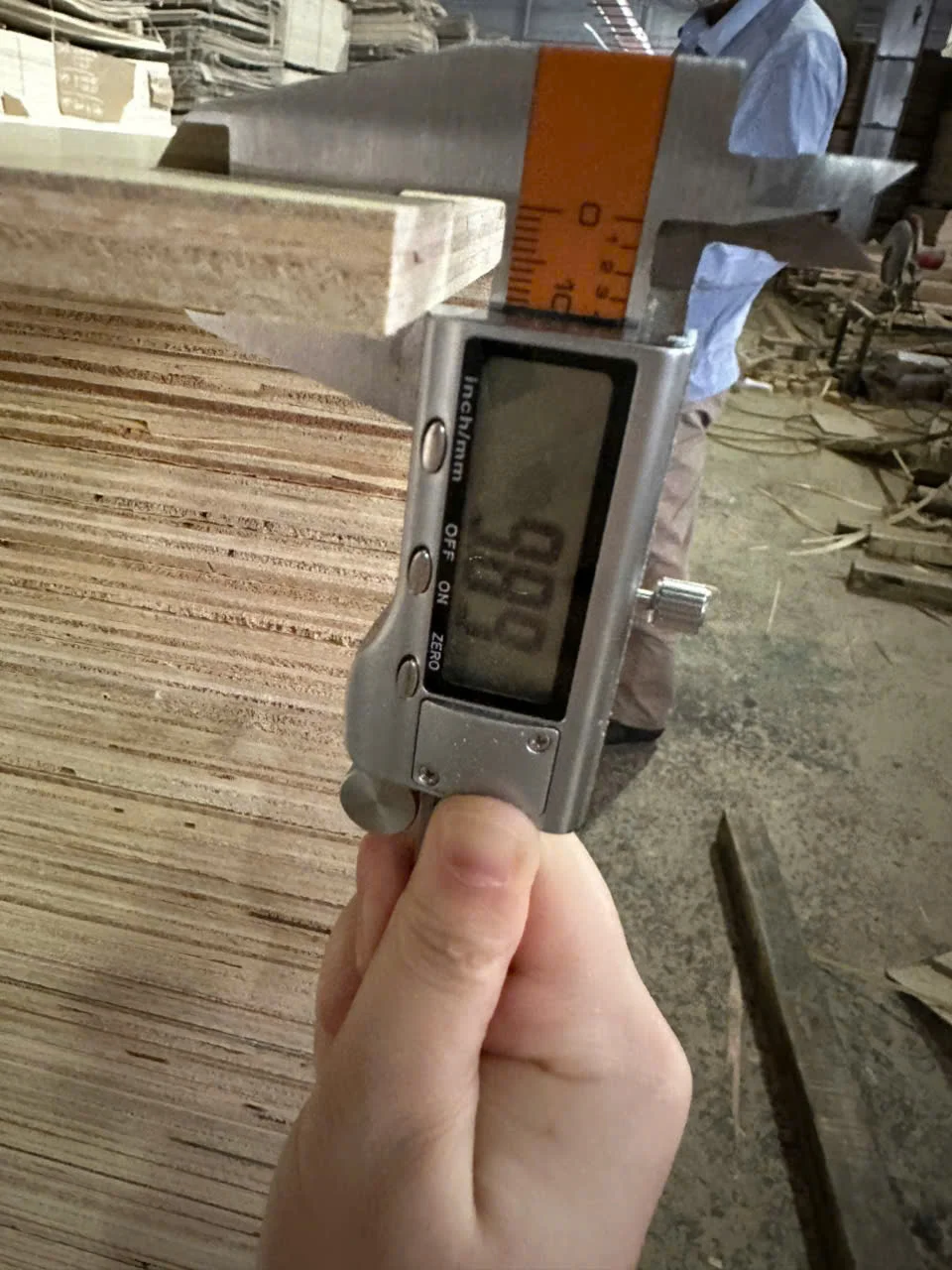
How to check:
- Use a calibrated digital caliper (not a tape measure)
- Measure at all 4 corners and the center — 5 points per sheet
- Calculate the range (max − min reading)
- Reject if any individual sheet exceeds ±0.5mm from nominal
For furniture panels going into CNC machines, tight thickness tolerance is critical — 18mm panels with ±0.8mm variation will cause visible gaps in cabinet assemblies. This is where sanded furniture-grade panels from Mika Plywood’s specialized furniture facility outperform general commercial suppliers.
Sampling protocol for full containers:
Test 3 sheets from the top layer, 3 from mid-stack, and 3 from the bottom of each pallet. If >2 of 9 sheets fail tolerance, request a full batch re-inspection before loading.
✅ Step 8 — Certifications That Verify Strength Systems
Certifications do not directly measure panel strength, but they verify the quality management systems that produce consistent strength.
| Certification | What It Proves | Relevance to Strength |
|---|---|---|
| ISO 9001 | Factory QC system is documented and audited | Process consistency reduces variation |
| CARB P2 | Low formaldehyde — requires proper glue cure cycles | Confirms full hot-press cycle was followed |
| FSC | Chain-of-custody from certified forest | Verifies raw veneer quality consistency |
| CE (EN 636) | Meets European structural plywood standard | Direct structural performance indicator |
For plywood certifications and export documentation, Mika Plywood holds FSC, CARB P2, CE, and ISO 9001 — covering all major export markets.
Request a free sample with test report from Mika Plywood
📊 Plywood Strength Test Results — Quick Reference
| Test | Pass Criteria | Fail Indicator |
|---|---|---|
| Visual inspection | Flat, no warp, even veneer | Bubbles, peeling, gaps |
| Core cross-section | Tight joints, symmetric layers | Gaps >1mm, asymmetric construction |
| WBP boil test (72h) | Zero delamination | Any layer separation |
| MR cold soak (24h) | Zero delamination | Edge softening or layer lift |
| Moisture content | 8–12% (furniture), 8–14% (construction) | >14% at loading |
| Load-bearing (15mm) | ≤12mm deflection at 50kg | >12mm or permanent set |
| Thickness tolerance | ±0.3mm per sheet | >±0.5mm variation |
🏭 How a 3-Stage Factory QC Covers These Tests
Mika Plywood’s on-site quality control team runs checks at three production stages — not just at final inspection.
Stage 1 — Post-pressing: Moisture content and initial delamination check on random samples from each press cycle. Any batch with moisture above 10% after pressing goes back for re-drying.
Stage 2 — Post-sanding: Thickness calibration measurements. Panels outside ±0.3mm tolerance are separated and regraded or rejected.
Stage 3 — Pre-loading: Full visual inspection and moisture re-check. Real-time photos and video sent to buyer before container is sealed.
This 3-stage system means that by the time panels reach the port, the strength tests in this guide have already been run internally. Buyers who request a pre-shipment inspection report receive documentation from all three stages.
“We run the same tests our buyers will run. If a panel doesn’t pass our check, it doesn’t leave the factory.” — Jay, International Sales Manager, Mika Plywood
📌 Conclusion
Buyers who know how to check plywood strength before buying avoid the most common import failures. Work through these 7 tests in order: visual inspection → core cross-section → glue bond → moisture content → load-bearing → screw pull-out → thickness calibration. Add certification verification as the final gate.
The most critical tests for most buyers are moisture content (prevents transit damage) and the core cross-section check (reveals species substitution and construction quality). These two tests take under 10 minutes per batch and prevent the majority of import disputes.
Samples with full test reports are available on request.
Disclosure: This article is published by Mika Plywood, a Vietnam-based plywood manufacturer and export operator. While we aim to provide objective industry guidance, readers should consider our perspective as a market participant when evaluating recommendations.
Request a free plywood sample with test report — no commitment required
Frequently Asked Questions
What is the fastest way to check plywood strength on-site?The fastest on-site check is a visual + bending combination: lay the panel flat to confirm no warp, then press the face with your palm near the center to feel stiffness. For cut sections, inspect core joints — tight stitched layers indicate strength. This takes under 2 minutes per sheet.How do you test plywood glue bond strength?For WBP-grade plywood, cut a 25×75mm sample and boil it for 72 hours — no delamination should occur. For MR-grade plywood, submerge in cold water for 24 hours. If layers separate, the bond is substandard. The WBP boil test per EN 314-2 Class 3 is the gold standard for construction-grade panels.What moisture content should export-grade plywood have?Export-grade plywood from Vietnam targets 8–12% moisture content, measured with a pin-type digital meter. Panels above 14% risk mold during transit and warping on arrival. Mika Plywood's QC team measures moisture at pre-loading stage to verify every container meets this range.Does heavier plywood mean stronger plywood?Not automatically. Density correlates with strength — eucalyptus core at 650–750 kg/m³ is denser and stiffer than styrax at 480–500 kg/m³ — but bonding quality and core construction matter equally. A full-stitched styrax core panel often outperforms a loose-laid eucalyptus core panel despite lower density.Which certifications prove plywood strength and quality?ISO 9001 certifies the factory quality management system. CARB P2 proves low formaldehyde (linked to proper glue curing). FSC certification includes chain-of-custody controls that indirectly verify raw material consistency. For structural applications, look for CE marking or compliance with EN 636 or ASTM D3043.
Ready to order?
Request a free sample with test report from Mika Plywood

Written by
David
Export Project Leader
Content contributor at Vietnam Plywood.
On this page
- 📋 Why Plywood Strength Tests Matter for Importers
- 🔍 Test 1 — Visual Surface Inspection to Check Plywood Strength
- 🔍 Test 2 — Core Veneer Quality Check
- 🔍 Test 3 — Glue Bond Strength Test
- 🔍 Test 4 — Moisture Content Measurement
- 🔍 Test 5 — Load-Bearing Bending Test
- 🔍 Test 6 — Screw Pull-Out Capacity
- 🔍 Test 7 — Thickness Calibration Check
- ✅ Step 8 — Certifications That Verify Strength Systems
- 📊 Plywood Strength Test Results — Quick Reference
- 🏭 How a 3-Stage Factory QC Covers These Tests
- 📌 Conclusion
On this page
- 📋 Why Plywood Strength Tests Matter for Importers
- 🔍 Test 1 — Visual Surface Inspection to Check Plywood Strength
- 🔍 Test 2 — Core Veneer Quality Check
- 🔍 Test 3 — Glue Bond Strength Test
- 🔍 Test 4 — Moisture Content Measurement
- 🔍 Test 5 — Load-Bearing Bending Test
- 🔍 Test 6 — Screw Pull-Out Capacity
- 🔍 Test 7 — Thickness Calibration Check
- ✅ Step 8 — Certifications That Verify Strength Systems
- 📊 Plywood Strength Test Results — Quick Reference
- 🏭 How a 3-Stage Factory QC Covers These Tests
- 📌 Conclusion
Industry Newsletter
Stay Updated with
Plywood Industry Insights
Factory prices, spec guides, market trends and export tips — delivered weekly to B2B buyers and importers in 20+ countries.