Product Overview
EV Plywood — Engineered Veneer for Perfect Visual Consistency
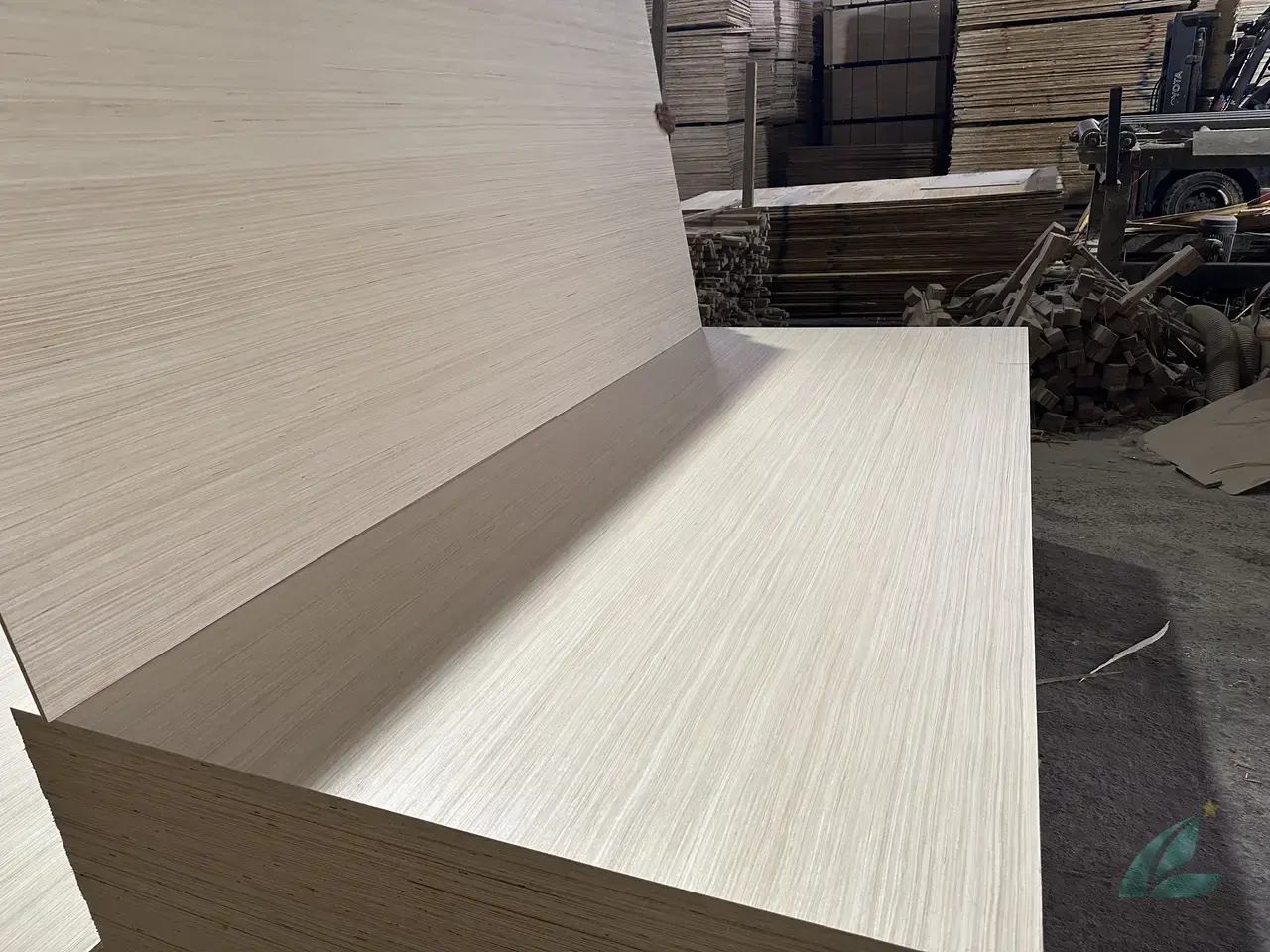
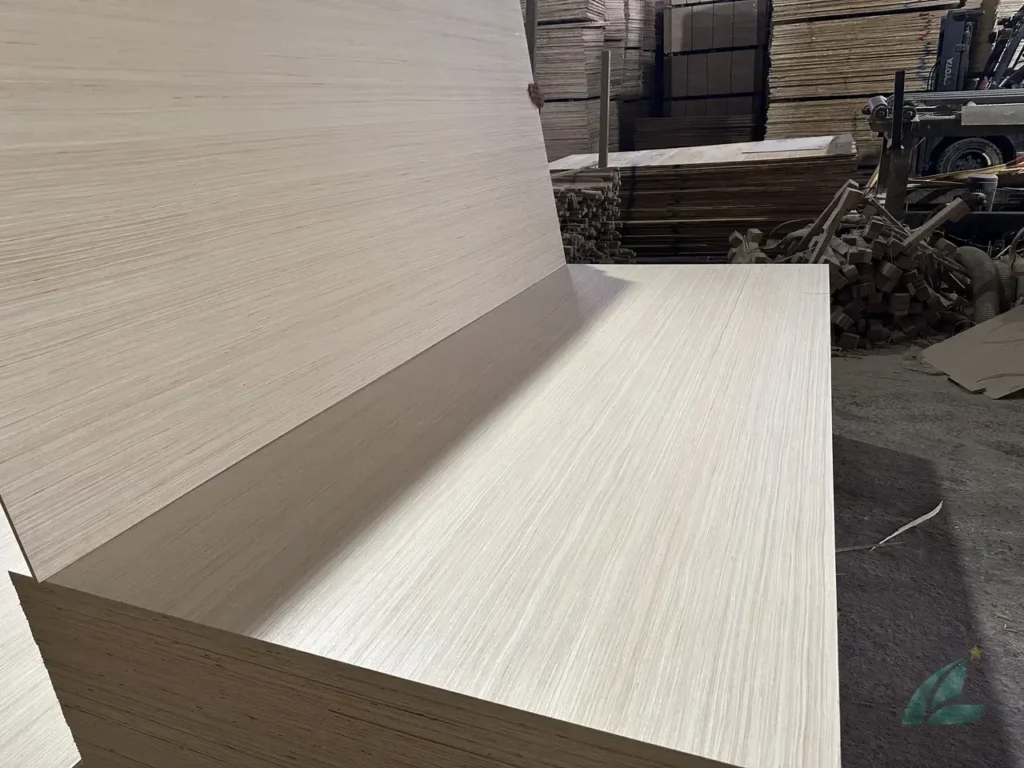
EV (engineered veneer) plywood from Mika Plywood Vietnam provides perfectly uniform grain patterns and consistent color across all panels — ideal for matched furniture sets, modern interiors, and export OEM furniture production.
- Engineered veneer — consistent grain pattern, no natural defects
- Uniform color across entire panel — perfect for matched furniture sets
- Smooth surface ready for UV coating, lacquer, or lamination
- E0/E1 low formaldehyde — compliant with EU and Korean standards
- Thickness 3–25mm | Standard 1220×2440mm (4×8ft)
- Flexible core options for balancing cost, weight, and performance
Need a sample or quotation?
Request Quote →Technical Data
EV Plywood Vietnam — Technical Specifications
| Face / Back Veneer | EV (Engineered Veneer) — uniform grain, consistent color |
| Core Options | Styrax, Eucalyptus, Acacia |
| Glue Type | Melamine (MR) or Phenolic (WBP) |
| Emission Standard | E0, E1 available |
| Thickness Range | 3mm – 25mm (Common: 9, 12, 15, 18mm) |
| Standard Sizes | 1220×2440mm (4×8ft) |
| Moisture Content | ≤ 12% |
| Density | Depends on core: Styrax 480–500, Acacia ~580, Eucalyptus 650–750 kg/m³ |
| Surface Finish | Smooth sanded — ready for lacquer, UV coating, or lamination |
| Veneer Grade | A/B, B/B — premium finish options |
| Thickness Tolerance | ±0.3mm |
| Container Load (40HC) | Styrax core ~53 CBM (18 pallets) | Eucalyptus core ~44.5 CBM (15 pallets) |
| MOQ | 1 × 40ft High Cube container |
| Lead Time | 15–20 working days after confirmation |
| Popular Markets | South Korea, Japan, Europe, Middle East, Southeast Asia |
| Certifications | FSC, E0 emission tested, CO, Fumigation, Insurance |
Construction Options
Core Construction — Choose Your Grade
We always use eucalyptus for outermost layers before veneering with face material, ensuring maximum strength and adhesion.
Styrax Core
Lightweight styrax (bồ đề) core with EV face. Density 480–500 kg/m³. Best value for lightweight furniture, maximizes container load at ~53 CBM (18 pallets) per 40HC.
Layers
100% Styrax core (VN birch alternative)
Mixed Core
Eucalyptus outer layers + styrax or acacia inner layers with EV face. Combines eucalyptus stability near the face with lighter inner core. Ideal for flat-pack furniture production.
Layers
Eucalyptus outer + Styrax/Acacia inner
Eucalyptus Core
Full eucalyptus core (650–750 kg/m³) with EV face both sides. Maximum density and screw-holding for kitchen cabinets, modular furniture, and export production requiring high durability.
Layers
100% Eucalyptus (9/13-ply)
Applications
Key Applications of EV Plywood Vietnam
Modern Interior Furniture
Clean, uniform EV veneer surface is ideal for contemporary furniture with consistent wood-grain aesthetics.
High-End Cabinetry
Premium EV face for kitchen cabinets, wardrobes, and built-in storage systems requiring perfect surface uniformity.
Interior Wall Panels
Used in luxury residential and commercial interior wall cladding and decorative paneling.
UV & Lacquer Finishing
Smooth EV surface accepts UV coating, lacquer, and paint uniformly for high-gloss furniture production.
Export Furniture Components
OEM furniture production for global brands requiring consistent veneer appearance across large volumes.
Decorative Display Panels
Retail displays, showroom fitouts, and exhibition panels requiring premium visual quality.
Why Mika Plywood
Why OEM Furniture Makers Choose Mika Plywood EV Plywood Vietnam
- Engineered veneer — consistent grain pattern, no natural defects
- Uniform color across entire panel — perfect for matched furniture sets
- Smooth surface ready for UV coating, lacquer, or lamination
- E0/E1 low formaldehyde emission — compliant with EU and Korean standards
- Factory-direct manufacturing — full control over veneer quality
- Flexible core options for balancing cost, weight, and performance
How to Order
Order EV Plywood Vietnam in 5 Simple Steps
Send Your Inquiry
Contact via WhatsApp or email with your required specs — thickness, core, grain pattern, emission standard.
Get Quotation
Receive FOB pricing, veneer samples, and full specifications within 12 hours.
Confirm Order
Review PI, confirm order or request air-freight sample panels for testing.
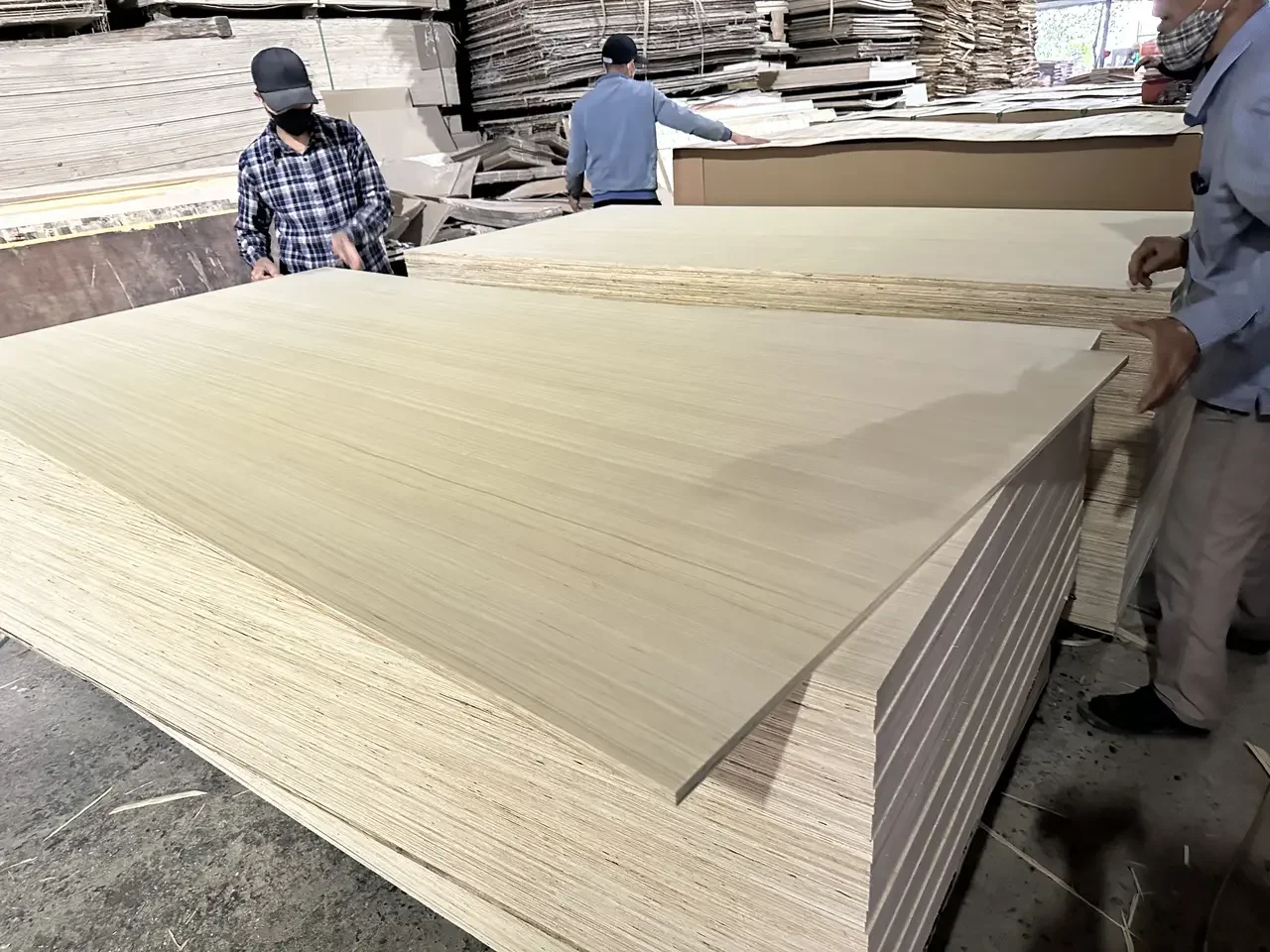
Production & QC
15–20 days production with detailed loading photos and veneer quality confirmation.
Shipping & Documents
Ship from Hai Phong Port with Invoice, Packing List, Bill of Lading, and E0 test report.
Related Plywood Products
Birch Plywood Matt Plywood Okoume Plywood Bintangor PlywoodFAQ
Frequently Asked Questions — EV Plywood Vietnam
Common questions from importers about ev plywood vietnam — specifications, ordering, shipping, and quality.
What is EV plywood (engineered veneer plywood)?
EV plywood uses engineered veneer (EV) as the face material — a reconstituted wood veneer produced to have perfectly uniform grain pattern and consistent color. This makes it ideal for modern furniture and interiors where visual consistency across panels is critical.
How does EV veneer differ from natural wood veneer?
Natural veneer has natural variations in grain and color. EV (engineered veneer) is manufactured to have a completely consistent appearance — same grain direction, same color tone — making it ideal for matched sets and large furniture production runs where uniformity is required.
Which markets prefer EV plywood Vietnam?
EV plywood is especially popular in South Korea, Japan, and Europe where modern interior design demands consistent, defect-free wood grain appearances. It is also used by high-end furniture OEM manufacturers in Southeast Asia and the Middle East.
What finish can be applied on EV plywood?
EV plywood from HCPLY accepts UV coating, lacquer, water-based paint, and decorative film lamination. The smooth, uniform surface provides even absorption and professional finish quality.
Can EV plywood be customized for specific grain patterns?
Yes. HCPLY offers EV plywood in various grain patterns including straight grain, cross-grain, and other wood-look designs. Veneer color and pattern can be customized based on order specifications and target market requirements.
What formaldehyde emission standards are available for EV plywood…
HCPLY EV plywood is available in E0 (required for furniture export to South Korea, Japan, and EU markets) and E1 (accepted for general commercial applications). E0 emission standard is separate from glue type — specify both independently. E0 test reports from accredited Vietnamese laboratories are included with every container on request.
What glue type should I specify for EV plywood — MR or WBP?
EV plywood is predominantly used for interior furniture and cabinetry, where Melamine (MR) glue is standard and sufficient. WBP (Phenolic) glue is available for applications with elevated moisture exposure. Note that glue type (MR/WBP) and emission standard (E0/E1) are two separate specifications — you can request WBP glue with E0 emission, for example.
What moisture content does EV plywood have, and how should it be…
HCPLY EV plywood core is kiln-dried to ≤12% moisture content before pressing and packing. Store panels flat in a dry, covered environment upon receipt, ideally acclimatized for 24–48 hours in your production environment before lamination or finishing. The engineered veneer face is sensitive to surface moisture marks — avoid condensation contact during storage.
What certifications does HCPLY EV plywood carry?
HCPLY offers FSC Chain of Custody certification for EV plywood, E0/E1 emission test reports from accredited laboratories, and standard export documentation (CO, Phytosanitary/Fumigation Certificate, B/L). European importers can request EUDR-compliant supply chain records. Korean buyers can receive F★★★★-equivalent documentation aligned with E0 test methodology.
How many panels fit in a 40HC container, and can I mix thicknesses?
Container load for EV plywood depends on core species: styrax core loads ~53 CBM (18 pallets), acacia core ~47.5 CBM (16 pallets), eucalyptus core ~44.5 CBM (15 pallets) per 40HC. Mixed thicknesses in a single container are fully supported — HCPLY provides a detailed loading plan with sheet counts and weight per bundle.
How can I verify EV plywood quality on arrival?
Inspect the engineered veneer face for consistent color and grain pattern across all panels — EV should look identical from sheet to sheet. Check panel flatness and thickness at multiple points (±0.3mm tolerance). Review the edge cross-section for clean layer bonding with no delamination or voids. HCPLY provides loading photos and QC video before every container sails, giving you visual verification before departure.
Can I order EV plywood samples before placing a full container order?
Yes. HCPLY can send air-freight sample panels of EV plywood in your required thickness, core option, and grain pattern before you commit to a full 40HC order. Samples allow you to test UV coating adhesion, verify emission level with your own laboratory, and confirm visual grain matching with your production requirements. Contact us to arrange a sample shipment.
Complete Guide to EV Plywood Vietnam
Everything importers need to know — specifications, construction, quality verification, and export process.
What is EV Plywood? Understanding Engineered Veneer
EV stands for Engineered Veneer — a reconstituted decorative wood veneer manufactured through a controlled industrial process. Unlike natural veneer, which is sliced directly from a log and inherits all the natural variations of that specific tree (grain direction changes, mineral streaks, knot clusters, color shifts between heartwood and sapwood), engineered veneer is built from scratch.
The manufacturing process starts with fast-growing plantation timber — typically light-colored hardwood species. The raw wood is broken down into veneer strips, dyed uniformly to the target color, and then laminated together under heat and pressure in a controlled orientation block. This reconstituted block is then sliced into face veneer sheets using the same equipment as natural veneer slicing. The result is a face veneer with absolutely consistent grain direction, consistent color, and no natural defects — the same visual pattern repeating precisely from one sheet to the next.
For furniture manufacturers producing large matched sets — a bedroom suite with 12 matching cabinet doors, or a run of 500 identical kitchen cabinet fronts — this consistency is not cosmetic preference. It is a production requirement. Natural veneer requires skilled matching labor to arrange sheets for consistent appearance; EV veneer eliminates that process entirely.
At Mika Plywood Vietnam, EV plywood is manufactured by applying engineered veneer face to carefully selected plywood cores — styrax, acacia, or eucalyptus — depending on the weight, density, and performance requirement of the end application. The price of EV plywood Vietnam is comparable to okoume plywood, positioning it as a mid-range premium option that delivers a superior visual result at accessible pricing for OEM furniture production lines.
EV Plywood Core Options & Construction
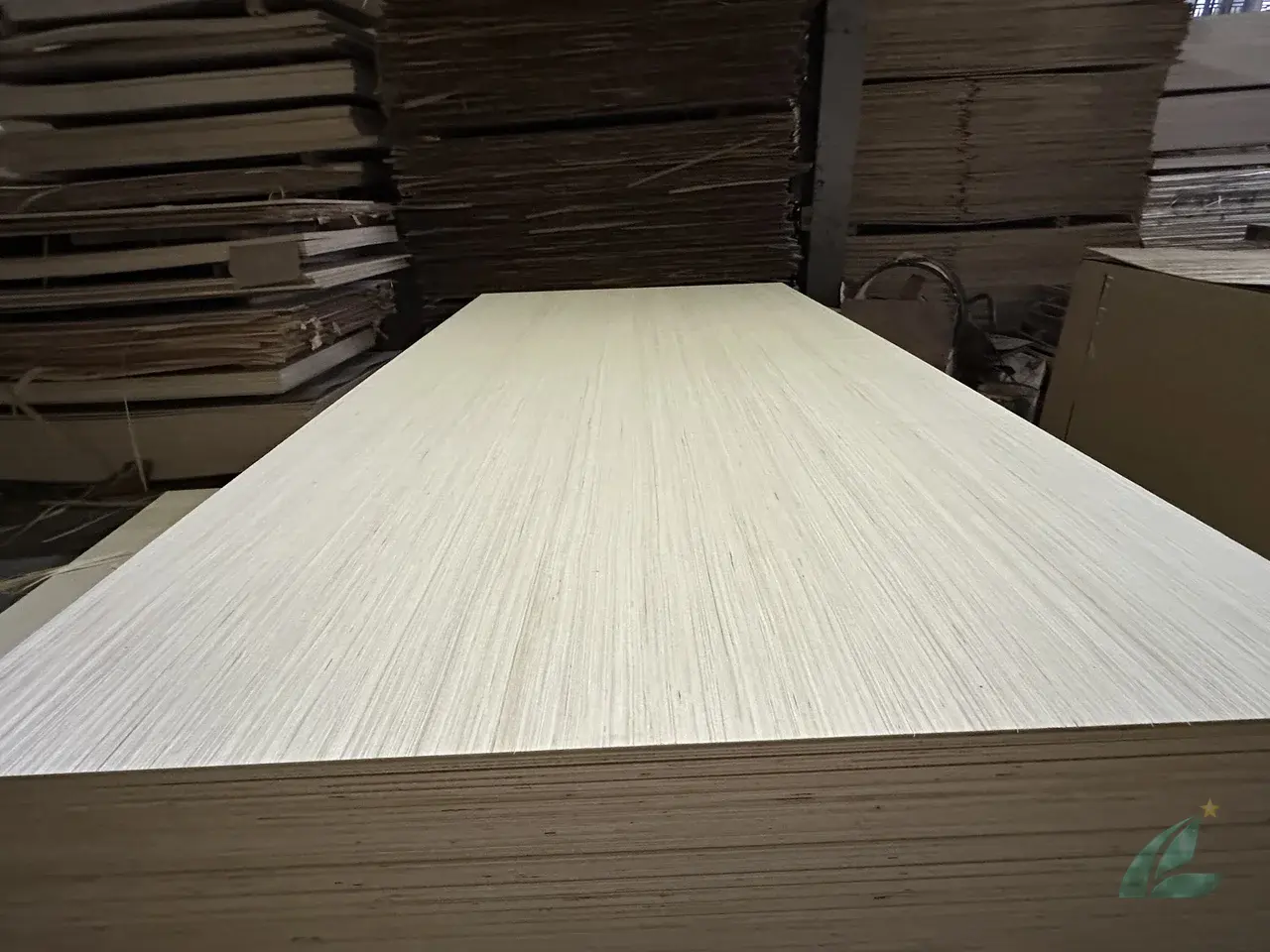
EV plywood Vietnam cross-section showing core construction layers Mika Plywood factory
EV face veneer is thin — 0.2 to 0.4mm — so the structural and weight properties of EV plywood are determined almost entirely by the core, not the face. Mika Plywood offers three core configurations for EV plywood Vietnam, each suited to different production and application requirements.
Styrax core EV plywood is the lightest option. Styrax (bồ đề) is Vietnam's equivalent of birch core — a light, stable plantation hardwood with density 480–500 kg/m³. This is the most popular choice for furniture factories in South Korea and Japan where flat-pack furniture production demands consistent thickness tolerance and low panel weight per square meter. Styrax core also maximizes container loading efficiency: a 40HC container loads approximately 53 CBM of styrax-core panels (18 pallets) compared to 44.5 CBM for eucalyptus core.
Mixed core EV plywood uses eucalyptus as the outer plies — the layers immediately adjacent to the EV face veneer — with styrax or acacia filling the inner plies. This configuration provides superior face adhesion because eucalyptus (650–750 kg/m³) creates a dense, stable substrate directly beneath the glue line, preventing surface delamination under humid conditions. The lighter inner core keeps overall panel weight manageable. This is the best general-purpose configuration for export OEM furniture production.
Eucalyptus core EV plywood delivers the highest panel density (650–750 kg/m³) and strongest screw-holding capacity. This option is recommended for kitchen cabinet carcasses, built-in wardrobes, and modular furniture systems using cam locks or confirmat screws, where consistent screw retention across the panel face and edges is critical for assembly quality. Full eucalyptus core panels are also the correct choice when buyers specify minimum density in their OEM furniture production contracts.
The EV face veneer itself is not affected by core choice — grain pattern, color consistency, and surface smoothness remain identical across all three core configurations. Core selection affects weight, cost, container loading, and mechanical properties only.
EV Plywood Vietnam — Full Technical Specifications & Standards
The following specifications apply to standard Mika Plywood EV plywood production. Density values reflect core species — the EV face veneer (0.2–0.4mm) has negligible effect on overall panel density.
| Property | EV Plywood Specification |
|---|---|
| Face / Back Veneer | Engineered Veneer (EV) — 0.2–0.4mm reconstituted face |
| Core Options | Styrax (480–500 kg/m³) | Acacia (~580 kg/m³) | Eucalyptus (650–750 kg/m³) |
| Panel Density | Depends on core: Styrax 480–500 | Acacia ~580 | Eucalyptus 650–750 kg/m³ |
| Thickness Range | 3mm – 25mm (Common: 9, 12, 15, 18mm) |
| Standard Panel Size | 1220×2440mm (4×8ft) | 1250×2500mm available |
| Thickness Tolerance | ±0.3mm |
| Moisture Content | ≤ 12% (kiln-dried core) |
| Surface Finish | Double-sided sanded (S2S) — ready for UV, lacquer, lamination |
| Veneer Grade | A/B standard | B/B available |
| Glue Bond | Melamine (MR) or Phenolic (WBP) — buyer's choice |
| Emission Standard | E0 or E1 (buyer's choice) — E0 required for Korea, Japan, EU |
| Container Load (40HC) | Styrax core ~53 CBM | Eucalyptus core ~44.5 CBM |
Why Choose Mika Plywood for EV Plywood Vietnam
EV Plywood for Korean & Japanese OEM Furniture Export
The two markets that drive the highest volume of EV plywood orders from Vietnam are South Korea and Japan — both countries with demanding interior design aesthetics and strict indoor air quality standards that create the ideal demand profile for EV plywood.
Korean furniture OEM manufacturers source EV plywood Vietnam for a very specific production context: large-volume flat-pack furniture production for global retail brands. In this context, visual uniformity is a specification, not a preference. Furniture sets sold through large retail chains require every panel in a bedroom suite, every cabinet door in a kitchen line, to have exactly the same grain appearance. Natural veneer cannot guarantee this at the volume these factories produce — the matching labor would consume the cost advantage. EV veneer solves this problem at source.
Korean buyers also demand E0 emission certification as a minimum — the domestic Korean F-star standard and the equivalent CARB P2 used for export to the US require formaldehyde emission below 0.05 ppm. Mika Plywood's E0 production line for EV plywood meets this threshold, and test reports from accredited Vietnamese laboratories are provided with each container.
Japanese buyers have slightly different requirements: they tend to specify thinner panels (9mm and below) for sliding door panels and interior feature walls, and they are particularly demanding about surface flatness — panels destined for CNC-machined drawer fronts or precision-fit cabinet components need thickness tolerances tighter than the standard ±0.3mm. Mika Plywood has experience with these specifications and can discuss tighter tolerance commitments for confirmed volume orders.
European buyers of EV plywood Vietnam typically use it for interior cladding panels, display fixtures, and retail fit-out panels where consistent wood-grain appearance at competitive pricing is the brief. E1 emission is the minimum requirement for EU interior applications; E0 is available and increasingly requested as EU indoor air quality standards evolve.
Middle East buyers use EV plywood primarily for residential furniture manufacturing — wardrobes, kitchen cabinets, and built-in storage systems where a consistent mid-range wood finish is required at a price point below birch plywood. EV plywood Vietnam delivered FOB Hai Phong typically lands in UAE ports at a price competitive with Chinese EV plywood while offering tighter thickness tolerance and certified emission documentation.
EV Plywood vs Natural Veneer Plywood vs Birch Plywood
Understanding how EV plywood compares to natural face veneers and birch plywood helps buyers match the right product to their production requirements and market specifications.
| Feature | EV Plywood | Natural Veneer Plywood (e.g. Okoume) | Birch Plywood |
|---|---|---|---|
| Face Veneer Type | Reconstituted engineered veneer | Natural sliced veneer | Natural birch veneer |
| Visual Consistency | Perfect — grain and color identical panel to panel | Moderate — natural variation between panels | Good — birch is naturally uniform but has grain variation |
| Face Matching Required | No — EV is production-ready matched | Yes — skilled labor required for matching | Moderate — better than tropicals |
| Panel Density (core-driven) | Depends on core: Styrax 480–500 | Acacia ~580 | Eucalyptus 650–750 kg/m³ | Depends on core species | Styrax core (480–500 kg/m³) — no birch core in VN |
| Emission Standard | E0, E1 available | E0, E1 available | E0, E1 available |
| Price Range (FOB) | USD 320–500/m³ | USD 250–450/m³ (okoume) | USD 400–650/m³ |
| Best Application | OEM furniture production, matched sets, modern interiors | Marine, painted furniture, lightweight furniture | Premium furniture, Scandinavian design, precision furniture |
| Surface Finish Options | UV, lacquer, lamination, paint | UV, lacquer, marine varnish | UV, lacquer, paint — premium sanded surface |
| Korean/Japanese Market | Very high demand | Low | Moderate |
| Grain Customization | Yes — multiple EV patterns available | No — natural only | No — natural birch only |
Surface Finish & Coating Compatibility
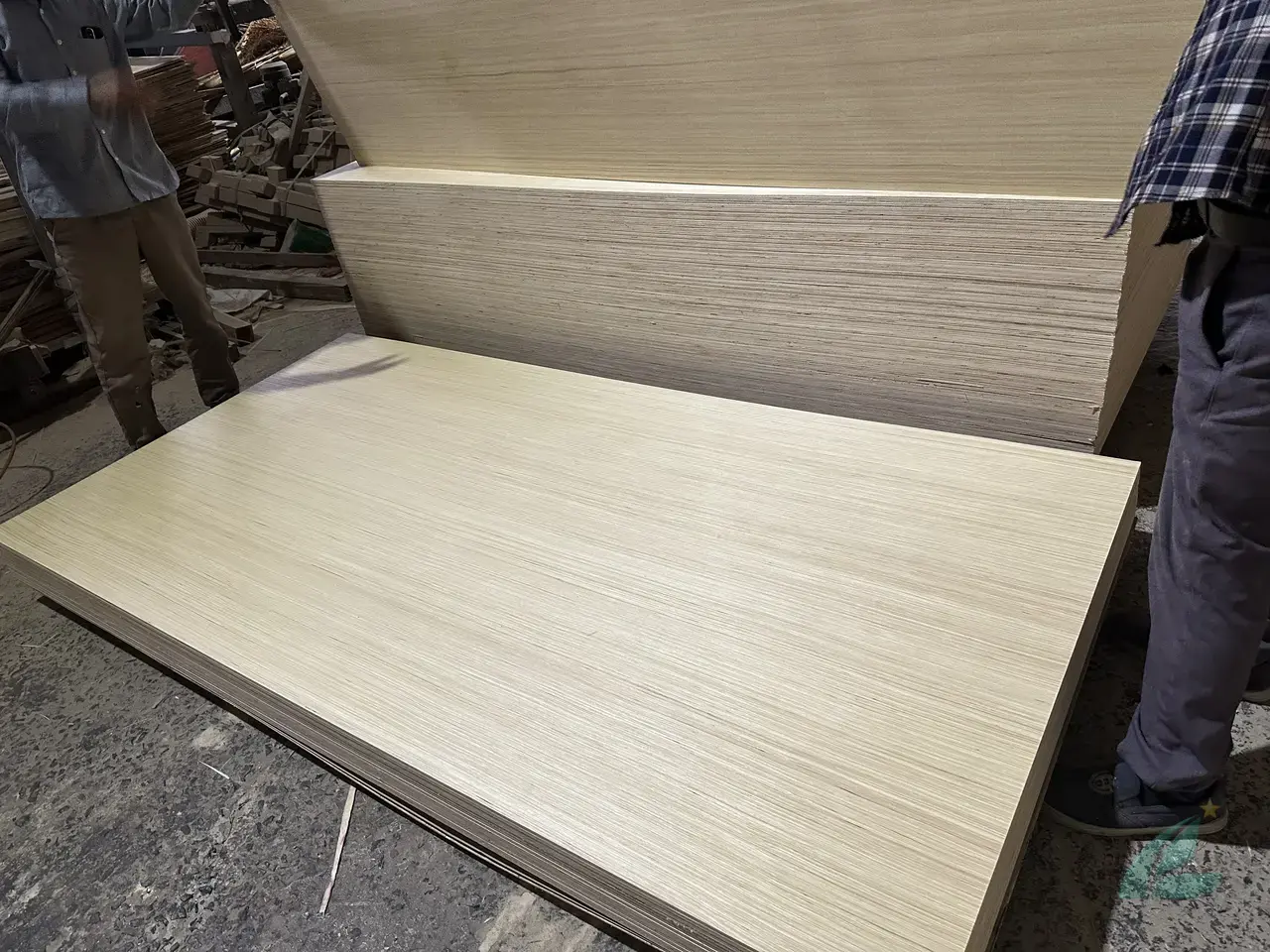
EV plywood Vietnam smooth sanded surface UV coating ready Mika Plywood export
The defining characteristic that makes EV plywood the preferred choice for high-output furniture production lines is its coating compatibility. The engineered veneer face is specifically manufactured to provide an ideal substrate for every major surface finishing process used in modern furniture manufacturing.
UV coating lines — the most common finishing process in Korean and Japanese furniture factories — require a perfectly flat, consistently dense surface for even cure. EV veneer, being manufactured from uniform, dye-treated wood fiber with consistent density across the panel face, provides exactly this substrate. UV coating applied to EV plywood cures uniformly, with no absorption variation between areas of different grain density (a common issue with open-grained natural veneers like ash or oak).
Lacquer and polyurethane finishes applied to EV plywood Vietnam panels behave identically to lacquer on high-quality natural birch plywood — smooth, consistent sheen, no grain raise between coats. For furniture factories running automated spray finishing lines with robot applicators, this predictability is a production efficiency advantage. Variable-absorption natural veneers require additional sealer coats to equalize before topcoat application; EV plywood eliminates this step.
Decorative film lamination — PVC, polyester, or woodgrain CPL (continuous pressure laminate) — bonds to the EV surface cleanly with standard solvent-based or hot-melt adhesive. The EV face provides a better adhesion surface than unsanded natural veneers because the reconstitution process creates a more homogeneous surface energy across the full panel face.
For applications where the EV plywood will be painted — particularly cabinetry in contemporary all-white kitchen designs — the smooth, defect-free EV surface requires minimal filler preparation before paint application. One coat of a fine grain filler followed by primer is typically sufficient before the topcoat, compared to the more extensive preparation natural grain veneers require before achieving a smooth painted finish.
EV Plywood Export Packaging & Container Loading
Mika Plywood EV plywood Vietnam is packaged to export standard for sea freight shipment from Hai Phong Port. The packaging process is designed to protect the engineered veneer face — which, being a surface product, is more sensitive to moisture and mechanical damage than structural panels — through the full voyage to destination ports.
Each bundle of EV plywood panels is wrapped in polyethylene moisture barrier film before steel strapping. The EV face panels on top and bottom of each bundle receive an additional protective kraft paper layer between the bundle surface and the plastic wrap to prevent any condensation-related surface marking during transit. Bundle sizes are calibrated to container geometry — typically 50–80 sheets per bundle at 18mm, adjusting by thickness.
Container loading quantities depend on core species: styrax-core EV plywood loads approximately 53 CBM per 40HC (18 pallets), acacia core loads approximately 47.5 CBM (16 pallets), and eucalyptus core loads approximately 44.5 CBM (15 pallets). For mixed-thickness or mixed-core container orders, Mika Plywood provides a detailed loading plan confirming total CBM, total panel count, and weight distribution.
Export documentation provided with every EV plywood shipment includes: Commercial Invoice, Packing List with bundle-level detail, Bill of Lading (negotiable), Certificate of Origin, Phytosanitary/Fumigation Certificate, and E0 formaldehyde emission test report from an accredited Vietnamese testing laboratory. For buyers requiring FSC Chain of Custody certification for their own sustainability reporting, FSC documents are available on request.
Custom panel sizes are available. In addition to the standard 1220×2440mm (4×8ft), Mika Plywood can produce 1250×2500mm panels for European-format production lines, and custom cuts for specific joinery applications. Mixed sizes in a single container are accepted.
Building Long-Term Supply Partnerships with Mika Plywood
Furniture manufacturers and trading companies that work with Mika Plywood for EV plywood Vietnam over multiple containers gain access to partnership-level services that go beyond transactional supply. The difference between a first-order relationship and a long-term partnership is practical: priority production scheduling during peak demand periods, pre-shipment video inspection as a standard included service, and dedicated account communication in English.
For OEM furniture manufacturers with production planning requirements — quarterly forecasts, scheduled container releases on 60-day cycles, or standing orders with defined weekly volumes — Mika Plywood can accommodate structured supply arrangements that provide the production consistency these manufacturers need to run their lines without inventory disruption.
Factory-direct pricing is transparent: when eucalyptus or styrax core veneer prices change in Vietnam's domestic market, Mika Plywood provides the adjustment with cost documentation rather than opaque quarterly price changes. This transparency allows furniture manufacturers to plan their own selling prices with confidence.
Buyers evaluating EV plywood Vietnam alongside competing products — such as matt plywood Vietnam (unfaced substrate for the buyer to apply their own veneer) or birch plywood Vietnam (natural birch face, premium positioning, Scandinavian furniture market) — will find Mika Plywood's export team equipped to provide honest comparative guidance for their specific application. The goal is the correct product specification for each buyer's production context, supporting repeat business that sustains both parties over the long term.
Related Products & Resources
Bintangor Plywood — Commercial Grade ExportOkoume Plywood — Lightweight Furniture GradeBirch Plywood — D/E Grade Baltic QualityBirch UV Coated — Pre-Finished PanelsFilm Faced Plywood — Formwork & ConstructionGurjan Plywood — Premium Hardwood FaceEucalyptus Plywood — High-Density Hardwood CoreMika Plywood — ManufacturerReady to Import EV Plywood Vietnam?
Contact Mika Plywood now — factory-direct EV plywood with consistent veneer quality. Get quotation and samples within 12 hours.
Get Free Quote